Partha Chatterjee
Overview
Chattarjee has signed a BDS statement arguing that a boycott of Israel’s presence in the West Bank is insufficient because Israel must be boycotted entirely.
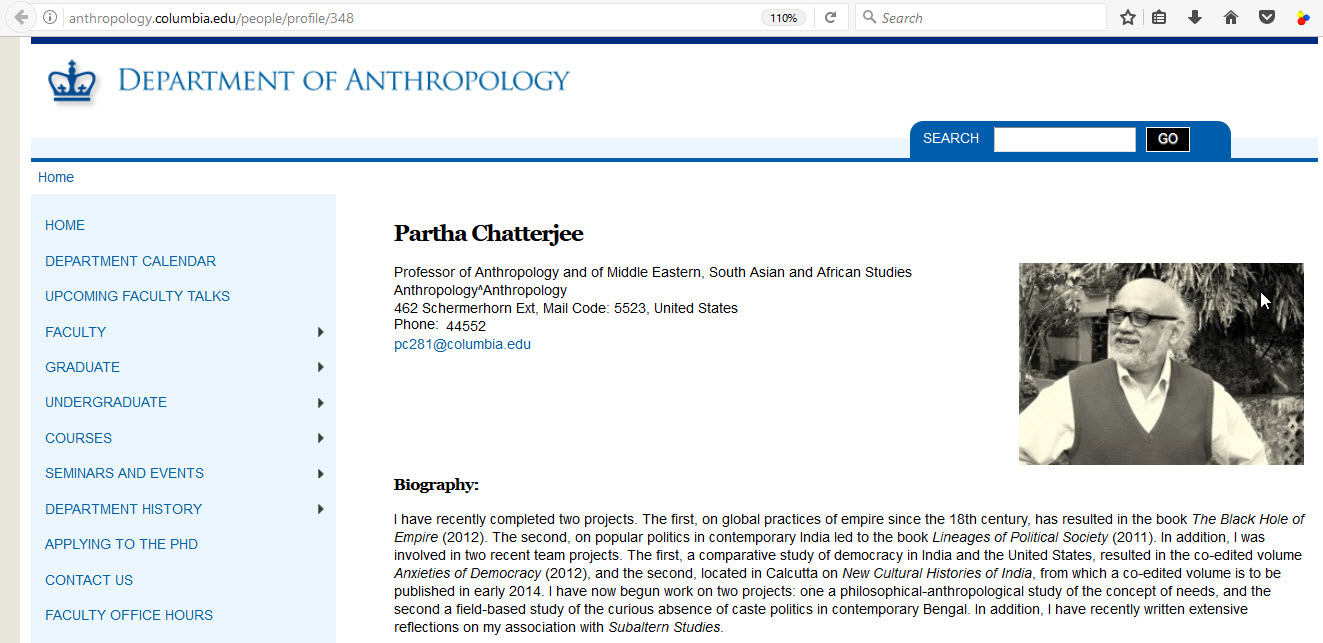
Chatterjee promotes BDS at Columbia University (Columbia), where he is a professor of Anthropology and of Middle Eastern, South Asian and African Studies.
Demonizing Israel
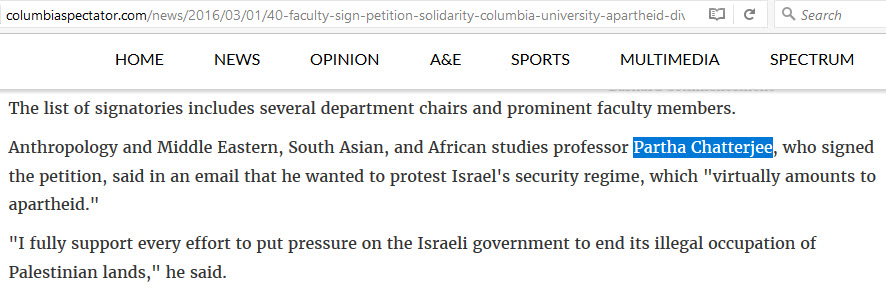
In a July 2016 interview with Columbia’s student newspaper, Chatterjee accused Israel of practicing “apartheid” and stated that “I fully support every effort to put pressure on the Israeli government to end its illegal occupation of Palestinian lands."On September 9, 2015, Chatterjee published an essay titled “Partha Chatterjee: Why I Support the Boycott of Israeli Institutions”.
In it, he wrote that in his “personal capacity” he has “always boycotted Israeli institutions.”
Chatterjee went on to claim that Israel treats its Arab citizens “as lowly barbarians” and also referred to Israeli security measures as “blatantly colonial protocols of the Israeli authorities” — accusing Israel of “colonial rule as well as apartheid”.
Chatterjee then compared Israel to the Indian state Tripura, which was “overrun… by Bengali Hindus” that “drove the indigenous population into the hills.”
Promoting BDS at Columbia
In March of 2016, Chatterjee signed a petition created by a Columbia student initiative to rebrand BDS at Columbia as Columbia University Apartheid Divest (CUAD).CUAD group is comprised of Jewish Voice for Peace (JVP) and Students for Justice in Palestine (SJP) members, who joined forces in February 2016. The group called on Columbia to divest its equity holdings and endowment funds from companies that — in CUAD’s words — “profit from the State of Israel’s ongoing system of settler colonialism, military occupation, and apartheid law.”
CUAD listed eight companies that it believed “likely to be invested in by a university like CU,” without knowing whether Columbia actually had holdings in the corporations.
BDS
The Boycott, Divestment, Sanctions (BDS) movement was founded by Omar Barghouti in 2005 to challenge “international support for Israeli apartheid and settler-colonialism.” BDS is an allegedly “Palestinian-led movement,” although leading BDS activists have admitted [00:01:01] this is not true.
One of the demands of BDS includes [point 3] what is generally known as the “right of return,” a demand discredited as a way to eliminate Israel. Barghouti said the “right of return” is a means to “end Israel’s existence as a Jewish state.”
Barghouti has said that BDS “aims to turn Israel into a pariah state, as South Africa once was.”
In his activism, Barghouti has also said [00:05:55] regarding Israel: “Definitely, most definitely, we oppose a Jewish state in any part of Palestine. No…rational Palestinian, not a sellout Palestinian, will ever accept a Jewish state in Palestine.”
The movement has been linked to numerous terrorist organizations and received a public endorsement from Hamas in 2017.
BDS initiatives include calling on institutions and individuals to divest from Israeli-affiliated companies, promoting academic and cultural boycotts of Israel, and organizing anti-Israel rallies, protests and campaigns.
The movement’s most notable achievement has been the infiltration of university campuses through lobbying for “BDS resolutions.” In these cases, student governments and student groups, backed by their own anti-Israel members and affiliates, have proposed resolutions on some form of boycott of, or divestment from, Israel and Israeli-affiliated entities.
Boycott resolutions, although non-binding, have been passed by student governments on numerous North American campuses.
BDS activity is often aggressive and disruptive. It has been noted that universities that pass BDS resolutions see a marked increase in anti-Semitic incidents on campus. On one campus, when the student government debated a BDS resolution, reports emerged of violent threats against those opposing it.
Social Media and Weblinks

- Status:
- Professor
- University:
- Columbia
- Organizations:
- BDS
- Related Profiles:
- Marianne Hirsch,
- Last Modified:
- 05/04/2026
Photos & Screenshots