Lucas Di’Vennci
Overview
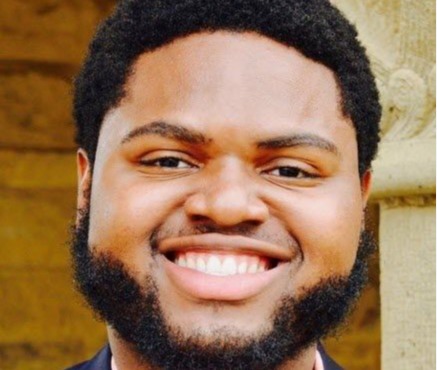
Lucas Di’Vennci is a member of Stanford Out of Occupied Palestine (SOOP) at Stanford University (Stanford). SOOP defines itself as a coalition of 19 student groups without any formal leadership structure and has as its stated mission to "end Stanford's investments in corporations which profit from the Israeli Occupation of the Palestinian Territories."
SOOP disseminates Boycott, Divestment, Sanctions (BDS) movement materials and solicits donations for BDS, but has stated that it is not connected to the formal BDS movement and is focused on “selective divestment.”
Di’Vennci was heavily involved in the 2014-2015 SOOP divestment campaign at Stanford.
Di’Vennci graduated from Stanford in 2015 with a degree in History.
Supporting Divestment at Stanford
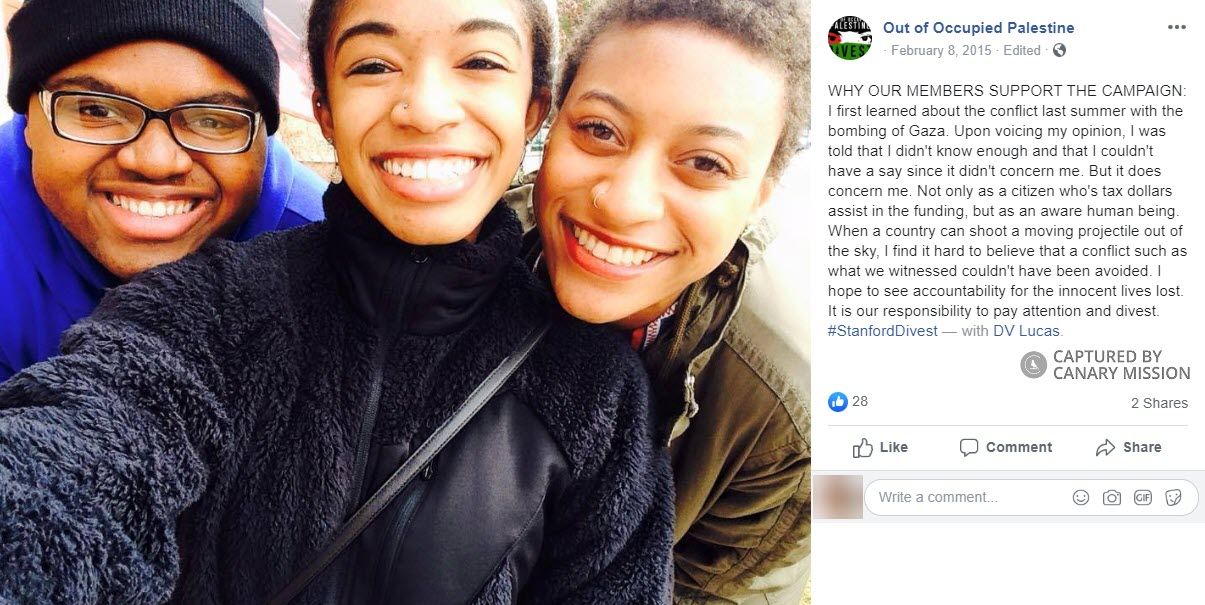
On February 17, 2015, the Stanford Undergraduate Senate voted in favor of a SOOP resolution calling on the university to divest from corporations that "maintain the occupation of Palestine." Di’Vennci supported the campaign.
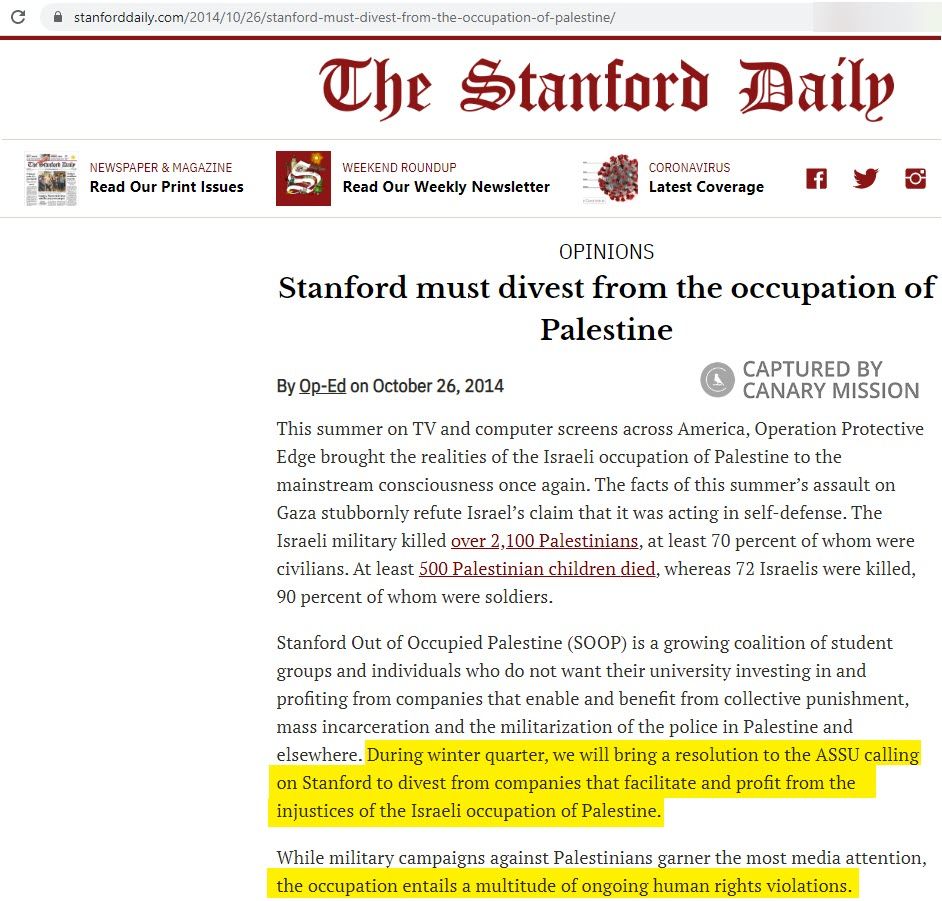
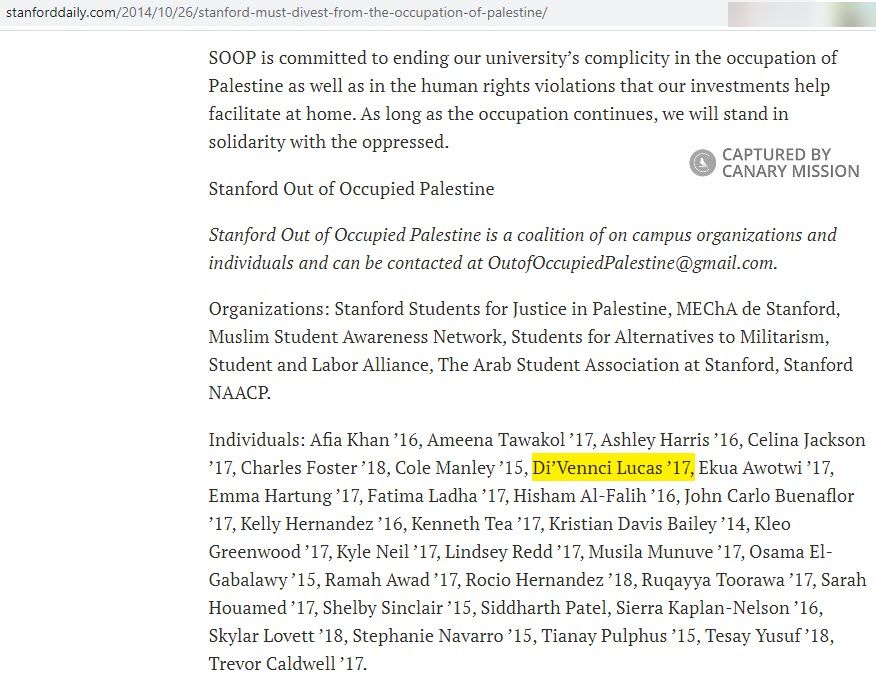
On October 26, 2014, Di’Vennci penned his name to an Op-Ed written for the student newspaper titled "Stanford must divest from the occupation of Palestine."
On December 23, 2014, Di’Vennci co-signed a letter titled "Searching for partners for justice on campus" that promoted the “call” of the BDS movement to “implement divestment initiatives against Israel.”
On January 22, 2015, Di’Vennci posted on Facebook a message to encourage his followers to sign a SOOP Divest petition.
On January 23, 2015, Di’Venncci posted on Facebook saying "You know what's a damn shame? When you attend the same University at which one of the LEADING EXPERTS of Martin Luther King, Jr. teaches, the man whom Coretta herself recruited to write his autobiography, the man whom has devoted an almost inconceivable amount of his life to the study of King and you STILL try to say that MLK would not approve of divestment from companies affiliated with human and civil rights violations in Palestine as a result of the Occupation. Sit down, shut up, and listen. Otherwise, don't you dare try to use the legacy of Dr. King to oppose divestment. Unbelievable. I don't care what quote you pull if it lacks the context in which it was said."
On January 26, 2015, Di’Vennci posted on Facebook the SOOP Divest petition. He was the 16th member to sign.
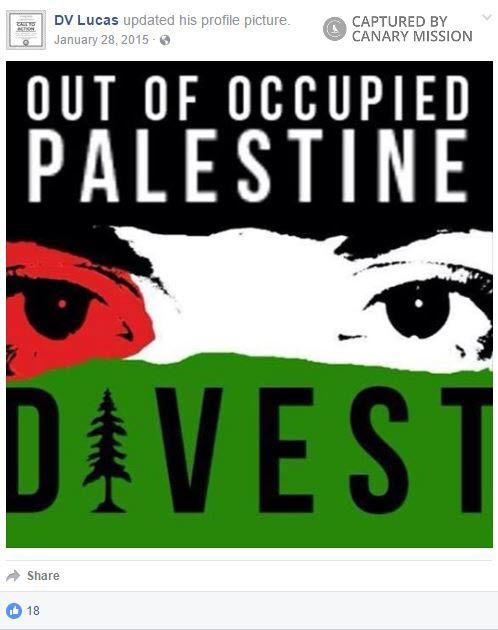
On January 28, 2015, Di’Vennci updated his cover photo and profile picture with SOOP Divest graphics
On January 29, 2015, Di’Vennci posted on Facebook an article written by Stanford professor Joel Beinin supporting the divestment campaign.
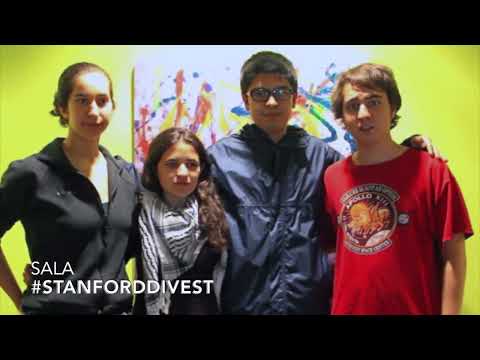
On February 9, 2015, Di’Vennci participated in a SOOP Divest campaign video as a representative of Stanford’s First-Generation Low Income Partnership (FLIP).
SOOP’sresolution called for Stanford University trustees to divest from companies that "violate international humanitarian law by: maintaining illegal infrastructure of the Israeli occupation… facilitating Israel and Egypt’s collective punishment of Palestinian civilians… [and] facilitating state repression against Palestinians by Israeli, Egyptian or Palestinian Authority security forces."
On February 8, 2015, a student newspaper article reported that the United States Securities and Exchange Commission (SEC) filings showed no evidence that Stanford has been invested in any of these companies that SOOP targeted for divestment over the last ten years, with the exception of Raytheon for just one filing period.
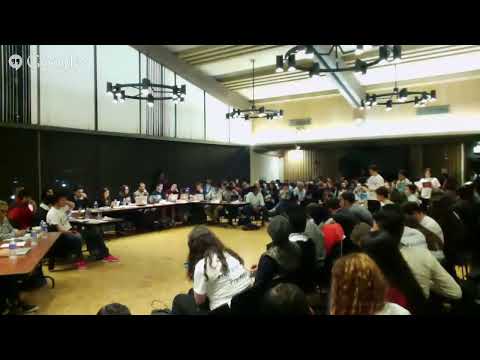
In a vote held on February 10, 2015, the resolution failed to garner the required 66% senate approval, eliciting shouts of anger from the crowd and leaving one senator in tears. But a February 17 re-vote called by Senate Chair Ana Ordonez — who had abstained from the first vote due to the "hostile" atmosphere making it difficult for her to concentrate — garnered enough support for the resolution to pass.
Stanford’s Students for Justice in Palestine (SJP) was a central partner in the SOOP coalition. In 2014, SJP Stanford made a divestment request to the university’s Advisory Panel on Investment Responsibility and Licensing (APIRL).
In April of 2015, however, the Stanford Board of Trustees announced that Stanford would take no action on SJP’s request, nor consider it further. In accordance with the board’s Statement on Investment Responsibility, the board focused on "questions of divisiveness and negative impact" and determined that acting on the request would be “likely to impair the capacity of the University to carry out its educational mission.”
President John Hennessy also addressed the issue at a Faculty Senate meeting: "I have never seen a topic that has been more divisive within the university community," Hennessy said. “As a university, we must remain committed to civil and rational discussion, especially when the issues are highly controversial. An atmosphere of intimidation or vitriol endangers our ability to operate as an intellectual community.”
SJP has been rumoured to be planning a BDS campaign in 2017 to coincide with the 50th anniversary of the Six-Day War.
Demonizing Israel
On January 22, 2015, Di’Vennci posted an article on Facebook written by fellow SOOP member Sid Patel titled "A False Security". Manley introduced the article calling Operation Protective Edge (OPE) an “invasion”, saying “Sid explains why the "security" narrative is not a reason one should be against divestment. Security for whom and at what expense? How terrible is the rationale behind "security" when 2100 people die in an invasion? Peace and justice and love.”
In the article, Patel claimed that "Security is the rebuttal to efforts to hold Israel accountable for atrocities and violations of international law, like the collective punishment of Gazans or the construction of the apartheid wall in the West Bank."
To further downplay Israeli security concerns with regard to Palestinian terrorist attacks, Patel alleged that "the greatest purveyor of terrorism — political violence against civilians — is the Israel Defense Forces" and that Israel is “a state founded on the dispossession and expulsion of the indigenous population.”
Patel defined Palestinian attacks "both nonviolent and armed" as “Resistance” and stated that “[u]ntil Palestinians have no reason to resist, Israeli appeals for one-sided security, for a sham peace process and for an “end to violence” serve as little more than cloaks for Israel’s ongoing oppression and domination of the Palestinians.”
On January 17, 2015, Di’Vennci posted on Facebook a SOOP video titled "FilasteenFridays: Collective Punishment in the Palestinian Territories." The video opened with SOOP member Ruqayya Toorawa who claimed that “This summer, the Israeli military killed over 2100 Palestinians in Gaza. Over 70% were civilians, including over 500 children. That’s considered ‘collective punishment’”
Toorawa continued saying "Israel deliberately destroys the family homes of Palestinians suspected to be part of the resistance" - referring to Israeli deterrent measures against Palestinian terrorists that murdered or attempted to murder Israeli citizens.
The video continued with SOOP member Sid Patel accusing Israel’s "collective punishment" against Palestinians as “war crimes.”
BDS
The Boycott, Divestment, Sanctions (BDS) movement was founded by Omar Barghouti in 2005 to challenge “international support for Israeli apartheid and settler-colonialism.” BDS is an allegedly “Palestinian-led movement,” although leading BDS activists have admitted [00:01:01] this is not true.
One of the demands of BDS includes [point 3] what is generally known as the “right of return,” a demand discredited as a way to eliminate Israel. Barghouti said the “right of return” is a means to “end Israel’s existence as a Jewish state.”
Barghouti has said that BDS “aims to turn Israel into a pariah state, as South Africa once was.”
In his activism, Barghouti has also said [00:05:55] regarding Israel: “Definitely, most definitely, we oppose a Jewish state in any part of Palestine. No…rational Palestinian, not a sellout Palestinian, will ever accept a Jewish state in Palestine.”
The movement has been linked to numerous terrorist organizations and received a public endorsement from Hamas in 2017.
BDS initiatives include calling on institutions and individuals to divest from Israeli-affiliated companies, promoting academic and cultural boycotts of Israel, and organizing anti-Israel rallies, protests and campaigns.
The movement’s most notable achievement has been the infiltration of university campuses through lobbying for “BDS resolutions.” In these cases, student governments and student groups, backed by their own anti-Israel members and affiliates, have proposed resolutions on some form of boycott of, or divestment from, Israel and Israeli-affiliated entities.
Boycott resolutions, although non-binding, have been passed by student governments on numerous North American campuses.
BDS activity is often aggressive and disruptive. It has been noted that universities that pass BDS resolutions see a marked increase in anti-Semitic incidents on campus. On one campus, when the student government debated a BDS resolution, reports emerged of violent threats against those opposing it.
Social Media and Weblinks
Facebook:https://www.facebook.com/divenncil
Twitter:https://twitter.com/kerondl
https://twitter.com/diveluca [Deleted]
- Status:
- Student
- University:
- Stanford
- Organizations:
- BDS,
- SJP,
- more...
- Related Profiles:
- Stephanie Navarro,
- Last Modified:
- 05/04/2026
Videos
Photos & Screenshots