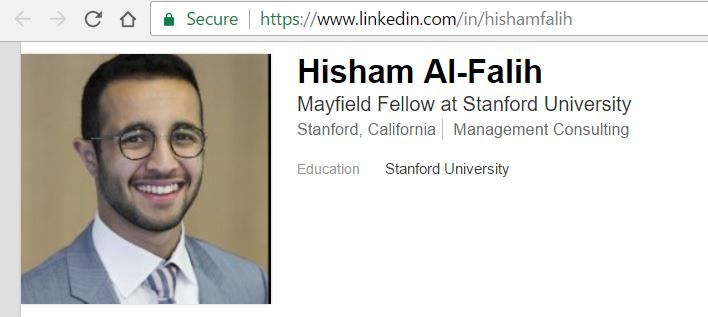
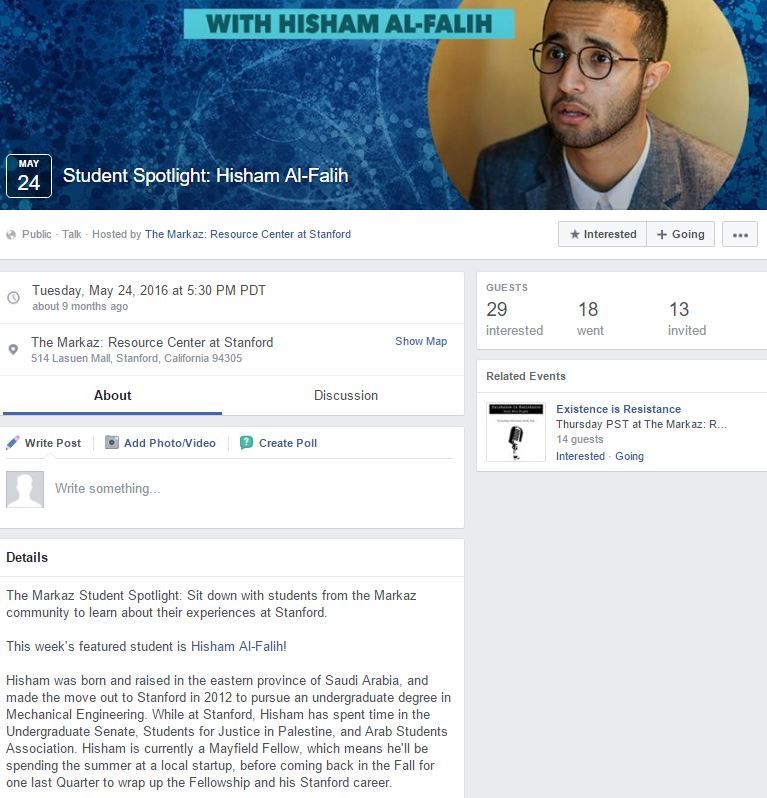
Hisham Al-Falih
Overview
Hisham Al-Falih was a member of Students for Justice in Palestine (SJP) at Stanford University (Stanford).
Al-Falih was also a member of Stanford Out of Occupied Palestine (SOOP), which defines itself as a coalition of 19 student groups without any formal leadership structure and has as its stated mission to "end Stanford's investments in corporations which profit from the Israeli Occupation of the Palestinian Territories."
SOOP disseminates Boycott, Divestment, Sanctions (BDS) movement materials and solicits donations for BDS, but has stated that it is not connected to the formal BDS movement and is focused on “selective divestment.”
Al-Falih was heavily involved in the 2014-2015 SOOP divestment campaign at Stanford.
Al-Falih graduated from Stanford in 2016 with a degree in Mechanical Engineering. He was a Senator of the Associated Students of Stanford University (ASSU) in 2013 and the founder and president of Stanford’s Arab Student Association (ASAS).
Supporting Divestment at Stanford
On February 17, 2015, the Stanford Undergraduate Senate voted in favor of a SOOP resolution calling on the university to divest from corporations that "maintain the occupation of Palestine." Al-Falih supported the campaign.
On October 26, 2014, Al-Falih penned his name to an Op-Ed written for the student newspaper titled "Stanford must divest from the occupation of Palestine."
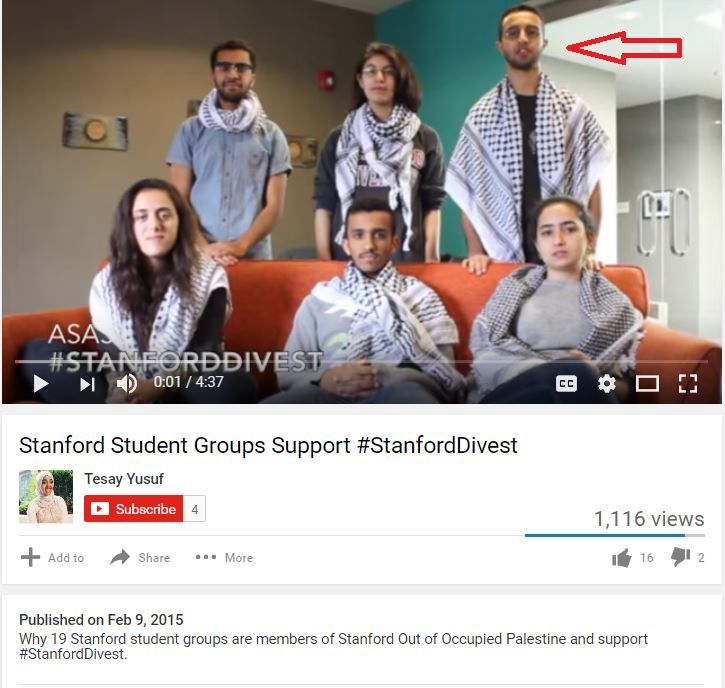
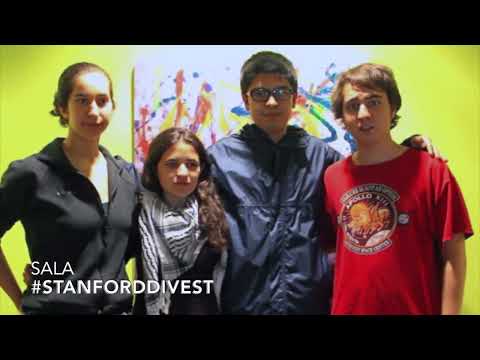
On February 9, 2015, Al-Falih featured in the SOOP Divest campaign video on behalf of ASAS.
SOOP’sresolution called for Stanford University trustees to divest from companies that "violate international humanitarian law by: maintaining illegal infrastructure of the Israeli occupation… facilitating Israel and Egypt’s collective punishment of Palestinian civilians… [and] facilitating state repression against Palestinians by Israeli, Egyptian or Palestinian Authority security forces."
On February 8, 2015, a student newspaper article reported that the United States Securities and Exchange Commission (SEC) filings showed no evidence that Stanford has been invested in any of these companies that SOOP targeted for divestment over the last ten years, with the exception of Raytheon for just one filing period.
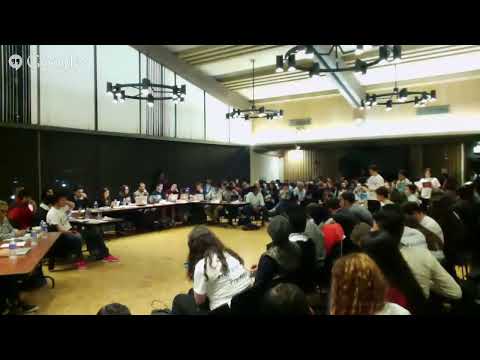
In a vote held on February 10, 2015, the resolution failed to garner the required 66% senate approval, eliciting shouts of anger from the crowd and leaving one senator in tears. But a February 17 re-vote called by Senate Chair Ana Ordonez — who had abstained from the first vote due to the "hostile" atmosphere making it difficult for her to concentrate — garnered enough support for the resolution to pass.
Stanford SJPwas a central partner in the SOOP coalition. In 2014, SJP Stanford made a divestment request to the university’s Advisory Panel on Investment Responsibility and Licensing (APIRL).
In April of 2015, however, the Stanford Board of Trustees announced that Stanford would take no action on SJP’s request, nor consider it further. In accordance with the board’s Statement on Investment Responsibility, the board focused on "questions of divisiveness and negative impact" and determined that acting on the request would be “likely to impair the capacity of the University to carry out its educational mission.”
President John Hennessy also addressed the issue at a Faculty Senate meeting: "I have never seen a topic that has been more divisive within the university community," Hennessy said. “As a university, we must remain committed to civil and rational discussion, especially when the issues are highly controversial. An atmosphere of intimidation or vitriol endangers our ability to operate as an intellectual community.”
Stanford SJP has been rumoured to be planning a BDS campaign in 2017 to coincide with the 50th anniversary of the Six-Day War.
SJP Stanford - Disrespecting Vigil for Victims of Terrorism
In October 2015, SJP Stanford organized a protest as a preemptive response to a vigil mourning innocent Israelis murdered in a wave of terror attacks across Israel.
The SJP protesters held signs, some of which which read: "#Al Aqsa under fire." The claim that the Al Aqsa mosque was under threat echoed the same incitement that fueled the Palestinian killings whose victims the vigil was meant to memorialize. The “threat” of “attacks on Al Aqsa” has been a pretext for Arab attacks on Jews, well before the existence of Israel.
SJP Stanford President Fatima Zehra considered the emails advertising the vigil for Israelis problematic because they acknowledged that Israelis who had been murdered were "victims of terror."
SJP Stanford - Hosting Omar Barghouti
On October 26, 2016, Stanford SJP held an event hosting BDS founder Omar Barghouti for a live-video lecture.
SJP Stanford - Supporting the “Right To Education” Tour
On November 12, 2014, Stanford SJP hosted a “Right 2 Education” tour at Stanford.
The Right to Education Tour brings Birzeit University students to U.S. campuses, where they claim that Israel is obstructing the rights of Palestinians to higher education. This claim mischaracterizes the sweeps Israeli security forces have made to shut down terror cells operating on the Birzeit campus, including cells linked to Hamas.
SJP - Stanford Hosting Mads Gilbert
On November 09, 2015, Stanford SJP held a “Visual Talk” event featuring Dr. Mads Gilbert and decrying that he was “hit with a lifetime ban from entering Gaza by the Israeli government.”
Gilbert has been banned indefinitely from entering Gaza through Israel because of his connections to the Hamas leadership.
In 2008, 2009, 2012 and 2014 Gilbert was stationed at a hospital that served as a Hamas command center and rocket launching site. During that time he acted as a propagandist for the Hamas government in Gaza.
In 2001, following al Qaeda's September 11 terrorist attacks, Gilbert expressed support for the terror acts as a “legitimate response.” In December of 2009, Gilbert was accused of faking resuscitation on a dead child in Gaza for dramatic effect for a CNN video.
SJP
SJP is a student organization engaged in anti-Israel activity on North American college and university campuses.
The first chapter of SJP was founded in 2001 at the University of California at Berkeley by Professor Hatem Bazian. Bazian has spread classic anti-Semitism, reportedly promoted religious anti-Semitism and defended the Hamas terror group. In 2004, Bazian called for “intifada” in America.
SJP organizes anti-Israel campaigns, including running annual Israel Apartheid Weeks, often in collaboration with Jewish Voice for Peace (JVP) and Muslim Students Association (MSA) campus chapters.
SJP has been a major force in pushing the anti-Semitic Boycott, Divestment, Sanctions (BDS) movement on campuses. Chapters have initiated dozens of BDS resolutions in student governments, which have been proposed on or around Jewish holidays, a time when many Jewish students are off-campus.
SJP activists have reportedly physically assaulted, intimidated and harassed Jewish students, disrupted pro-Israel campus events and demonized pro-Israel campus organizations.
Chapters have often endorsed and campaigned for numerous terrorists and whitewashed terrorism.
BDS
The Boycott, Divestment, Sanctions (BDS) movement was founded by Omar Barghouti in 2005 to challenge “international support for Israeli apartheid and settler-colonialism.” BDS is an allegedly “Palestinian-led movement,” although leading BDS activists have admitted [00:01:01] this is not true.
One of the demands of BDS includes [point 3] what is generally known as the “right of return,” a demand discredited as a way to eliminate Israel. Barghouti said the “right of return” is a means to “end Israel’s existence as a Jewish state.”
Barghouti has said that BDS “aims to turn Israel into a pariah state, as South Africa once was.”
In his activism, Barghouti has also said [00:05:55] regarding Israel: “Definitely, most definitely, we oppose a Jewish state in any part of Palestine. No…rational Palestinian, not a sellout Palestinian, will ever accept a Jewish state in Palestine.”
The movement has been linked to numerous terrorist organizations and received a public endorsement from Hamas in 2017.
BDS initiatives include calling on institutions and individuals to divest from Israeli-affiliated companies, promoting academic and cultural boycotts of Israel, and organizing anti-Israel rallies, protests and campaigns.
The movement’s most notable achievement has been the infiltration of university campuses through lobbying for “BDS resolutions.” In these cases, student governments and student groups, backed by their own anti-Israel members and affiliates, have proposed resolutions on some form of boycott of, or divestment from, Israel and Israeli-affiliated entities.
Boycott resolutions, although non-binding, have been passed by student governments on numerous North American campuses.
BDS activity is often aggressive and disruptive. It has been noted that universities that pass BDS resolutions see a marked increase in anti-Semitic incidents on campus. On one campus, when the student government debated a BDS resolution, reports emerged of violent threats against those opposing it.
Social Media and Weblinks
Facebook:https://www.facebook.com/hisham.alfalih
Twitter:https://twitter.com/bufali7/ [Protected]
LinkedIn:https://www.linkedin.com/in/hishamfalih
Instagram:https://www.instagram.com/hishamkf/ [Private]
Google+:https://plus.google.com/113734091670119662310
_(1)_203x172_ODtjQT.jpg "Hisham Al-Falih")
- Status:
- Student
- University:
- Stanford
- Organizations:
- BDS,
- SJP,
- more...
- Related Profiles:
- Stephanie Navarro,
- Last Modified:
- 05/04/2026
Videos
Photos & Screenshots