Kyle Neil
Overview
As of 2015, SOOP was reportedly a coalition of 19 student groups campaigning for Stanford to “divest from corporations profiting from human rights abuses in occupied Palestine.” The campaign was initiated [00:12:16] by Students for Justice in Palestine (SJP) Stanford.
As of May 2020, SOOP’s Facebook page said its mission was to “end Stanford's investments in corporations which profit from the Israeli Occupation of the Palestinian Territories.”
As of May 2020, Neil’s LinkedIn page said he was Wellness Organizer at Community United Against Violence, since August 2018. It also said he graduated with a bachelor’s degree in African and African American Studies from Stanford in 2017.
Supporting Divestment at Stanford
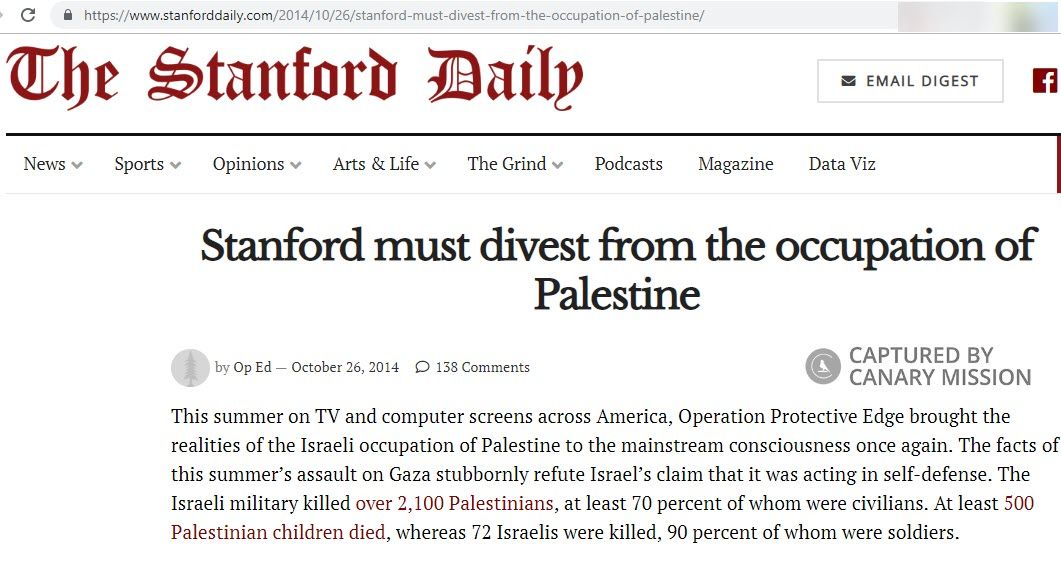
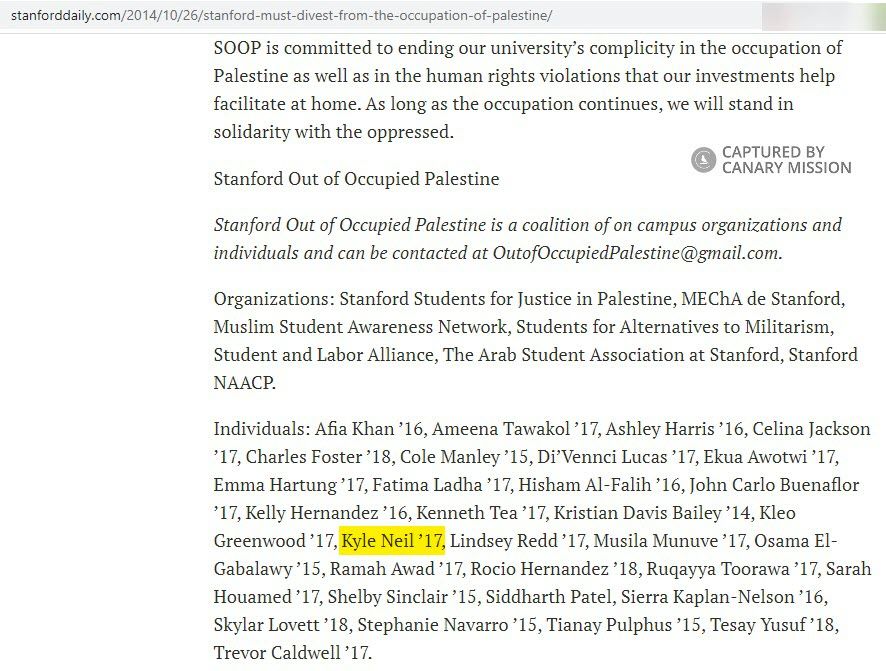
On October 26, 2014, Neil co-signed a SOOP op-ed in The Stanford Daily student newspaper, titled: “Stanford must divest from the occupation of Palestine” that suggested Israel’s Operation Protective Edge (OPE) was not self-defense.Israel commenced OPE in July 2014 to stop rocket fire targeting Israeli civilians and to destroy Hamas attack tunnels.
SOOP published a BDS resolution on January 27, 2015, that called on Stanford to divest from companies it claimed “violate international humanitarian law by: maintaining the illegal infrastructure of the Israeli occupation…facilitating Israel and Egypt’s collective punishment of Palestinian civilians…[and] facilitating state repression against Palestinians.”
On January 28, 2015, Neil set his Facebook cover photo to an image promoting SOOP’s campaign.
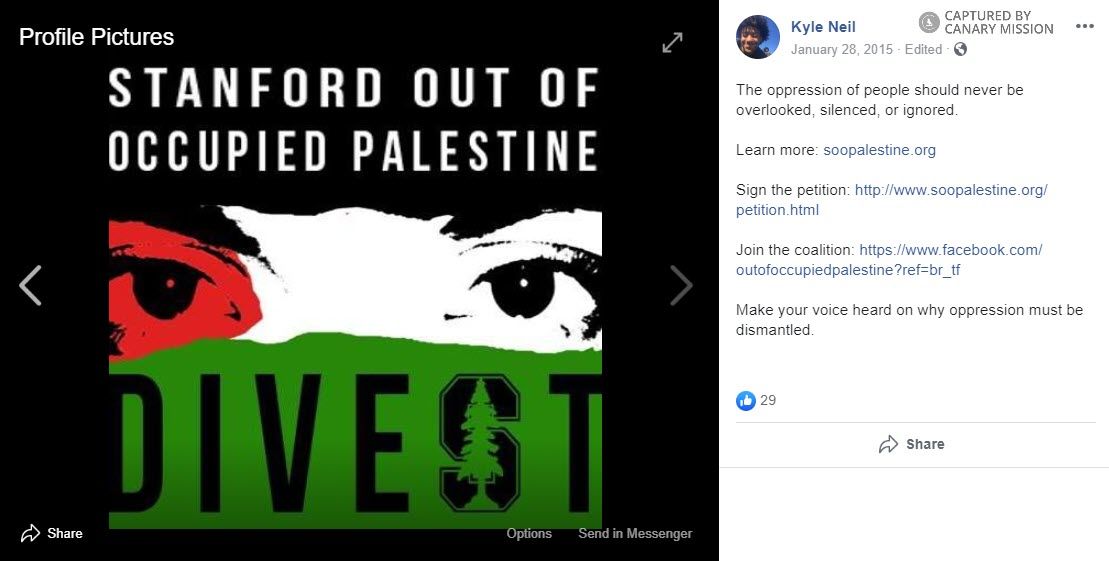
That same day, he also set his Facebook profile picture to an image promoting the campaign and linked to SOOP’s campaign website, petition and Facebook page. He urged readers to “Sign the petition… Join the coalition” and “Make your voice heard on why oppression must be dismantled.”
On February 2, 2015, Neil posted SOOP’s Divest petition on Facebook and quoted from a press release about the petition, accusing Israel of “collective punishment” and “state sanctioned repression.” Neil was the 66th person to sign SOOP’s Divest petition.
SOOP’s Divest petition called on the Stanford University Board of Trustees to divest from companies that it claimed were “complicit in the infrastructure of occupation, collective punishment, state-sponsored repression, and unjust incarceration in Palestine.”
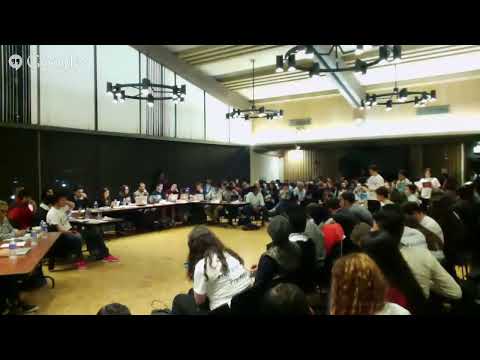
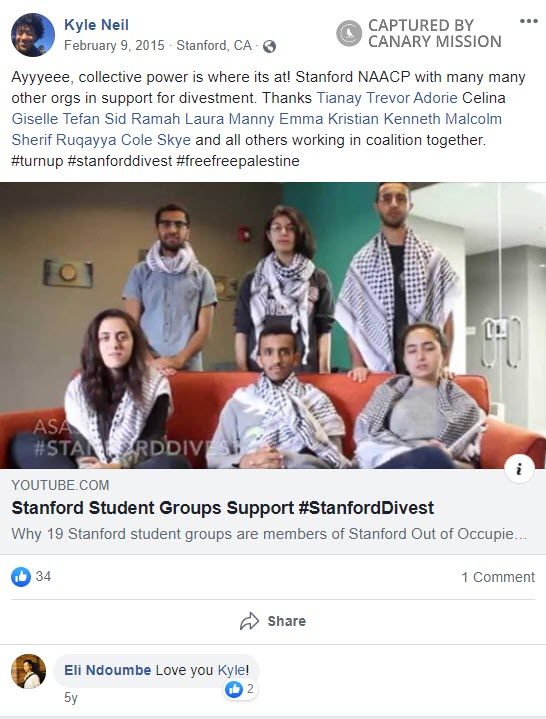
Neil featured [00:03:03] in a video, titled: “Stanford Student Groups Support #StanfordDivest,” posted to YouTube on February 9, 2015, as a representative of Stanford’s National Association for Advancement of Colored People (NAACP).
In the video, various Stanford student groups expressed [00:03:59] their support for SOOP’s BDS campaign.
Also on February 9, 2015, Neil shared the video on Facebook and wrote: “Ayyyeee, collective power is where its at!”
Again on February 9, 2015, Neil set his Facebook profile picture to an image promoting SOOP’s campaign and the details of the Stanford Undergraduate Senate hearing where the senate would vote on SOOP’s resolution.
Neil wrote on his Facebook post: “Less than 48 hours til the ASSU Senate vote. Can't believe this issue needs to be taken to the senate again. Lets do this #stanforddivest #nojusticenopeace #freepalestine.”
The SOOP BDS resolution initially failed [00:00:42] on February 10, 2015, but was later brought forward in a motion calling for a re-vote and passed on February 17, 2015.
Also on February 17, 2015, Neil posted on Facebook celebrating the resolution passing.
Later, on April 14, 2015, the Stanford Board of Trustees announced that it would take no action based on the SOOP BDS Resolution, despite an SJP Stanford request for the Board to do so.
In accordance with the board’s Statement on Investment Responsibility, the board said in its statement on the Resolution that the Trustees focused on “questions of divisiveness and negative impact” and determined that acting on the request would be “likely to impair the capacity of the University to carry out its educational mission.”
SOOP #Stanford Divest
Stanford Out of Occupied Palestine (SOOP) was reportedly a coalition of 19 student groups campaigning for Stanford University (Stanford) to “divest from corporations profiting from human rights abuses in occupied Palestine.”The campaign was initiated [00:12:16] by Stanford Students for Justice in Palestine (SJP) and promoted on social media under the hashtag “#Stanford Divest.”
As of January 2020, SOOP’s Facebook page said its mission was “To end Stanford's investments in corporations which profit from the Israeli Occupation of the Palestinian Territories.”
SOOP has reportedly stated that it is not connected to the Boycott, Divestment, Sanctions (BDS) movement and is focused on “selective divestment.” However, the coalition has reportedly disseminated BDS materials and promoted a video that solicited donations for BDS.
SOOP - 2015 Divestment Campaign
In February 2015, members of SOOP presented a petition and a divestment resolution to the Associated Students of Stanford University (ASSU) Undergraduate Senate to further the agenda of the Boycott, Divestment Sanctions (BDS) movement.The resolution, titled: “A Resolution to Divest from Companies Violating Human Rights in Occupied Palestine,” was co-authored by Ramah Awad, SOOP leader and co-president of Students for Justice in Palestine (SJP) at Stanford (SJP Stanford) at the time and then-members of SOOP, Clayton Evans, Laura Perez and Emma Hartung.
The resolution called for Stanford University Trustees to divest from companies that it alleged: “violate international humanitarian law by: maintaining the illegal infrastructure of the Israeli occupation.”
The resolution also called for divestment from companies it claimed facilitates Israel’s “collective punishment of Palestinian civilians…[and] state repression against Palestinians.”
On February 8, 2015, The Stanford Review, a student-run political magazine reported that the United States Securities and Exchange Commission (SEC) filings showed no evidence that Stanford has been invested in any of the companies that SOOP targeted for divestment over the last ten years, with the exception of Raytheon, for one filing period.
The resolution initially failed [00:00:42] to garner the required 66% majority senate approval, in a vote held on February 10, 2015.
Senate Chair Ana Ordonez then brought forward a motion calling for a re-vote. Ordonez reportedly initially abstained from voting and was later quoted in the student newspaper, the Stanford Daily, as saying: “Now that the noise has subsided, I know that I voted incorrectly.”
Ordonez voted in favor of the resolution in the re-vote, which passed on February 17, 2015. However, the Stanford Board of Trustees later announced on April 14, 2015, that Stanford would take no action on SJP’s request.
In accordance with the board’s Statement on Investment Responsibility, the board said in its statement on the resolution that they focused on “questions of divisiveness and negative impact” and determined that acting on the request would be “likely to impair the capacity of the University to carry out its educational mission.”
SOOP - Promoting BDS
On February 10, 2015, SOOP promoted a BDS Youtube video on Facebook, titled: “Stanford Student Groups Support #StanfordDivest.”The video featured members of student groups, including [00:03:38] SJP Stanford, expressing why they support “#StanfordDivest.” Ramah Awad, SOOP leader and co-president of SJP Stanford at the time, said [00:03:45]: “We recognize divestment as one step on that path to liberation.”
On January 23, 2015, SOOP posted a photo album on Facebook titled: “Human of ‘Out of Occupied Palestine,’” which featured photos of Stanford students holding posters with anti-Israel messages and showing support for #StanfordDivest.
One photo showed a student holding a sign which read: “I support divestment because collective punishment is a war crime.” Another sign read: “There are better & more commendable ways to fiscally profit that doesn’t contribute to the displacement & exploitation of human lives.”
On January 21, 2015, SOOP reportedly organized a panel discussion to promote its BDS petition, which called for Stanford’s divestment from corporations that allegedly “facilitate human rights violations in Israel’s occupation of the Palestinian Territories.”
On January 9, 2015, SOOP published a Youtube video titled: “FilasteenFridays: Collective Punishment in the Palestinian Territories.” The video urged Stanford students to support their BDS campaign as “the only way to show true moral neutrality.”
On January 8, 2015, SOOP hosted an informational event titled: “Case for Divestment from the Occupation of Palestine.”
The event’s Facebook description said it would include an explanation of SOOP’s “divestment criteria, followed by a moderated discussion with some of the campaign organizers.”
BDS
The Boycott, Divestment, Sanctions (BDS) movement was founded by Omar Barghouti in 2005 to challenge “international support for Israeli apartheid and settler-colonialism.” BDS is an allegedly “Palestinian-led movement,” although leading BDS activists have admitted [00:01:01] this is not true.
One of the demands of BDS includes [point 3] what is generally known as the “right of return,” a demand discredited as a way to eliminate Israel. Barghouti said the “right of return” is a means to “end Israel’s existence as a Jewish state.”
Barghouti has said that BDS “aims to turn Israel into a pariah state, as South Africa once was.”
In his activism, Barghouti has also said [00:05:55] regarding Israel: “Definitely, most definitely, we oppose a Jewish state in any part of Palestine. No…rational Palestinian, not a sellout Palestinian, will ever accept a Jewish state in Palestine.”
The movement has been linked to numerous terrorist organizations and received a public endorsement from Hamas in 2017.
BDS initiatives include calling on institutions and individuals to divest from Israeli-affiliated companies, promoting academic and cultural boycotts of Israel, and organizing anti-Israel rallies, protests and campaigns.
The movement’s most notable achievement has been the infiltration of university campuses through lobbying for “BDS resolutions.” In these cases, student governments and student groups, backed by their own anti-Israel members and affiliates, have proposed resolutions on some form of boycott of, or divestment from, Israel and Israeli-affiliated entities.
Boycott resolutions, although non-binding, have been passed by student governments on numerous North American campuses.
BDS activity is often aggressive and disruptive. It has been noted that universities that pass BDS resolutions see a marked increase in anti-Semitic incidents on campus. On one campus, when the student government debated a BDS resolution, reports emerged of violent threats against those opposing it.
Social Media and Weblinks
Facebook:https://www.facebook.com/100000395211612LinkedIn:https://www.linkedin.com/in/kyle-neil-b6b11790