Fatima Zehra
Overview
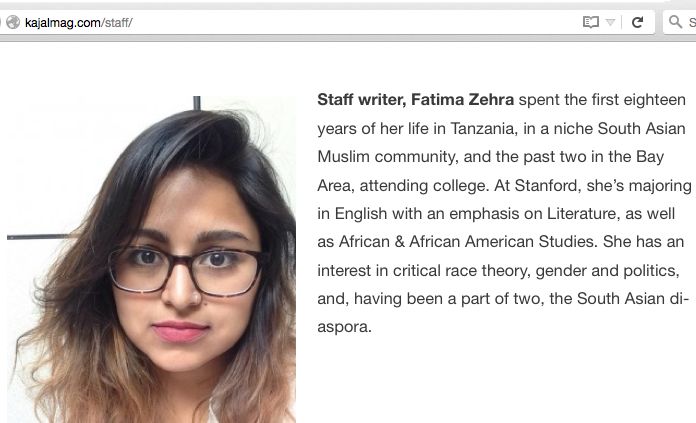
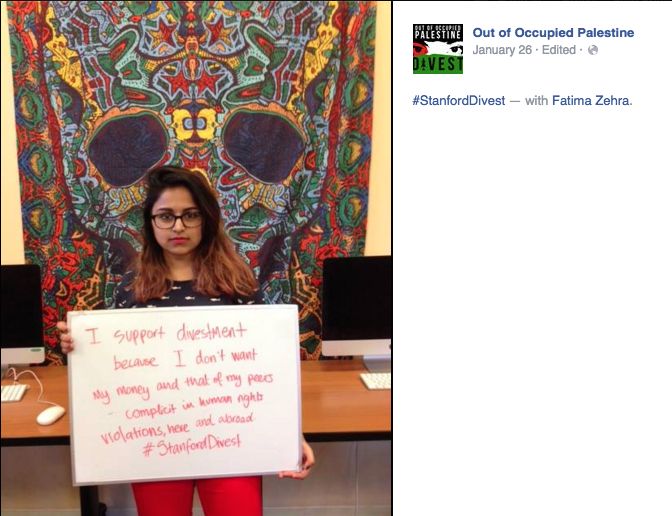
Fatima Zehra [Fatima Ladha Zehra] was co-president and spokesperson for Students for Justice in Palestine (SJP) at Stanford University. She is also a member of Stanford Out of Occupied Palestine (SOOP)
As of July 2018, Zehra’s LinkedIn page indicated that she graduated from Stanford in 2017 with a degree in English Literature and African & African American Studies.
Her LinkedIn also said that she is the Deputy Editor at Kajal Magazine and is a Community Advocate for Asian Americans Advancing Justice-Asian Law Caucus.
Protesting the Mourning of Terror-Victims
In October 2015 — at a time of heightened tensions in Israel — SJP Stanford organized a protest of a vigil mourning Israelis murdered in a then-recent wave of terror attacks across Israel.
In a Stanford Daily article written about the SJP Stanford protest, Zehra stated that she considered e-mails advertising the vigil problematic because they acknowledged that the murdered Israelis were "victims of terror." Zehra opined, “There’s implicit racism in that, because it’s like, all Palestinian Arabs are terrorists, as opposed to mentioning the 39 Palestinians who have lost their lives because of the [Israeli Defense Forces].”
At the protest, SJP members held misleading and incendiary placards reading: "Netanyahu shuts down Palestinian businesses in East Jerusalem" and “#Al Aqsa under fire.” The placards that conjured the threat of attacks on the Al Aqsa mosque echoed the incitement that fueled the violence then sweeping across Israel. Such claims have been a pretext for Arab attacks on Jews since well before the existence of Israel.
Stanford Divestment Resolution
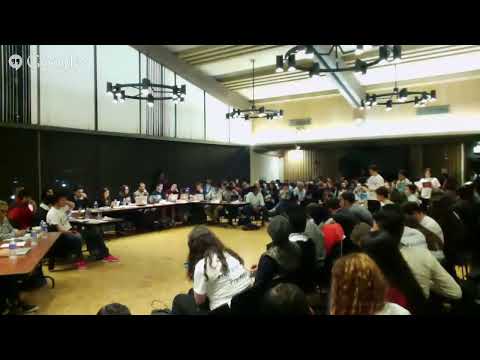
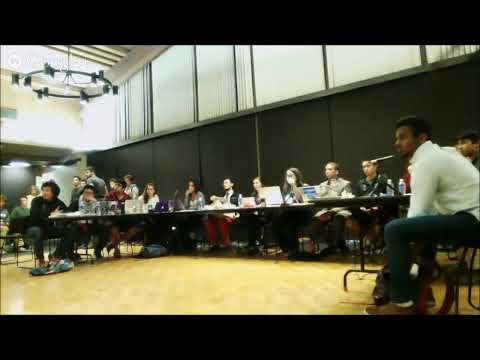
On February 17, 2015, the Stanford Undergraduate Senate voted in favor of a SOOP resolution calling on Stanford to divest from corporations that "maintain the occupation of Palestine."
The resolution called for Stanford University trustees to divest from companies that "violate international humanitarian law by: maintaining illegal infrastructure of the Israeli occupation… facilitating Israel and Egypt’s collective punishment of Palestinian civilians… [and] facilitating state repression against Palestinians by Israeli, Egyptian or Palestinian Authority security forces."
Following an initial vote, the resolution failed to garner the required 66% Senate approval, eliciting shouts of anger from the crowd and leaving one senator in tears. However, a re-vote was called by Senate Chair Ana Ordonez, who had abstained from the first vote because the "hostile" atmosphere made it difficult for her to concentrate on the vote. The second vote garnered enough support for the resolution to pass.
In April 2015, the Stanford Board of Trustees announced that the University would not divest from certain companies operating in Israel after concluding that any action to divest would serve to deeply divide the Stanford community.
President John Hennessy also addressed the issue at a faculty senate meeting. "I have never seen a topic that has been more divisive within the university community," Hennessy said. “As a university, we must remain committed to civil and rational discussion, especially when the issues are highly controversial. An atmosphere of intimidation or vitriol endangers our ability to operate as an intellectual community.”
SJP
SJP is a student organization engaged in anti-Israel activity on North American college and university campuses.
The first chapter of SJP was founded in 2001 at the University of California at Berkeley by Professor Hatem Bazian. Bazian has spread classic anti-Semitism, reportedly promoted religious anti-Semitism and defended the Hamas terror group. In 2004, Bazian called for “intifada” in America.
SJP organizes anti-Israel campaigns, including running annual Israel Apartheid Weeks, often in collaboration with Jewish Voice for Peace (JVP) and Muslim Students Association (MSA) campus chapters.
SJP has been a major force in pushing the anti-Semitic Boycott, Divestment, Sanctions (BDS) movement on campuses. Chapters have initiated dozens of BDS resolutions in student governments, which have been proposed on or around Jewish holidays, a time when many Jewish students are off-campus.
SJP activists have reportedly physically assaulted, intimidated and harassed Jewish students, disrupted pro-Israel campus events and demonized pro-Israel campus organizations.
Chapters have often endorsed and campaigned for numerous terrorists and whitewashed terrorism.
BDS
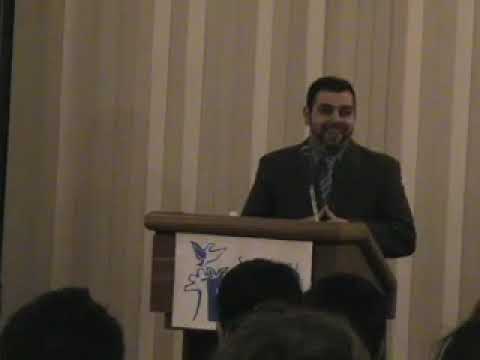
The Boycott, Divestment, Sanctions (BDS) movement was founded by Omar Barghouti in 2005 to challenge “international support for Israeli apartheid and settler-colonialism.” BDS is an allegedly “Palestinian-led movement,” although leading BDS activists have admitted [00:01:01] this is not true.
One of the demands of BDS includes [point 3] what is generally known as the “right of return,” a demand discredited as a way to eliminate Israel. Barghouti said the “right of return” is a means to “end Israel’s existence as a Jewish state.”
Barghouti has said that BDS “aims to turn Israel into a pariah state, as South Africa once was.”
In his activism, Barghouti has also said [00:05:55] regarding Israel: “Definitely, most definitely, we oppose a Jewish state in any part of Palestine. No…rational Palestinian, not a sellout Palestinian, will ever accept a Jewish state in Palestine.”
The movement has been linked to numerous terrorist organizations and received a public endorsement from Hamas in 2017.
BDS initiatives include calling on institutions and individuals to divest from Israeli-affiliated companies, promoting academic and cultural boycotts of Israel, and organizing anti-Israel rallies, protests and campaigns.
The movement’s most notable achievement has been the infiltration of university campuses through lobbying for “BDS resolutions.” In these cases, student governments and student groups, backed by their own anti-Israel members and affiliates, have proposed resolutions on some form of boycott of, or divestment from, Israel and Israeli-affiliated entities.
Boycott resolutions, although non-binding, have been passed by student governments on numerous North American campuses.
BDS activity is often aggressive and disruptive. It has been noted that universities that pass BDS resolutions see a marked increase in anti-Semitic incidents on campus. On one campus, when the student government debated a BDS resolution, reports emerged of violent threats against those opposing it.
Social Media and Weblinks
Facebook: www.facebook.com/fatimazehra10000
https://www.facebook.com/fatimazehra123 [Deleted]
https://www.facebook.com/fatima.ladha?ref=br_rs
Linkedin: https://www.linkedin.com/pub/fatima-ladha/9a/905/334

- Status:
- Professional
- University:
- Stanford
- Organizations:
- BDS,
- SJP,
- more...
- Related Profiles:
- Stephanie Navarro,
- Last Modified:
- 05/04/2026
Videos

Photos & Screenshots