Amira Subaey
Overview
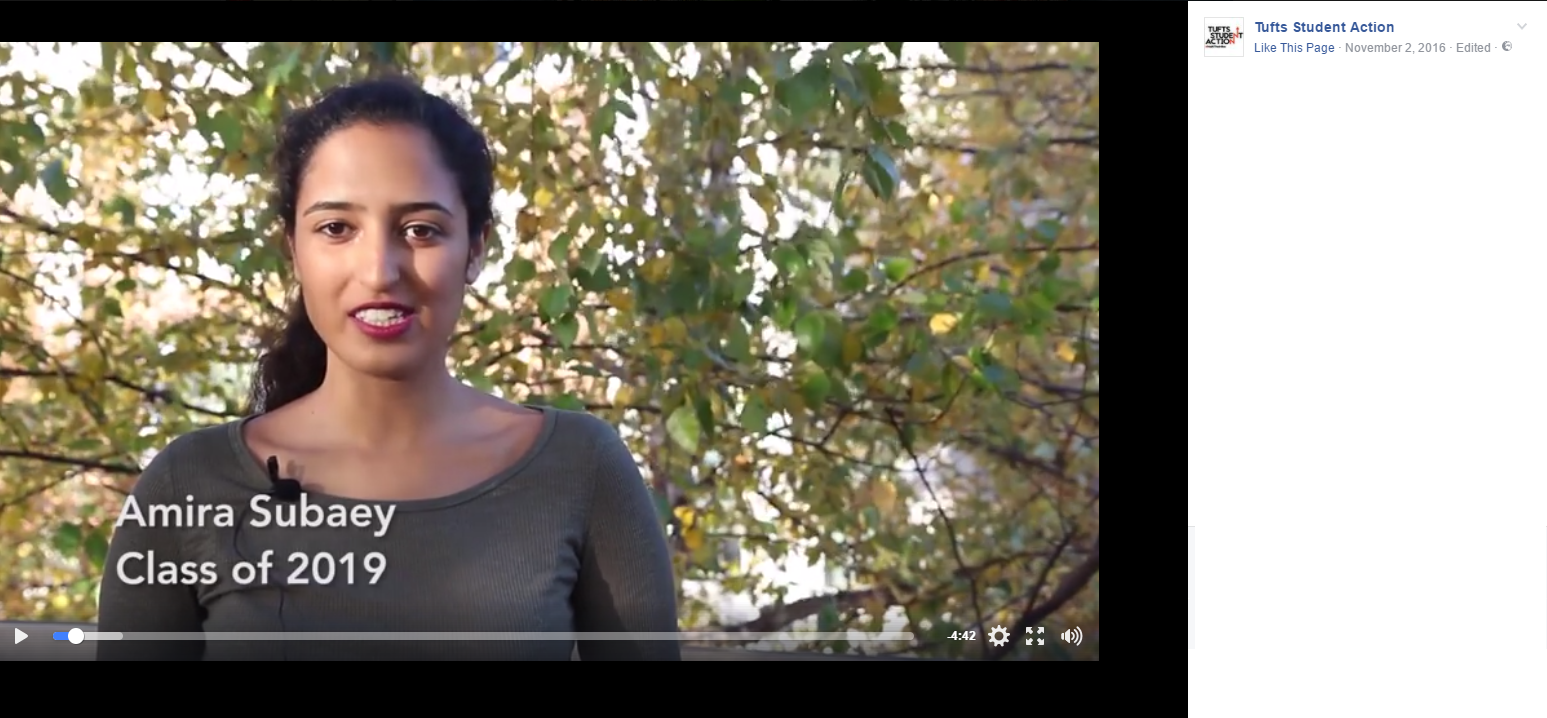
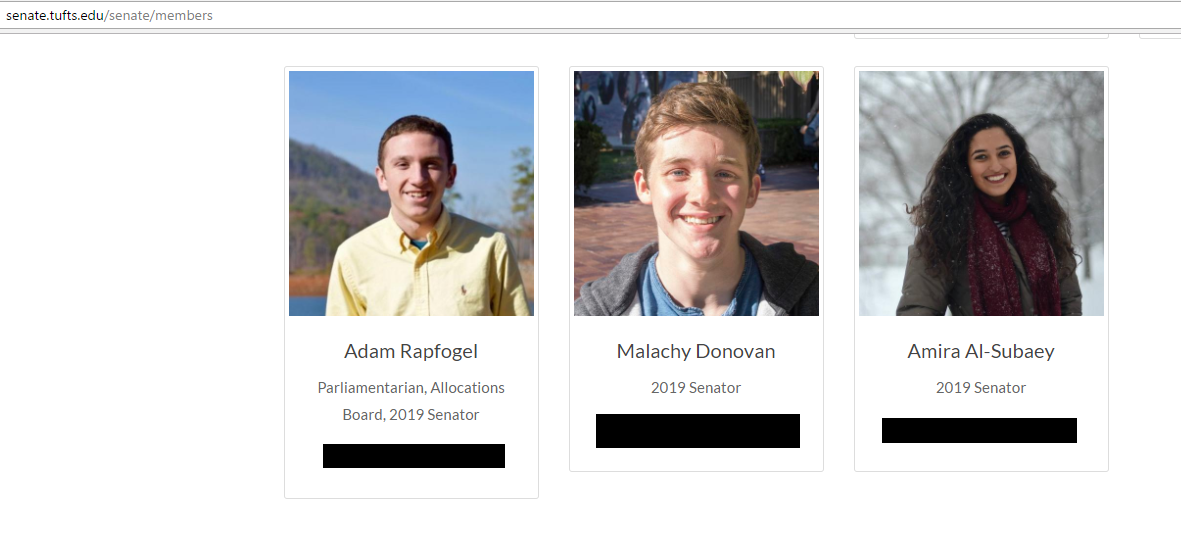
Amira Subaey co-sponsored a surprise anti-Israel divestment resolution vote at Tufts University (Tufts), that excluded many Jewish students, on Passover Eve, 2017.Subaey is a student senator for the Class of 2019 in the Tufts Community Union Senate (TCU Senate), where she defended the BDS resolution.
Students for Justice in Palestine (SJP) at Tufts (Tufts SJP) authored the resolution to further the agenda of the Boycott, Divestment and Sanctions (BDS) movement.
Subaey was one of at least seven Tufts SJP activists who attended the 2017 Jewish Voice for Peace (JVP) National Member Meeting (NMM) in Chicago where Tufts SJP presented.
On November 6, 2016, Subaey appeared in a Tufts SJP Facebook photo with the caption: “Tufts takes National SJP - thanks GMU for the mems! #NSJP2016#FreePalestine.” The 2016 National SJP Conference was held at George Mason University (GMU).
According to Facebook, Subaey has attended over two dozen Tufts SJP events from 2015 to 2017 including a Tufts SJP “Greater Boston SJP Planning Meeting” on November 15, 2015.
As of June 14, 2017, Subaey was a member of the Facebook groups for Tufts SJP and the Muslim Student Association (MSA) at Tufts (Tufts MSA).
As of July 2017, uae-trekkers.com reported that Subaey was majoring in International Relations.
Supporting Terrorists
On May 10, 2017, Subaey led Tufts SJP in the “Saltwater Challenge,” in solidarity with Palestinian inmates in Israeli prisons who were then on a hunger strike.The hunger strike was initiated by Marwan Barghouti, who was serving five consecutive life sentences for his role in suicide bombings and shooting attacks — that killed five Israelis during the second Intifada. Barghouti also financed the guitar-case bomb used in the Sbarro Cafe massacre, where 15 civilians were killed and 130 injured.
In a short video of the event produced by Tufts SJP, Subaey claimed that Israel practices “apartheid” (0:40) and that Tufts SJP was “protesting the conditions in Israeli prisons” (0:20). Barghouti completed his doctorate in Political Science while in Israeli prison.
Also among the hunger strikers was Popular Front for the Liberation of Palestine (PFLP) Secretary-General Ahmad Sa’adat, jailed for his role in organizing the assassination of Israeli Tourism Minister, Rehavam Ze'evi in 2001.
More than 1,500 Palestinian prisoners participated in the hunger strike — most of whom were also convicted for acts of terrorism.
In May of 2017, Subaey was listed on Facebook as attending an event titled “Emergency Standout for Palestinian Prisoners on Hunger Strike.” Tufts SJP shared the Facebook event page, which cited and linked to Addameer, an organization that advocates on behalf of Palestinian prisoners. Many of those for whom Addameer advocates for are either supporters or members of terror groups.
Pushing BDS
On April 9, 2017, Subaey admitted that the Tufts SJP divestment resolution, as originally submitted before amendments, directly quoted from BDS movement’s website — but without quotation marks.Subaey admitted (2:32:40) that the line “ending Israel’s occupation and colonization of all Arab lands” was part of a larger “direct quote from … the BDS website.” Tufts SJP then agreed to place the larger BDS quote (lines 12 - 17) in quotation marks — but refused to alter the quote in any way. Hannah Freedman, another Tufts SJP leader, said: “We don’t feel comfortable changing the three-fold goal of the BDS movement” (2:33:40).
The BDS website block quote began with BDS’ demand for “ending Israel’s occupation and colonization of all Arab lands.” During the Passover Eve debate on the divestment resolution, that language was the point of fierce debate, since it could be interpreted as a call for Israel’s destruction.
Indeed, BDS leaders, like Omar Barghouti, have long insisted (5:50) that there is no room for a “Jewish state in Palestine in any shape or form,” claiming that “no rational Palestinian ... will ever accept a Jewish state in Palestine.”
Subaey’s admission forced Tufts SJP to officially tie the resolution to the BDS movement despite previous protestations that it was not affiliated. The resolution as finally passed added quotation marks around the BDS quotation, but never expressly sourced the block quote to the BDS website.
Subaey’s and Tufts SJP’s tactics at the BDS vote hearing matched tactics explicitly articulated by BDS founder Omar Barghouti, shortly thereafter, at another university. On May 5, 2017, Barghouti said (58:53): “If you join a campaign for justice and freedom, it doesn’t have to carry the BDS logo. It doesn't have to say ‘boycott’ and it doesn’t have to say ‘BDS.’ There are many creative ways to do things without labeling it as BDS.”
Demonizing Israel
On April 9, 2017, Subaey, in her opening remarks at the divestment resolution hearing, claimed (16:20) that one of the companies targeted for divestment helps Israeli prisons to “systematically oppress and use a bunch of torture tactics.”On April 6, 2017, Subaey appeared in a Tufts SJP Facebook photo promoting Israeli Apartheid Week 2017. Subaey handed out a publication titled “Whose Birthright?,” an online zine targeting Jewish students considering going on Birthright Israel trips. Birthright Israel is a series of Jewish heritage trips to Israel for Jewish young adults.
Sophia Goodfriend, a Tufts SJP activist, wrote a publication titled “Whose Birthright?” undermining the Jewish millennia-long connection to the Land of Israel, including ancient Jewish religious sites like the Western Wall in Jerusalem (pages 9 and 15). Goodfriend claimed that Jews were “creating their own origin stories, or claims to nativism” (page 18). She also claimed that Israel was established on “expropriated land” and that Israel continues to “evict, incarcerate or kill millions of Palestinians” (page 2).
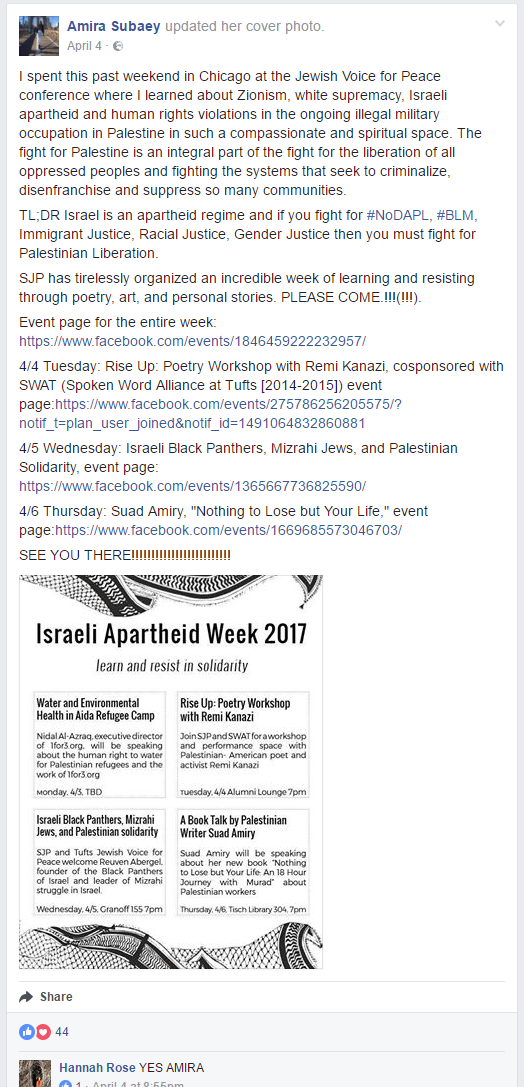
Subaey also promoted Tufts SJP’s “Israeli Apartheid Week 2017” (IAW 2017) in the photo. Among the events was a performance by anti-Israel poet Remi Kanazi, who is known for his aggressive anti-Israel performances. Tufts SJP hosted IAW 2017 from April 3 - 7, all less than a week before the Passover Eve BDS resolution vote.
On April 4, 2017, Subaey stated on Facebook that she attended the 2017 JVP NMM in Chicago the previous weekend. She said she “learned about Zionism, white supremacy, Israeli apartheid and human rights violations in the ongoing illegal military occupation in Palestine…”
The 2017 Divestment Hearing: Marginalizing Jewish Voices
On Thursday April 6, 2017, the Tufts Community Union Senate (TCU Senate) announced that an anti-Israel divestment resolution — authored by Tufts SJP — would be voted on at the TCU Senate’s Sunday, April 9th meeting.Monday evening, April 10th, marked the beginning of the Jewish holiday of Passover. Passover Eve is a time when many Jewish students are traditionally at home with family. Many Jewish students who had long-standing plans to spend the weekend with their families in anticipation of the holiday, were unable to attend the vote.
On the day of the vote, Tufts Hillel executive director Rabbi Jeffrey Summit noted: “The Hillel Jewish community is deeply disturbed by this vote, and by the way the resolution was brought so close to Pesach [Passover], at a time when many of our students are home with their families, readying themselves for the holiday.”
On Sunday April 9, the TCU Senate voted on the divestment resolution which passed with 17 in favor, six opposed and eight abstentions. Amid protests against the resolution’s timing, the TCU Senate voted down a motion to table the resolution. Six out of the 37 TCU Senators eligible to vote in April 2017 were absent from the final vote.
In a marked departure from protocol, photography and video recording of the divestment resolution’s proceedings were banned, due to “safety” concerns. The TCU Senate livestreamed a video of a vote taken on another issue at the same meeting.
An audio-only broadcast of the divestment resolution proceedings was livestreamed on the TCU Senate Facebook page. During the 3.5 hour-long session, TCU Senate members and speakers avoided referring to one another by name and identified (1:15:35) one another, instead, via references to physical characteristics and clothing.
One Senator asked (36:00) Tufts SJP activist and TCU Senator Parker Breza if his group consulted with any campus groups other than Jewish Voice for Peace (JVP) at Tufts (Tufts JVP) during the drafting of the divestment resolution. Breza answered (36:20): “So, we didn’t, um, actually, like, talk to any other groups, like, while we were drafting this resolution.”
The TCU Senate parliamentarian and Tufts SJP leaders Hannah Freedman and Noah Habeeb all agreed (41:11 and 44:40) on Wednesday, April 5th, to make a Google doc available for anyone unable to attend the vote, to submit comments that could be read “at some point” during the April 9th meeting. Immediately prior to the vote, the parliamentarian urgently requested the attendees to approve 10 minutes of time to read out the submitted comments, so he would not be put in an “awkward situation” (53:37).
Eventually, the parliamentarian read out write-in comments for a total of 15 minutes. The parliamentarian read out 22 (about 25%) out of the 81 student comments that were submitted to the senate via the Google doc.
In choosing which comments to read, the parliamentarian prioritized student comments over non-student comments and read them at random. Of the 22 randomized student comments read, at least 10 opposed the resolution.
One anonymous Jewish student, at home for Passover said (1:17:12): “My freedom to appear and speak for myself and stand up for something I believe in was taken away. As you might imagine, this feels like a personal blow to me and also to students who are at home preparing for Passover who are being blatantly left out … the timing it was released gives the impression that this was intentional.”
In an April 11, 2017 interview with the Tufts Daily, Habeeb denied that Tufts SJP intentionally scheduled the vote to coincide with Passover. The TCU Senate meeting was the last of the semester.
During the debate preceding the vote, one Senator questioned (40:12) the “specific intent” behind the resolution’s timing “when many students cannot attend this meeting simply because they are observing their holiday, Passover.”
In answer to the question, Freedman revealed the resolution’s authors decided to not schedule the vote for the previous week’s meeting because “many of us were away at a conference last weekend when we had had [sic.] the resolution ready — and so we decided to put it this weekend” (40:43). Freedman omitted that the conference was the anti-Israel Jewish Voice for Peace (JVP) National Member Meeting (NMM), where Tufts SJP had sent a delegation of at least seven members and met with senior JVP officials.
The 2017 Divestment Hearing: Denying Culpability
Tufts SJP leaders Noah Habeeb and Hannah Freedman addressed the question of the divestment resolution’s timing.When asked, specifically, “Why tonight?” Habeeb blamed Christianity, stating (44:25): “This country is characterized by Christian hegemony, this university is not immune to that. This a choice that Jewish students have to make frequently, to choose between our cultural religious practices and other things that matter to us.”
Freedman, who proudly invokes her own Jewishness in her activism, claimed not to have known about the timing conflict. She stated (41:02), “we were pretty upset when we heard” about the BDS vote conflicting with a time “when many Jewish students, specifically, are travelling for Passover,” and said (41:08): “obviously we want, like, a full dialogue in this room.”
Habeeb stressed the “sense of urgency” (44:05) within Tufts SJP for passing the resolution to mark the “50th year of occupation” (44:07). June 2017 marked the 50th anniversary of the 1967 Six-Day War.
Habeeb went on to attack (45:18) any assumption that those who could not attend because of Passover “are folks who would be against this resolution.” Habeeb said (45:20): “To me that verges on a dangerous anti-Semitic trope that the Jewish people are not loyal to their host societies and that they care more about Israel. There are people on both sides who are affected by this.”
Attempts to table the divestment resolution were overridden. Olivia Dehm, a Tufts SJP member and TCU Senator, explicitly discounted (2:00:58) the exclusion of religiously observant Jewish students and claimed that the Senate had gone “above and beyond” (2:01:17) its obligation to accommodate Jewish students inconvenienced by Tufts SJP’s scheduling.
Dehm insisted that the proposed option for anyone absent “due to religious holidays” (2:01:32) to write in their opinions via Google doc and have them read out would adequately “represent voices that are not able to be physically here in this room.” Dehm then claimed that the vote’s timing was justified, even if it excluded some Jewish voices, because “there are so many Palestinian voices that are not heard constantly in the hegemonic dialogue of the United States” (2:01:35).
After a motion to table the divestment resolution failed, 13-19 (2:11:53) the TCU Senate proceeded to vote for BDS.
The 2017 Divestment Hearing: Half-truths and Lies
The bulk of the divestment resolution demonized Israel — in successive “whereas” clauses, laden with half-truths. The resolution outlined Israeli operations — and touched on some U.S. operations — of the four companies targeted for divestment. Tufts SJP admitted in the divestment resolution that it did not know of any Tufts investments in the companies. The divestment resolution referred to Israel’s Operation Protective Edge (OPE)Israel commenced Operation Protective Edge (OPE) in July 2014, to stop rocket fire targeting Israeli civilians and to destroy Hamas attack tunnels.
Habeeb declared (3:11:35): “21,000 Palestinians were killed in Operation Edge [sic.]. That wasn’t in 1964, that was in 2014. You’re here to vote on whether or not you are going to continue materially supporting Israel’s material capacity to kill Palestinians.”
Habeeb did not retract his statement — even when corrected by a Senator, who said (3:12:05): “It was not 21,000. It was 2,100, including combatants.”
Tufts SJP refused to strike or amend the second paragraph of the resolution, which claimed “a recent United Nations report” stated that Israel had “established ‘an apartheid regime that oppresses and dominates the Palestinian people as a whole.’”
The so-called “United Nations report” was published by a Beirut-based regional commission of 18 U.N. member states without any input from the U.N. Secretary General’s office. Richard Falk, a report co-author, was expelled from Human Rights Watch in 2012 and censured on three occasions by the UK for his anti-Semitism.
U.N. Secretary General António Guterres disavowed the report when it was published on March 15, 2017. The report was formally withdrawn two days later.
An anonymous Senator proposed an amendment to strike the erroneous reference from the resolution. The Senator informed (3:15:02) the Senate that the citation to an outdated Al Jazeera article, rendered the paragraph inaccurate “since the report was pulled” and “the U.N. doesn’t have this position.”
Habeeb acknowledged (3:15:55) that the report referenced by the resolution was not issued by the U.N. General Assembly and was rescinded. However, Habeeb insisted the resolution retain the inaccurate paragraph, since the report “was published” and “the report exists.” Habeeb said (3:16:09): “You can read the press release and this quote is in the press release.” The TCU parliamentarianinsisted that Senators had to vote on the amendment without verifying further, since “we don’t have a mechanism for verification” (3:16:30).
The fourth paragraph of the divestment resolution also referred to Israel’s security fence as an “Apartheid Wall.” Freedman, in the discussion leading up to the Senate’s vote on the divestment resolution, likened (34:37) Israeli policies to South African apartheid policies of “racial categorization.”
Tufts SJP leader Mile Krstev, on two occasions during the debate, made the false claim that the BDS movement recognizes Israel’s legitimacy.
Krstev said (2:54:00): “This BDS movement gives legitimacy to the State of Israel by referring to it and the Palestinian citizens that live within Israel.” Later, Krstev said (3:01:47): “The BDS movement itself accepts Israel and recognizes it as legitimate.”
The 2017 Divestment Resolution: Embracing BDS
Tufts SJP’s divestment resolution quoted from the official BDS website multiple times.Lines 12 - 17 of the divestment resolution, as originally presented, included a “block quote” from the BDS website, but without any quotation marks or source attribution.
The resolution as finally passed added quotation marks around the BDS quotation, but never expressly sourced the block quote to the BDS website.
Amira Subaey, a Tufts SJP leader and TCU Senator, admitted that the line “ending Israel’s occupation and colonization of all Arab lands” was part of a larger “direct quote from … the BDS website” (2:32:40). Tufts SJP then agreed to place the larger BDS quote (lines 12-17) in quotation marks — but refused to alter the quote in any way. Hannah Freedman, another Tufts SJP leader, said: “We don’t feel comfortable changing the three-fold goal of the BDS movement” (2:33:40).
The divestment resolution further quoted the BDS website, demanding the “dismantling the Israeli-West Bank separation wall known as the Apartheid Wall by many Palestinians.”
The resolution went on quoting, to call for “recognizing the fundamental rights of the Arab-Palestinian citizens of Israel to full equality.”
The divestment resolution’s BDS website block quote finally demanded: “respecting, protecting and promoting the inalienable rights of Palestinian refugees to return to the homes and properties from which they were expelled in 1948 as stipulated in UN resolution 194.”
U.N. Resolution 194 recommended that refugees be allowed to return to their pre-war homes, provided they were “willing to live in peace with their neighbors.” The Arabs unanimously rejected Resolution 194.
Tufts SJP refused to adjust any portion of the BDS language it incorporated into its divestment motion.
The 2017 Divestment Resolution Hearing: Attempting to Disavow BDS
During the Senate session preceding the resolution vote, Tufts SJP repeatedly (1:55:05 and 2:38:34) told TCU Senators that the resolution was a “divestment” resolution — not a BDS resolution. However, during the amendment process, questioners forced Tufts SJP to acknowledge (2:32:40) that lines 12 - 17 of the resolution quoted, word-for-word, the three pillars of the BDS movement from the BDS website — but without quotation marks.One Senator proposed an amendment stripping all BDS language from the resolution, insisting that Tufts SJP either “own the fact” that they were officially BDS or “get rid” of any BDS references (2:40:05). That amendment failed.
TCU President Gauri Seth observed that “one of the authors” of the resolution said “this isn’t BDS” and asked: “I’m just confused as to how to separate the two when you’re saying it's a part of the movement but, like, it’s not the movement” (2:49:25).
Breza continued to insist that the resolution was not BDS, saying: “I think when people say that this is not BDS, it’s not boycott and sanction in this specific resolution. It is one piece of a larger movement” (2:49:45).
However, when Breza was then challenged (2:50:10) about whether Tufts SJP would later bring “boycott and sanctions” measures to the TCU Senate, Breza dismissed the question as “irrelevant” (2:50:20).
Breza then attempted to defocus attention (2:51:38) from the resolution’s association with the BDS movement and its demonization of Israel. Instead, Breza demanded the Senators focus their attention solely on the resolution’s call for divestment.
The 2017 Divestment Hearing: Delayed in Favor of JVP Conference
The conference that Tufts SJP activists attended the weekend before the divestment resolution vote — thereby forcing a scheduling conflict with Passover — was the JVP NMM in Chicago from March 31 - April 2.Tufts SJP sent a delegation of at least seven activists to the JVP NMM which featured speeches from terrorist Rasmea Odeh and terror-group supporters, like Rachel Gilmer.
JVP published a Facebook video showing Molly Tunis and TCU Senator Parker Breza (11:51), as well as Katie Saviano (8:03) and Miriam Priven (21:07), at the JVP NMM. Noah Habeeb and Mile Krstev were listed on Facebook as attending while Amira Subaey, a TCU Senator, said on Facebook that she attended.
Tufts SJP - Supporting Terrorists
On May 10, 2017, Tufts SJP activists participated in the “Saltwater Challenge,” in solidarity with Palestinian inmates in Israeli prisons who were then on a hunger strike.More than 1,500 Palestinian prisoners participated in the hunger strike — most of whom were also convicted for acts of terrorism.
The hunger strike was initiated by Marwan Barghouti, who was serving five consecutive life sentences for his role in suicide bombings and shooting attacks — that killed five Israelis during the second Intifada. Barghouti also financed the guitar-case bomb used in the Sbarro Cafe massacre, where 15 civilians were killed and 130 injured.
In a short video of the event produced by Tufts SJP, activist Amira Subaey claimed that Israel practices “apartheid” (0:40) and that Tufts SJP was “protesting the conditions in Israeli prisons” (0:20). Barghouti completed his doctorate in Political Science while in Israeli prison.
Also among the hunger strikers was Popular Front for the Liberation of Palestine (PFLP) Secretary-General Ahmad Sa’adat, jailed for his role in organizing the assassination of Israeli Tourism Minister, Rehavam Ze'evi in 2001.
On May 11, 2017, Tufts SJP also promoted another event supporting the hunger-striking prisoners.
On February 28, 2017, Tufts SJP shared a video from the BDS movement that called, in its English language subtitles, for “human rights” (0:28) and “nonviolent resistance” (1:02). However, the video also featured multiple indications (0:03 and 0:47) of support for PFLP militant Bilal Kayed. Kayed was incarcerated for 14 years for terrorist operations committed during the second Intifada.
The video also displayed (0:48) the phrase “Support Palestinian Prisoners in Hunger Strike #Boycott Israel.”
On October 14, 2015, Tufts SJP posted various photos on Facebook of its members supporting terrorist Rasmea Odeh. The photo captions included a donation link to Odeh’s legal fund.
Odeh was a key military operative [00:02:08]with the terrorist group the Popular Front for the Liberation of Palestine (PFLP). In 1969, Odeh masterminded a PFLP bombing that killed two college students in a Jerusalem supermarket. Odeh also attempted to bomb the British consulate.
Odeh confessed, in a highly detailed account, the day following her arrest. In a 2004 documentary, one of Odeh’s co-conspirators directly implicated [00:10:53] Odeh as the mastermind.
In 1970, an Israeli court tried and convicted Odeh for her involvement in both bombings and sentenced her to life imprisonment. However, Odeh was released 10 years later, in a prisoner swap and emigrated to the United States.
On November 10, 2014, a Michigan federal jury convicted Odeh for immigration fraud because she failed to disclose her prior conviction and life sentence on her immigration application. On March 12, 2015, she was sentenced to 18 months in prison.
In 2017, after an appeal and a lengthy court battle, Odeh admitted to immigration fraud, was stripped of her U.S. citizenship, deported to Jordan and banned from re-entering the U.S.
Tufts SJP - Demonizing a Campus Hillel
On November 2, 2016, Tufts SJP questioned whether Tufts Hillel was fit to host an event on “indigenous genocide and settler-colonial violence,” since Hillel receives funding from Israel.Through its program Tufts Against Genocide (TAG), Tufts Hillel hosted a lecture about a massacre of Native Americans in 1864 “as part of a larger conversation on genocide of indigenous peoples in the U.S.”
TAG teaches students about “genocides in countries such as Cambodia, Bosnia, Rwanda, Darfur, Armenia and the Holocaust” in order to “understand the root causes of genocide, advocate for prevention, understand the aftermath, and combat prejudice in our own communities today.”
Tufts SJP, in its Facebook statement, said that it was “hurt” and “disturbed” that Hillel hosted the event.
Tufts SJP - Vilifying Israel
On October 23, 2016, Tufts SJP, on Facebook and in the Tufts Daily, stated: “We will not be silent when extra-judicial killings occur regularly in the West Bank.” The link attached to the word “killings” took readers to a discredited Amnesty International report that accused Israeli soldiers of murdering Sa’ad Al-Atrash and then planting a knife next to his body in October 2015. Al-Atrash had attempted to stab the soldiers who shot him.
October 2015 saw an upsurge in violence across Israel incited by Palestinian political and religious leaders. The wave of stabbings, known as the “Knife Intifada,” saw young Palestinians throughout the country stabbing and attempting to stab scores of Israeli civilians.
Many Palestinians killed during the Knife Intifada were shot after attempting to murder Israeli Jews and refusing to lay down their weapons. For instance, Fadi Alloun [Aloon] — referenced in the Amnesty International report — was shot by Israeli security forces after he stabbed a 15-year old Israeli boy in his chest and back. Several hours before his attack, Aloon posted “Either martyrdom or victory” on his Facebook page.
Tufts SJP added, in its above-mentioned October 23, 2016 Tufts Daily piece: “We will not be silent when Palestinian poets like Dareen Tatour are imprisoned for their writings.”
Dareen Tatour was placed under house arrest for inciting violence in the fall of 2015, during the “Knife Intifada.” Tatour posted a Facebook status reportedly “calling for intifada on behalf of al-Aqsa mosque.” Tatour also posted on Facebook “I am the next shahid [martyr],” under a picture of attempted-stabber Asraa Zidan Tawfik Abed. Tatour also posted a Youtube video, narrated with a poem that glorified violence and called for the eviction of Jews from “Arab Palestine.”
On October 5, 2016, Tufts SJP activists appeared in a Tufts SJP Facebook photo where they were building a parade float that expressed their desire to “tear down” Israel’s security fence.
The fence was built as a non-violent deterrent to Palestinian terrorist attacks like suicide bombings. The SJP activists referred to Israel’s barrier as “the Apartheid Wall” and likened it to the “US Mexico border wall.”
On March 9, 2016, Tufts SJP demonstrated against the “illegal Jewish occupation on Palestinian land,” according to the Tufts student newspaper. The protest included Gaza — which Israel left in 2005 — and the Negev Desert which is recognized as part of Israel. The demonstration was part of Tufts SJP’s Israeli Apartheid Week (IAW).
At the demonstration, Tufts SJP distributed its 2013 publication titled “The Zintifada” — a play on the word “Intifada.”
The publication showcased another Tufts SJP activist, Sophia Goodfriend, who claimed (p. 8) Israel was a “construction of simulated reality upon a foundation of genocide and delusion.” The pamphlet also featured Tufts SJP co-founder Lucas Koerner, who claimed (p.17) that pro-Israel Jews felt “the imperative to dominate” as a symptom of “internalized oppression.” Koerner is infamous for reportedly biting an Israeli police officer in 2011.
In March 2015, Tufts SJP profiled some of its activists on Facebook. Tufts SJP activist Nicole Joseph, in her profile photo, decried the “influence of the Zionist lobby and the US-Israel special relationship.”
March 4, 2015, Tufts SJP hung a banner in the main dining hall that claimed: “Israeli weapons tried and tested on Palestinians.” The banner promoted a film screening of “The Lab.”
On November 10, 2014, Tufts SJP held a “die-in” to protest a speech at the Fletcher School of Law and Diplomacy by Israel Defense Forces (IDF) legal advisor Lt. Col Dr. Eran Shamir-Borer. Shamir-Borer’s talk addressed Operation Protective Edge (OPE) in July 2014.
Tufts SJP organized a petition against the speech and what they called “the genocidal logic of the Israel’s so-called ‘defense’ forces.” Tufts SJP, at the die-in, called Shamir-Borer a “genocide apologist.”
Tufts SJP - Hosting Propagandists
On April 4, 2017, Tufts SJP hosted anti-Israel poet Remi Kanazi, who is known for his aggressive anti-Israel performances. His performance was part of Tufts SJP’s “Israeli Apartheid Week 2017,” which the group hosted from April 3-7, all less than a week before its Passover Eve BDS resolution vote, detailed above. On November 16, 2016, Tufts SJP hosted former Palestine Liberation Organization (PLO) spokesperson Diana Buttu. Buttu served in the PLO during the second intifada, when the PLO — via Fatah’s Al-Aqsa Martyrs’ Brigade — perpetrated terror attacks against Israeli civilians. Buttu was publicly discredited at least twice, in 2014, as a propagandist, who lied to defend terror organizations.
On March 1, 2016, Tufts SJP hosted an event featuring Nada Elia, titled “Refusing to be Complicit: The Question of Palestine and Non-Violent Resistance.” Elia wrote an article the previous fall — during the Knife Intifada — titled “Why Be Afraid of an Intifada?” In that article, Elia said: “Intifadas are good.”
On October 6, 2015, Tufts SJP brought Palestinian propagandist Bassem Tamimi to campus.
Bassem Tamimi is notorious for exploiting young children as political props. Tamimi regularly manufactures confrontations with Israeli soldiers, who respond to the rioting that Tamimi instigates. In 2011, Tamimi was jailed for organizing violent rallies and inciting minors to commit violent crimes, such as rock-throwing.
Tufts SJP - Harassing Fellow Students
On October 28, 2015, Tufts SJP activists attended a Tufts Friends of Israel (Tufts FOI)- hosted cultural event, with the express purpose of bullying FOI members of at the event. Claudia Aliff, a Tufts SJP activist, told The Tufts Daily: “The disruption of this event” was the purpose of SJP’s presence there.Tufts SJP members mocked Tufts FOI members and their displays while distributing Tufts SJP flyers. The flyers accused Israel of “theft” and “terrorism,” and blamed the deadly “Knife Intifada” — then taking place in Israel — on “Israeli police violence and oppressive policies.” Tufts SJP posted signs accusing Israel of “[p]racticing expulsion, occupation, apartheid & cultural cuisine appropriation” and declaring that Israel was founded on “stolen Palestinian land.”
On April 25, 2014, Tufts SJP staged a “die-in” next to an FOI event celebrating Israeli Independence Day. Hannah Freedman, a Tufts SJP activist, said that Tufts SJP “crashed” the event “with a memorial for al-Nakba,” a term defining Israel’s founding as a “catastrophe.” Tufts SJP activists laid on red cloth meant to symbolize pools of blood.
Tufts SJP - Promoting Incitement
On March 18, 2014, Tufts SJP members marched in support of SJP at Northeastern University (SJP Northeastern) after the group was suspended by the university for slipping mock eviction notices demonizing Israel under students’ doors. The marchers chanted a call for anti-Israel violence: “Long live the Intifada! Intifada, Intifada!” According to Tufts SJP activist Emma Brown, the marchers also called for Israel’s destruction, chanting: “From the river to the sea, Palestine will be free.”SJP
SJP is a student organization engaged in anti-Israel activity on North American college and university campuses.
The first chapter of SJP was founded in 2001 at the University of California at Berkeley by Professor Hatem Bazian. Bazian has spread classic anti-Semitism, reportedly promoted religious anti-Semitism and defended the Hamas terror group. In 2004, Bazian called for “intifada” in America.
SJP organizes anti-Israel campaigns, including running annual Israel Apartheid Weeks, often in collaboration with Jewish Voice for Peace (JVP) and Muslim Students Association (MSA) campus chapters.
SJP has been a major force in pushing the anti-Semitic Boycott, Divestment, Sanctions (BDS) movement on campuses. Chapters have initiated dozens of BDS resolutions in student governments, which have been proposed on or around Jewish holidays, a time when many Jewish students are off-campus.
SJP activists have reportedly physically assaulted, intimidated and harassed Jewish students, disrupted pro-Israel campus events and demonized pro-Israel campus organizations.
Chapters have often endorsed and campaigned for numerous terrorists and whitewashed terrorism.
BDS
The Boycott, Divestment, Sanctions (BDS) movement was founded by Omar Barghouti in 2005 to challenge “international support for Israeli apartheid and settler-colonialism.” BDS is an allegedly “Palestinian-led movement,” although leading BDS activists have admitted [00:01:01] this is not true.
One of the demands of BDS includes [point 3] what is generally known as the “right of return,” a demand discredited as a way to eliminate Israel. Barghouti said the “right of return” is a means to “end Israel’s existence as a Jewish state.”
Barghouti has said that BDS “aims to turn Israel into a pariah state, as South Africa once was.”
In his activism, Barghouti has also said [00:05:55] regarding Israel: “Definitely, most definitely, we oppose a Jewish state in any part of Palestine. No…rational Palestinian, not a sellout Palestinian, will ever accept a Jewish state in Palestine.”
The movement has been linked to numerous terrorist organizations and received a public endorsement from Hamas in 2017.
BDS initiatives include calling on institutions and individuals to divest from Israeli-affiliated companies, promoting academic and cultural boycotts of Israel, and organizing anti-Israel rallies, protests and campaigns.
The movement’s most notable achievement has been the infiltration of university campuses through lobbying for “BDS resolutions.” In these cases, student governments and student groups, backed by their own anti-Israel members and affiliates, have proposed resolutions on some form of boycott of, or divestment from, Israel and Israeli-affiliated entities.
Boycott resolutions, although non-binding, have been passed by student governments on numerous North American campuses.
BDS activity is often aggressive and disruptive. It has been noted that universities that pass BDS resolutions see a marked increase in anti-Semitic incidents on campus. On one campus, when the student government debated a BDS resolution, reports emerged of violent threats against those opposing it.
JVP
JVP was founded in Berkeley, California in 1996, as an activist group with an emphasis on the “Jewish tradition” of peace, social justice and human rights. The organization is currently led by Rebecca Vilkomerson and its board members include Israel critics Naomi Klein, Judith Butler, Noam Chomsky and Tony Kushner.
JVP, which generally employs civil disobedience tactics to disrupt pro-Israel speakers and events, consists of American Jews and non-Jewish “allies” highly critical of Israeli policies. A staunch supporter of the BDS movement, JVP claims to aim its campaigns at companies that either support the Israeli military (Hewlett-Packard) or are active in the West Bank (SodaStream).
Although several Jewish groups critical of Israeli policies, like J Street and Partners for a Progressive Israel, make efforts to operate within the mainstream American Jewish community, JVP functions outside. The group is often criticized for serving as a tokenized Jewish voice for the pro-Palestinian camp and is widely regarded as the BDS movement’s “Jewish wing.”
JVP denies the notion of “Jewish peoplehood” and has even gone so far as to refer to its own Ashkenazi (Jews who spent the Diaspora in European countries) leadership as “white supremacy inside of JVP.”
The Anti-Defamation League (ADL) has accused JVP of being “the largest and most influential Jewish anti-Zionist group in the United States,” and said the group “exploits Jewish culture and rituals to reassure its own supporters that opposition to Israel not only does not contradict, but is actually consistent with, Jewish value.”
The ADL also claimed that “JVP consistently co-sponsors rallies to oppose Israeli military policy that are marked by signs and slogans comparing Israel to Nazi Germany, demonizing Jews and voicing support for groups like Hamas and Hezbollah.”
According to the ADL website, JVP “uses its Jewish identity to shield the anti-Israel movement from allegations of anti-Semitism and provide it with a greater degree of legitimacy and credibility.”
MSA
The MSA was established by members of the Muslim Brotherhood in January 1963 at the University of Illinois, Urbana-Champaign, with the goal of "spreading Islam as students in North America." A 2004 FBI investigation uncovered an internal Muslim Brotherhood document in which a brotherhood leader identified the MSA as "one of our organizations."
The MSA reportedly has “nearly 600 chapters” located in the United States and Canada, and is “the most visible and influential Islamic student organization in North America,” boasting conferences, special events, publications, websites and other activities.
The organization includes a number of previous chapter presidents with explicit links to terrorist groups. Included are al-Qaeda cleric Anwar al-Awlaki (Colorado State University), Somali al-Shabaab militant leader Omar Shafik Hammami (University of South Alabama) and Pakistani Taliban recruiter Ramy Zamzam of the MSA's Washington, D.C. council.
Social Media and Weblinks
Facebook:https://www.facebook.com/100000665239425/
- Status:
- Student
- University:
- Tufts
- Organizations:
- BDS,
- JVP,
- more...
- Related Profiles:
- Nicolas Serhan,
- Last Modified:
- 05/04/2026
Videos

Photos & Screenshots