David Skrbina
Overview
David Skrbina has excused the actions of domestic terrorist Ted Kaczynski — known as the Unabomber — because "deplorable though they may have been," Kaczynski’s bombings “led directly to the release of his infamous Manifesto, and to forcing the problem of technology into the public eye.”
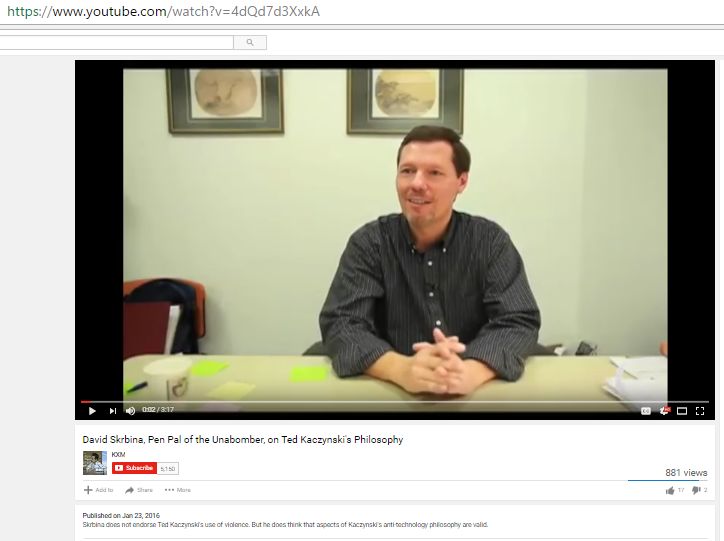
In an interview published on August 21, 2015, under the title: "Catching Up With the Unabomber. When Does the End Justify the Means?" Skrbina said that he had corresponded with Kaczynski, via mail, since 2003. Skrbina claimed that he had received “something over 100 letters” from Kaczynski — the last one sent in 2014. In another interview, which appears to have taken place in 2012, but was published on YouTube on January 23, 2016, Skrbina said that he had received 150 letters from Kaczynski.
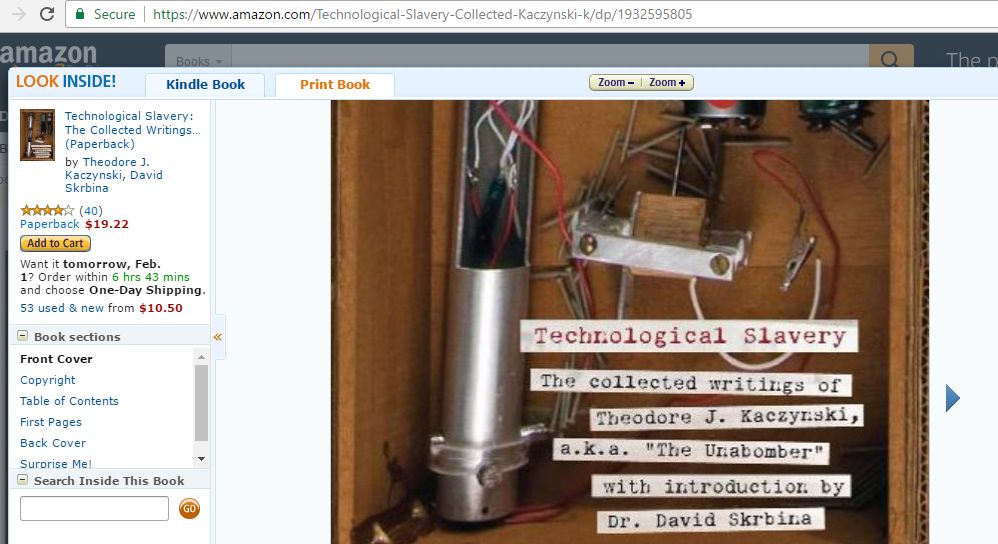
Skrbina authored the introduction to Kaczynski’s 2010 book, titled "Technological Slavery," and Skrbina’s name appeared on the cover of the book.
Skrbina is a professor of Philosophy at the University of Michigan-Dearborn (UM-Dearborn). He has written extensively on technology’s role in modern life and promotes the views of the Unabomber to his students, as shown below.
Skrbina received his Ph.D. from the University of Bath in the United Kingdom in 2001. He graduated from the University of Michigan, Ann Arbor, in 1993 with a master’s degree in Mathematics.
Skrbina is a supporter of the anti-Israel Boycott, Divestment and Sanctions (BDS) movement.
Exalting the Unabomber
On January 23, 2016, Skrbina said Kaczynski was possibly a "prophet and potentially a kind of savior of humanity and the planet" for promoting the idea that “only the most radical action against the system can protect us” from technology taking over humanity.
Kaczynski murdered three people and injured another 23 between 1978 and 1995, with letter bombs. He also attempted, unsuccessfully, to blow up a passenger airliner in 1979. Kaczynski was arrested in 1996 and was sentenced to eight life sentences, in 1998.
According to Skrbina, the purpose of Kaczynski’s terrorism was to get "leverage to force the publication" of his credo — known as the Unabomber Manifesto — in major newspapers (2:23). Skrbina called the Manifesto a “rational argument against technology” (1:17) and also claimed to have exchanged over 150 letters between himself and Kaczynski since 2003.
Skrbina said that Kaczynski is "portrayed as a radical" (0:57) but is part of a long line of “radical” (1:00) critics of technology, therefore “when I teach my course, I put Kaczynski in the mainstream of these technological critics” (1:05). Skrbina praised Kaczynski for having a “larger cause which was a noble cause” (2:40) to alert society that the “technological system is a kind of mortal threat” (2:51).
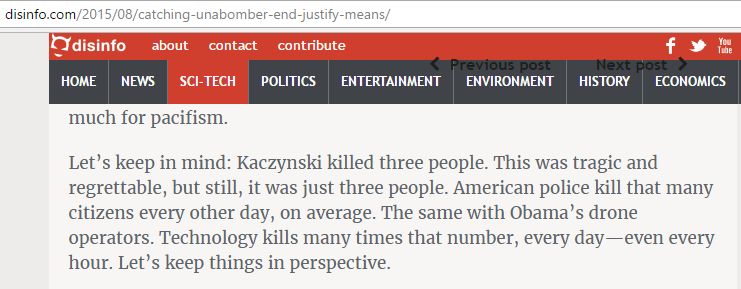
In an August 21, 2015, interview Skrbina excused Kaczynski’s tactics — blurring the difference between victims targeted by letter bombs and individuals killed at crime scenes across the U.S. or targeted in war zones. Skrbina stated: "Let’s keep in mind: Kaczynski killed three people. This was tragic and regrettable, but still, it was just three people. American police kill that many citizens every other day, on average. The same with Obama’s drone operators. Technology kills many times that number, every day—even every hour. Let’s keep things in perspective."
Pushing BDS
Skrbina has been pushing BDS among faculty at the university since as early as 2006.
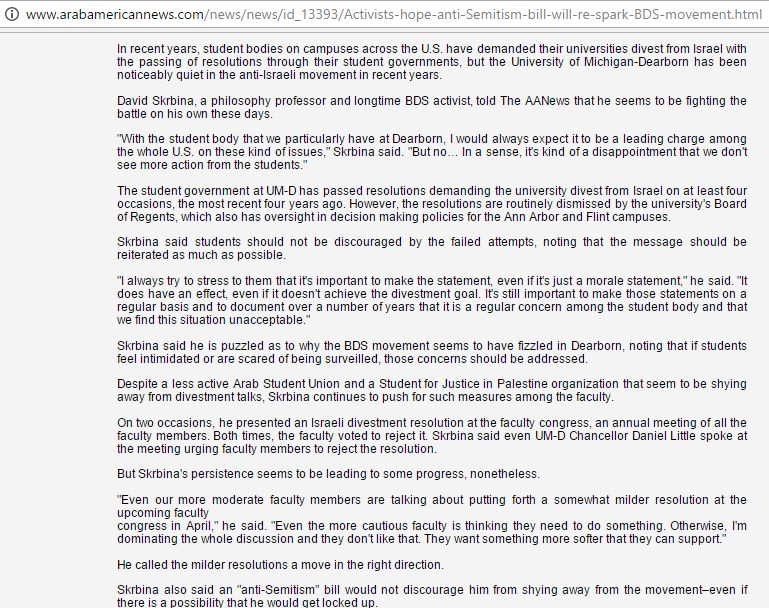
On December 15, 2016, Skrbina said that he twice introduced BDS resolutions to the UM-Dearborn Faculty Congress (FC), which meets once a year. Both times, the resolutions were rejected and Skrbina faced opposition from the university chancellor. Skrbina also spoke on behalf of a faculty BDS resolution at the FC in 2014. Skrbina said he plans on introducing another BDS resolution at the FC meeting in April 2017.
Although the UM-Dearborn student government passed BDS resolutions five times since 2005 — most recently in 2014, when Students for Justice in Palestine (SJP) at UM-Dearborn authored a resolution — Skrbina expressed his "disappointment" that student-led anti-Israel BDS activity had declined on the campus in recent years.
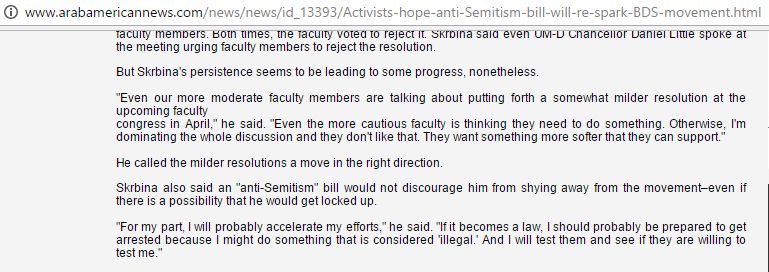
Skrbina also condemned the "Anti-Semitism Awareness Act of 2016," embraced by both Republicans and Democrats in response to the rise of anti-Semitic incidents attending BDS activity.
Skrbina said: "For my part, I will probably accelerate my efforts. If it becomes a law, I should probably be prepared to get arrested because I might do something that is considered 'illegal.' And I will test them and see if they are willing to test me."
BDS
The Boycott, Divestment, Sanctions (BDS) movement was founded by Omar Barghouti in 2005 to challenge “international support for Israeli apartheid and settler-colonialism.” BDS is an allegedly “Palestinian-led movement,” although leading BDS activists have admitted [00:01:01] this is not true.
One of the demands of BDS includes [point 3] what is generally known as the “right of return,” a demand discredited as a way to eliminate Israel. Barghouti said the “right of return” is a means to “end Israel’s existence as a Jewish state.”
Barghouti has said that BDS “aims to turn Israel into a pariah state, as South Africa once was.”
In his activism, Barghouti has also said [00:05:55] regarding Israel: “Definitely, most definitely, we oppose a Jewish state in any part of Palestine. No…rational Palestinian, not a sellout Palestinian, will ever accept a Jewish state in Palestine.”
The movement has been linked to numerous terrorist organizations and received a public endorsement from Hamas in 2017.
BDS initiatives include calling on institutions and individuals to divest from Israeli-affiliated companies, promoting academic and cultural boycotts of Israel, and organizing anti-Israel rallies, protests and campaigns.
The movement’s most notable achievement has been the infiltration of university campuses through lobbying for “BDS resolutions.” In these cases, student governments and student groups, backed by their own anti-Israel members and affiliates, have proposed resolutions on some form of boycott of, or divestment from, Israel and Israeli-affiliated entities.
Boycott resolutions, although non-binding, have been passed by student governments on numerous North American campuses.
BDS activity is often aggressive and disruptive. It has been noted that universities that pass BDS resolutions see a marked increase in anti-Semitic incidents on campus. On one campus, when the student government debated a BDS resolution, reports emerged of violent threats against those opposing it.
Social Media and Weblinks
University Website:https://umdearborn.edu/users/skrbina
- Status:
- Professor
- University:
- Michigan-Dearborn
- Organizations:
- BDS
- Related Profiles:
- Nesreen Mattar,
- Last Modified:
- 05/04/2026
Photos & Screenshots