Lucas Fleisher
Overview
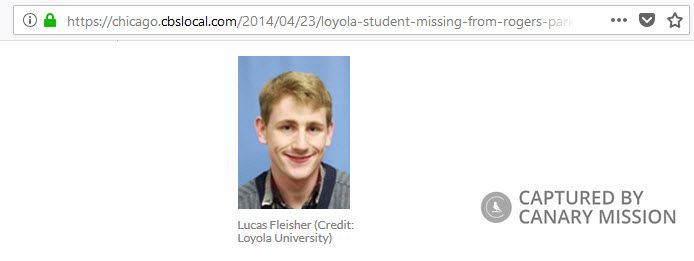
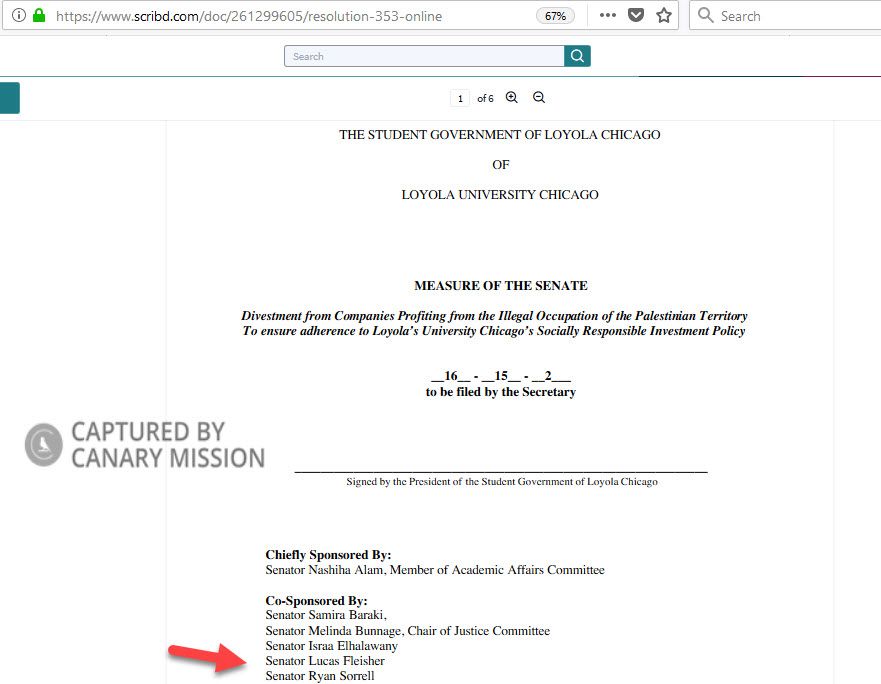
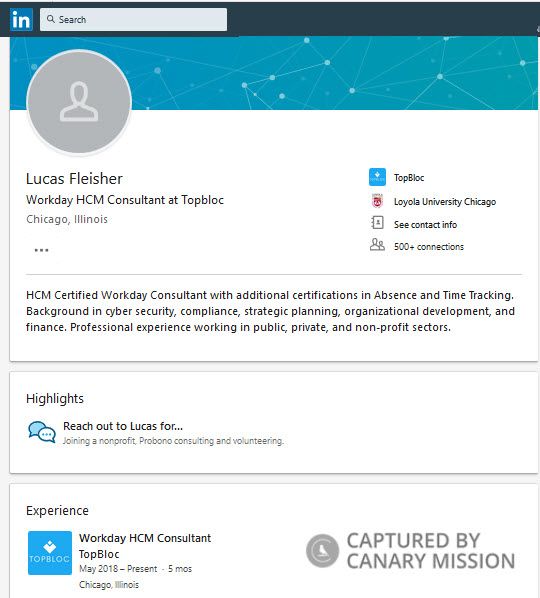
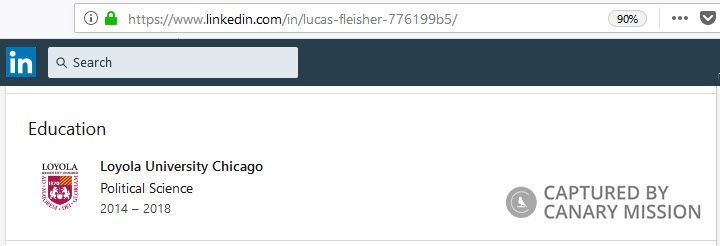
Lucas Fleisher [Lucas David Fleisher] co-sponsored a Boycott, Divestment, Sanctions (BDS) movement resolution at Loyola University Chicago (Loyola), where he served as a student senator, in 2015.As of September 2018, Fleisher’s LinkedIn page said he graduated from Loyola in 2018, with a bachelor’s degree in Political Science. As of the same date, his LinkedIn said Fleisher became a “Workday HCM Consultant” at TopBloc in Chicago, in May 2018.
BDS Activism
In 2015, Fleisher co-sponsored a Loyola Divestment resolution titled “Divestment from Companies Profiting from the Illegal Occupation of the Palestinian Territory To ensure adherence to Loyola’s University Chicago’s Socially Responsible Investment Policy.The resolution resolved to urge the Loyola’s Chief Investment Office to collaborate with “students, faculty and staff” and to divest from “corporations profiting from human rights violations committed against the Palestinian people.”
The resolution invoked the 2005 Palestine civil society call for BDS, and quoted the media outlet Al Jazeera, claiming that “Israel had been buying and ‘weaponizing’ Caterpillar bulldozers then using them to demolish Palestinian homes, build settlements and the separation wall, clear land to build Jewish-only roads, uproot olive and fruit trees, and carry out military operation. [sic].
Garanzini’s letter decried the divestment resolution as a divisive, harmful and ineffective way to conduct discourse about the situation in Israel and the Palestinian territories.
BDS
The Boycott, Divestment, Sanctions (BDS) movement was founded by Omar Barghouti in 2005 to challenge “international support for Israeli apartheid and settler-colonialism.” BDS is an allegedly “Palestinian-led movement,” although leading BDS activists have admitted [00:01:01] this is not true.
One of the demands of BDS includes [point 3] what is generally known as the “right of return,” a demand discredited as a way to eliminate Israel. Barghouti said the “right of return” is a means to “end Israel’s existence as a Jewish state.”
Barghouti has said that BDS “aims to turn Israel into a pariah state, as South Africa once was.”
In his activism, Barghouti has also said [00:05:55] regarding Israel: “Definitely, most definitely, we oppose a Jewish state in any part of Palestine. No…rational Palestinian, not a sellout Palestinian, will ever accept a Jewish state in Palestine.”
The movement has been linked to numerous terrorist organizations and received a public endorsement from Hamas in 2017.
BDS initiatives include calling on institutions and individuals to divest from Israeli-affiliated companies, promoting academic and cultural boycotts of Israel, and organizing anti-Israel rallies, protests and campaigns.
The movement’s most notable achievement has been the infiltration of university campuses through lobbying for “BDS resolutions.” In these cases, student governments and student groups, backed by their own anti-Israel members and affiliates, have proposed resolutions on some form of boycott of, or divestment from, Israel and Israeli-affiliated entities.
Boycott resolutions, although non-binding, have been passed by student governments on numerous North American campuses.
BDS activity is often aggressive and disruptive. It has been noted that universities that pass BDS resolutions see a marked increase in anti-Semitic incidents on campus. On one campus, when the student government debated a BDS resolution, reports emerged of violent threats against those opposing it.

- Status:
- Professional
- University:
- Loyola
- Organizations:
- BDS
- Related Profiles:
- Nashiha Alam,
- Last Modified:
- 05/04/2026
Photos & Screenshots