Igor Sadikov
Overview
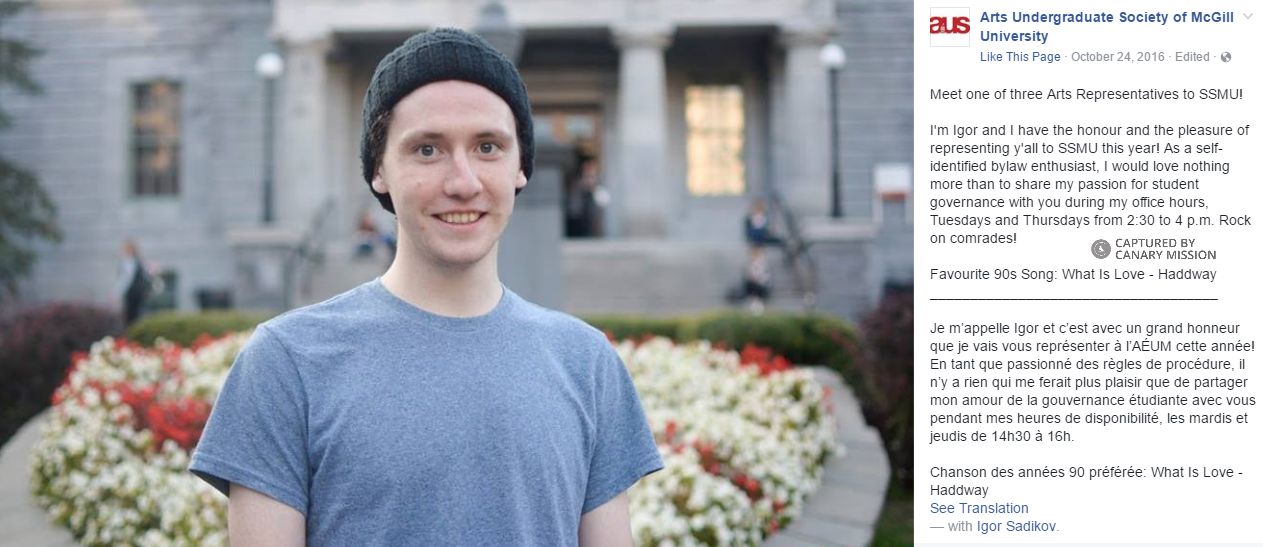
As of July 2023, Sadikov wrote on Facebook that he lived in Montreal, Quebec, Canada.
Hatred of Zionists
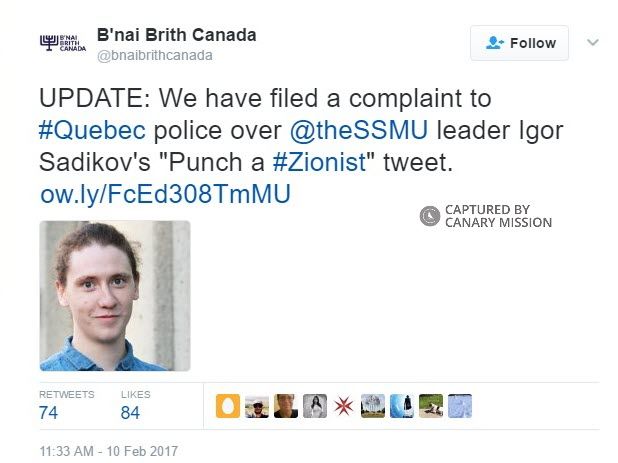
On February 6, 2017, Sadikov tweeted: “punch a zionist today,” reportedly in reference a “punch a Nazi” meme which circulated online at that time.Sadikov’s tweet was condemned as anti-Semitic incitement to violence and sparked calls for his resignation.
On February 9, 2017, Sadikov issued a statement on Facebook defending his tweet, which he claimed was “not an attack against Jewish students” but rather opposition to “the adherents of a political philosophy… one which, as Jewish people, we should not support.”
Sadikov wrote that Zionism was “an ideology that I oppose, in the same way that I oppose colonization and dispossession in Canada, the United States, and elsewhere in the world.”
Zionism is the belief that Jews have the right to self-determination in their own national home, and the right to develop their national culture.
Sadikov also wrote: “Given my own Jewish heritage, I believe that we must continue to disentangle Jewish identity from Zionism.”
Following his February 9 statement, Sadikov liked a comment from a supporter on his Facebook page, who offered to “punch one [Zionist] for you if your position does not allow you to.”

On February 9, 2017, the McGill administration condemned Sadikov’s February 6th“punch a zionist today” tweet, noting that it violated school policies.
The same day, McGill’s AUS formally requested Sadikov’s resignation “due to his encouragement of violence” and a motion to impeach Sadikov failed to pass on February 22, 2017.
On February 13, 2017, Suzanne Fortier, then principal and Vice Chancellor of McGill, issued a statement expressing her “shock” at Sadikov’s tweet.
On February 23, 2017, Sadikov resigned from the SSMU Board of Directors after he was formally censured for his post.
On March 8, 2017, Sadikov resigned from his position as arts representative on the Students’ Society of McGill University (SSMU) legislative council.He cited mental health reasons.
Anti-Israel Activism (SPHR, BDS)
On February 22, 2016, McGill BDS Network proposed a motion to the SSMU to demand the university withdraw investment from “corporations that profit from the occupation.” The motion was endorsed by SPHR and 19 other student groups at McGill. The vote passed 512 to 357, in support of BDS.
On February 27, 2016, the BDS initiative lost a subsequent online ratification vote by 57 to 43 percent. Following the announcement of the vote, McGill Principal and Vice-Chancellor Suzanne Fortier issued a statement to the university opposing BDS.
On February 23, 2015, Sadikov attended an event co-hosted by SPHR McGill and the SSMU titled: “Boycotting Apartheid States: A Panel on BDS.” The event featured McGill pro-BDS professors Jon Soske and Michelle Hartman.
On September 25, 2014, Sadikov participated in an SHPR panel discussion promoting BDS at McGill. The event was titled: “SPHR's First General Meeting - featuring McGill Professor Panel on BDS.”
The event’s Facebook description said: “5 McGill professors from across faculties to discuss the BDS movement and why they support boycotting Israel.”
Panelist and Associate Professor of Arabic Literature Michelle Hartman said [00:00:34] she wanted to think about how to change Canada’s "firmly Pro Israel, pro-Zionist" foreign policy. She stressed her special interest in working [00:00:50] against the idea of “normalization" and in implementing “Palestinian Civil Society’s Call for Boycott, Divestment and Sanctions against Israel," especially the boycott of Israeli universities.
Another panelist, Associate Professor of Islamic History Rula Abisaab insisted [00:03:29] that the only "non-violent option" available was “the boycott of Israeli academic institutions [and] Israeli academics."
SJP
SJP is a student organization engaged in anti-Israel activity on North American college and university campuses.
The first chapter of SJP was founded in 2001 at the University of California at Berkeley by Professor Hatem Bazian. Bazian has spread classic anti-Semitism, reportedly promoted religious anti-Semitism and defended the Hamas terror group. In 2004, Bazian called for “intifada” in America.
SJP organizes anti-Israel campaigns, including running annual Israel Apartheid Weeks, often in collaboration with Jewish Voice for Peace (JVP) and Muslim Students Association (MSA) campus chapters.
SJP has been a major force in pushing the anti-Semitic Boycott, Divestment, Sanctions (BDS) movement on campuses. Chapters have initiated dozens of BDS resolutions in student governments, which have been proposed on or around Jewish holidays, a time when many Jewish students are off-campus.
SJP activists have reportedly physically assaulted, intimidated and harassed Jewish students, disrupted pro-Israel campus events and demonized pro-Israel campus organizations.
Chapters have often endorsed and campaigned for numerous terrorists and whitewashed terrorism.
BDS
The Boycott, Divestment, Sanctions (BDS) movement was founded by Omar Barghouti in 2005 to challenge “international support for Israeli apartheid and settler-colonialism.” BDS is an allegedly “Palestinian-led movement,” although leading BDS activists have admitted [00:01:01] this is not true.
One of the demands of BDS includes [point 3] what is generally known as the “right of return,” a demand discredited as a way to eliminate Israel. Barghouti said the “right of return” is a means to “end Israel’s existence as a Jewish state.”
Barghouti has said that BDS “aims to turn Israel into a pariah state, as South Africa once was.”
In his activism, Barghouti has also said [00:05:55] regarding Israel: “Definitely, most definitely, we oppose a Jewish state in any part of Palestine. No…rational Palestinian, not a sellout Palestinian, will ever accept a Jewish state in Palestine.”
The movement has been linked to numerous terrorist organizations and received a public endorsement from Hamas in 2017.
BDS initiatives include calling on institutions and individuals to divest from Israeli-affiliated companies, promoting academic and cultural boycotts of Israel, and organizing anti-Israel rallies, protests and campaigns.
The movement’s most notable achievement has been the infiltration of university campuses through lobbying for “BDS resolutions.” In these cases, student governments and student groups, backed by their own anti-Israel members and affiliates, have proposed resolutions on some form of boycott of, or divestment from, Israel and Israeli-affiliated entities.
Boycott resolutions, although non-binding, have been passed by student governments on numerous North American campuses.
BDS activity is often aggressive and disruptive. It has been noted that universities that pass BDS resolutions see a marked increase in anti-Semitic incidents on campus. On one campus, when the student government debated a BDS resolution, reports emerged of violent threats against those opposing it.
Social Media and Weblinks
Facebook:https://www.facebook.com/igorsdvTwitter:https://twitter.com/goldenlentils [Deleted]
twitter.com/vokidas
GitHub:https://github.com/igorsdv
YouTube:https://www.youtube.com/user/vokidas
McGill Daily:https://www.mcgilldaily.com/author/igor-sadikov/
Muck Rack:https://muckrack.com/igor-sadikov

- Status:
- Professional
- University:
- McGill
- Organizations:
- BDS,
- SPHR
- Related Profiles:
- Michael McCauley,
- Last Modified:
- 05/04/2026
Photos & Screenshots