Anas Shakra
Overview
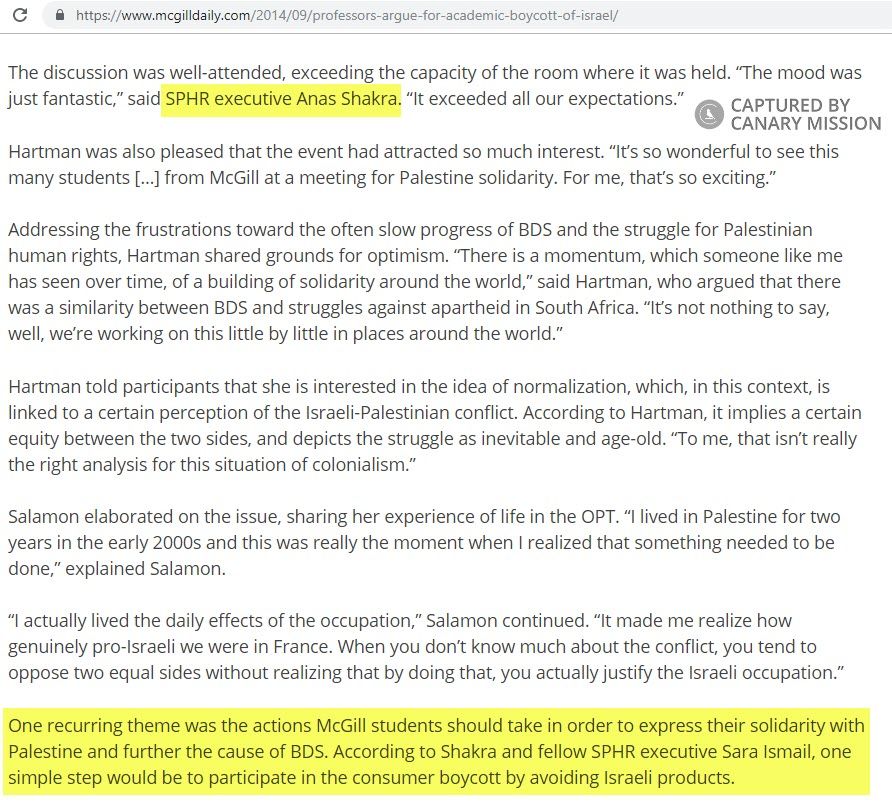
Anas Shakra promoted Boycott, Divestment, Sanctions (BDS) campaigns at McGill University (McGill) and was a Solidarity for Palestinian Human Rights (SPHR) executive at McGill in 2014. SPHR is an affiliate of Students for Justice in Palestine (SJP).As of July 2019, Shakra’s LinkedIn page said he was working since May 2019 as a Software Developer Intern for Ericsson, in Montreal, Canada.
As of July 2019, Shakra’s online resume said he was slated to graduate from Concordia University (Concordia) with a “BEng in Computer Engineering” in 2020 and had graduated from McGill University with a bachelor’s degree in Economics in 2014.
Shakra’s LinkedIn page said that he completed a Bachelor’s Degree in Computer Engineering from Concordia in 2019.
He also completed a hands-on Aircraft Familiarization Training program on airplanes and helicopters at Concordia in 2016.
Supporting BDS
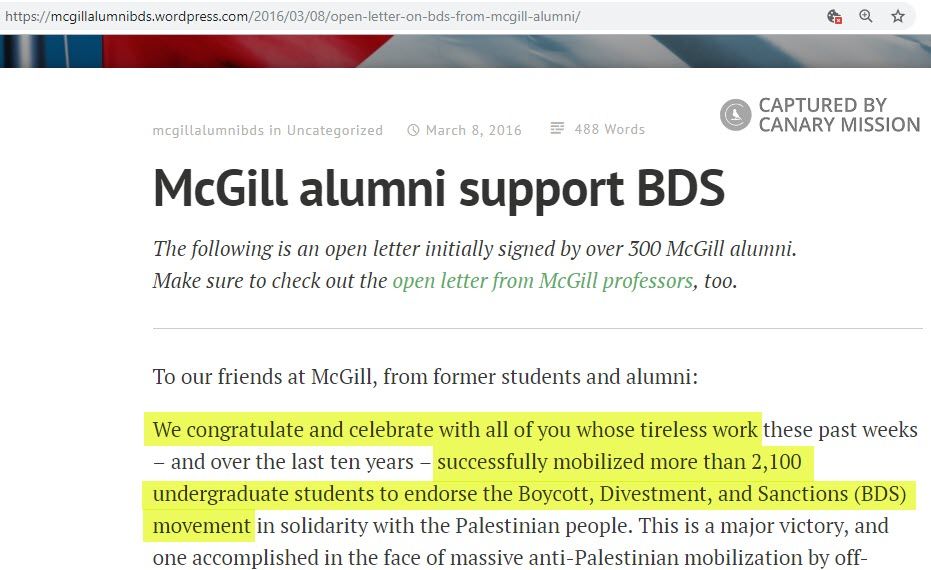
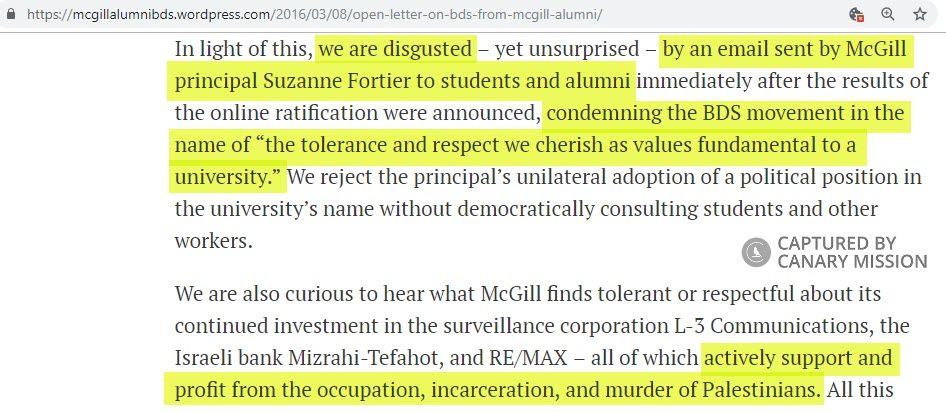
Shakra signed a March 8, 2016 letter, titled: “McGill alumni support BDS.” The letter said: “We congratulate and celebrate with all of you whose tireless work… successfully mobilized more than 2,100 undergraduate students to endorse the Boycott, Divestment, and Sanctions (BDS) movement.”The letter also stated: “we are disgusted” by an email sent from McGill principal Suzanne Fortier to students and alumni that condemned BDS “in the name of ‘the tolerance and respect we cherish as values fundamental to a university.’”
The letter went on to list companies that it alleged “actively support and profit from the occupation, incarceration, and murder of Palestinians.”
Shakra indicated on Facebook that he “went” to a February 16, 2016 McGill BDS panel discussion with Montreal anti-Israel organizers Mostafa Henaway and Zahia El-Masri. During the discussion, Henaway accused [00:29:46] Israel of “countless massacre after countless massacre” and claimed [00:30:21] that Gazans were denied access to medicine, “reconstruction materials” and “their waters.”
Henaway also referred [00:31:44] to a Palestinian wave of violence that began in the previous year as “popular struggle” born of “desperation.”
In October 2015, there was an upsurge in violence across Israel incited by Palestinian political and religious leaders. The wave of stabbings, known as the “Knife Intifada,” was characterized by young Palestinians throughout the country stabbing and attempting to stab Israeli civilians.
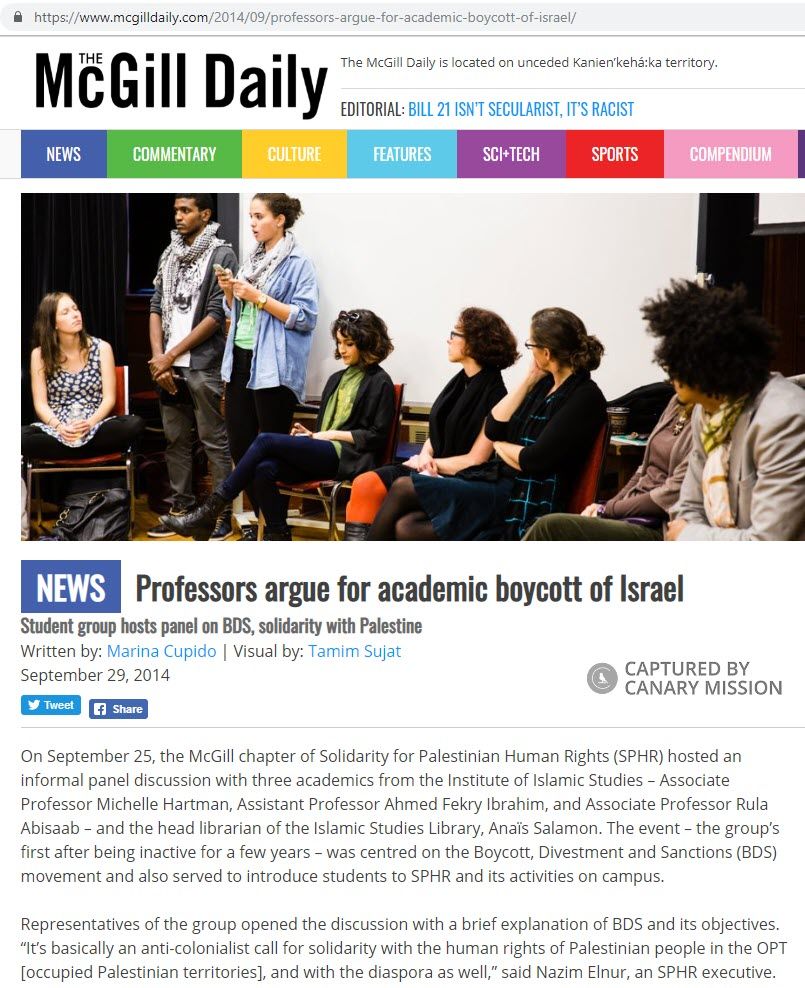
On September 25, 2014, Shakra co-organized an SPHR event, reportedly “the group’s first after being inactive for a few years,” to promote BDS and “to introduce students to SPHR and its activities on campus.”
The panel event was co-organized with McGill SPHR executive, Nazim Elnur and featured three professors from the university’s Institute of Islamic Studies and the then-head librarian of the Islamic Studies Library.
One of the panelists at the event, Associate Professor of Arabic Literature, Michelle Hartman, said [00:00:03] she wanted people to think about how to change Canada’s “firmly pro-Israeli, pro-Zionist foreign policy” at a governmental or grassroots level.
Hartman also expressed [00:00:04] her interest in working against the idea of “normalization” between Israelis and Palestinians and in answering [00:01:17] “the call from Palestinian Civil Society” for BDS, saying [00:01:31] Palestinian “universities have asked for an academic boycott” of Israeli universities.
Another panelist, Associate Professor of Islamic History, Rula Abisaab, said [00:03:28] “the only way you can move out of helplessness is actually to collectively support the boycott of academic institutions in Israel… Israeli academics… they have to feel the burden.” She also dismissed [00:05:08] charges that BDS is a “violent, discrimination [sic], anti-Semitic, whatever against Israel.”
In an interview following the event, Shakra stated [00:07:35] that BDS at McGill was aimed at cutting McGill’s academic research links with Israeli universities.
McGill BDS
On February 22, 2016, McGill BDS proposed a divestment motion to the General Assembly of the Student’s Society of McGill University (SSMU), the third time in 18 months, demanding the University withdraw investment from Israeli companies, including Mizrahi-Tefahot Bank, L-3 Communications and Re/Max.The motion passed 512 to 357, in support of BDS, but pending online ratification that required 2,200 votes for a quorum.
On February 25, 2016, it was reported that BDS supporters targeted Jewish students opposed to the vote, filling their social media with anti-Semitic remarks, such as “Little Zionist jewboys not happy that McGill students don’t support their genocide.”
It was reported that one campaigner voting against the bill said he knew at least 10 students who “sought counselling to help with intolerable situations.” It was also reported that a student was “followed home and verbally harassed” and another student contacted police regarding an attempted hack to his Facebook page.
On February 27, 2016, the BDS initiative lost the subsequent online ratification vote by 57 to 43 percent. Following the announcement of the vote, McGill Principal and Vice-Chancellor Suzanne Fortier issued a statement to the University community “to explain why the University’s administration continues to steadfastly oppose the BDS movement, of which this motion is a part.”
Fortier’s statement said: “The BDS movement, which among other things, calls for universities to cut ties with Israeli universities, flies in the face of the tolerance and respect we cherish as values fundamental to a university. It proposes actions that are contrary to the principles of academic freedom, equity, inclusiveness and the exchange of views and ideas in responsible, open discourse.”
Two similar BDS motions were voted down at McGill in March 2015 and October 2014. On March 15, 2015, SPHR presented SSMU with a motion calling for McGill to boycott five corporations conducting business in Israel. The motion failed by 64 votes, after an intense 45-minute debate.
On October 22, 2014, a BDS motion was shelved indefinitely by the McGill University undergraduates’ association at its general assembly.
Prior to the 2014 vote, the SPHR campaign to promote the resolution featured a pro-BDS panel discussion. Though the panel discussion pushed for an academic boycott of Israel, this was not included in the final McGill Divestment motion.
McGill Demonizing Israel
On February 18, 2016, McGill BDS hosted a screening of short films that the Facebook event page described as: “From checkpoints in the West Bank to the aftermath of the 2014 Israeli assault on the Gaza Strip.”One of the films, “Echoes of Beit Hanoun,” focused on buildings destroyed in Gaza during the course of Operation Protective Edge (OPE) in 2014. Israel commenced OPEin July 2014, to stop rocket fire targeting Israeli civilians and to destroy Hamas attack tunnels.
Hamas's deployment of human shields during OPE was extensively documented and publicized, including firing rockets from civilian areas in Gaza. Hamas encouraged Gazans to act as human shields to frustrate Israeli efforts to avoid Palestinian civilian casualties.
BDS
The Boycott, Divestment, Sanctions (BDS) movement was founded by Omar Barghouti in 2005 to challenge “international support for Israeli apartheid and settler-colonialism.” BDS is an allegedly “Palestinian-led movement,” although leading BDS activists have admitted [00:01:01] this is not true.
One of the demands of BDS includes [point 3] what is generally known as the “right of return,” a demand discredited as a way to eliminate Israel. Barghouti said the “right of return” is a means to “end Israel’s existence as a Jewish state.”
Barghouti has said that BDS “aims to turn Israel into a pariah state, as South Africa once was.”
In his activism, Barghouti has also said [00:05:55] regarding Israel: “Definitely, most definitely, we oppose a Jewish state in any part of Palestine. No…rational Palestinian, not a sellout Palestinian, will ever accept a Jewish state in Palestine.”
The movement has been linked to numerous terrorist organizations and received a public endorsement from Hamas in 2017.
BDS initiatives include calling on institutions and individuals to divest from Israeli-affiliated companies, promoting academic and cultural boycotts of Israel, and organizing anti-Israel rallies, protests and campaigns.
The movement’s most notable achievement has been the infiltration of university campuses through lobbying for “BDS resolutions.” In these cases, student governments and student groups, backed by their own anti-Israel members and affiliates, have proposed resolutions on some form of boycott of, or divestment from, Israel and Israeli-affiliated entities.
Boycott resolutions, although non-binding, have been passed by student governments on numerous North American campuses.
BDS activity is often aggressive and disruptive. It has been noted that universities that pass BDS resolutions see a marked increase in anti-Semitic incidents on campus. On one campus, when the student government debated a BDS resolution, reports emerged of violent threats against those opposing it.
Social Media and Weblinks
Facebook:https://www.facebook.com/814990242LinkedIn: https://www.linkedin.com/in/anas-shakra-3581b16a/

- Status:
- Student
- University:
- McGill,
- more...
- Organizations:
- BDS,
- SPHR (SJP)
- Related Profiles:
- Michael McCauley,
- Last Modified:
- 05/04/2026
Photos & Screenshots