Ray Hill-Cristol
Overview
Ray Hill-Cristol [Ray Nathan Hill-Cristol] supported two Boycott, Divestment, Sanctions (BDS) resolutions on behalf of the Jewish Voice for Peace (JVP) chapter at the Claremont Colleges (Claremont), in 2019 and 2021.Claremont is a consortium of five undergraduate colleges and two graduate colleges sharing a campus in Claremont, California. Claremont is also known as “5Cs” or “7Cs.”
On July 21, 2021, Hill-Cristol was listed as the Vice President and primary contact on the 5C JVP roster webpage. The chapter is also known as Claremont JVP.
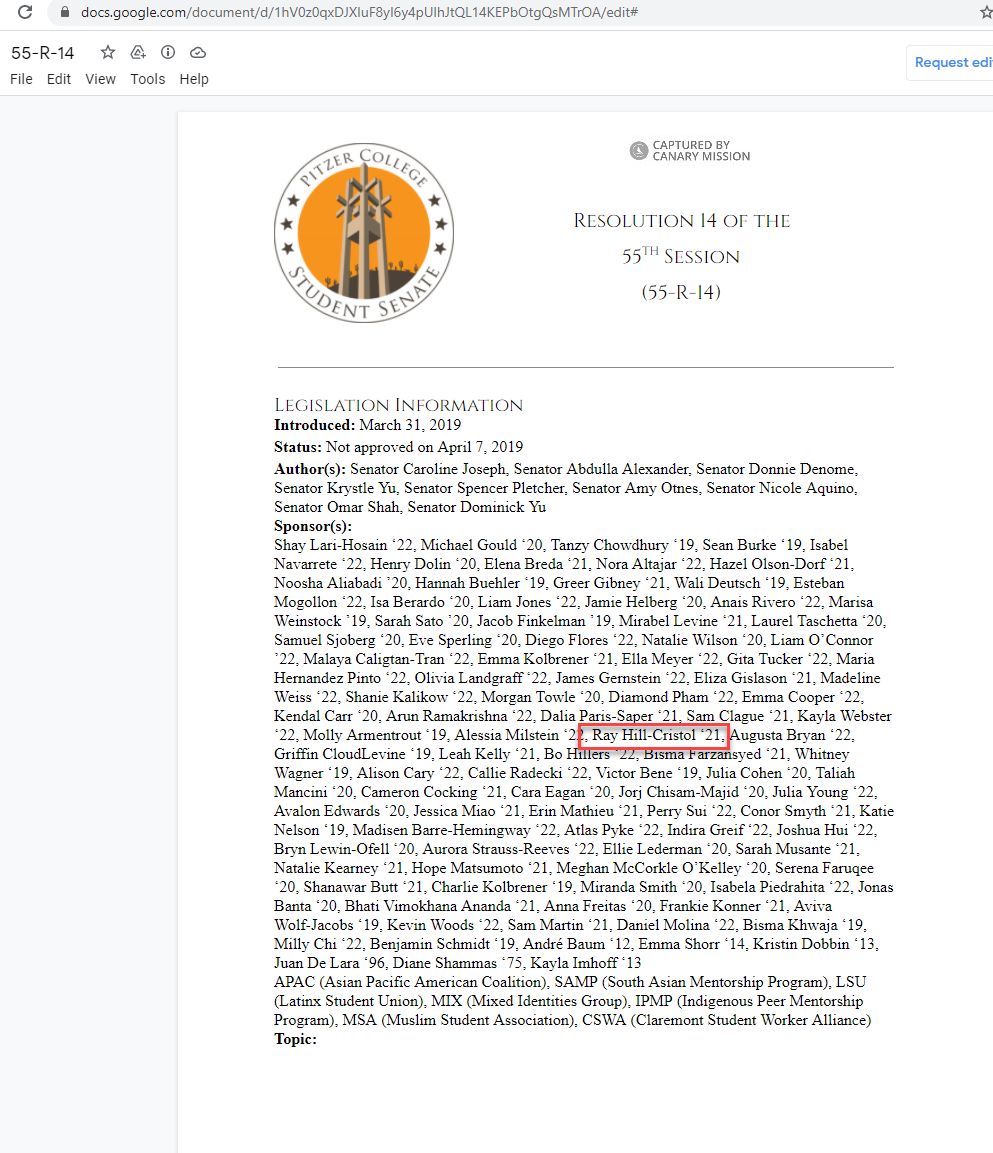
In March 2019, Hill-Cristol co-sponsored a Pitzer College (Pitzer) Student Senate resolution promoting BDS. Pitzer is one of five undergraduate colleges at Claremont.
As of August 2021, Hill-Cristol’s LinkedIn page said he received a bachelor’s degree in “American/United States Studies/Civilization” from Pitzer in 2021.
Hill-Cristol was listed by Pitzer as a 2020-21 Napier Fellow. The Napier Initiative is a partnership between Pilgrim Place and the five undergraduate Claremont Colleges that encourages leadership for social change.
Supporting BDS at Pomona
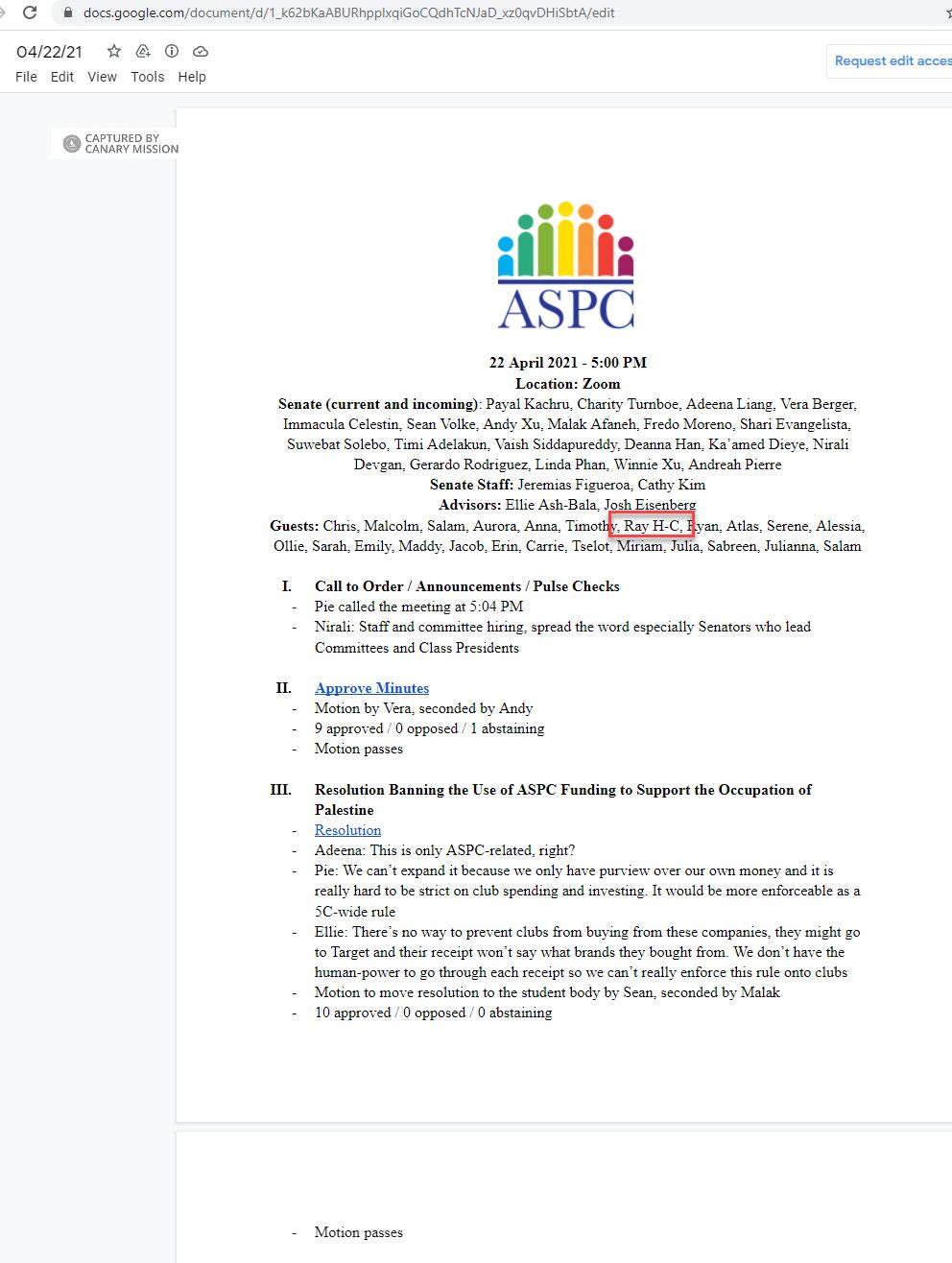
On April 29, 2021, Hill-Cristol spoke [p.5] on behalf of 5C JVP in support of a BDS resolution in the Pomona College (Pomona) student government, an undergraduate college at Claremont. Meeting minutes from that day’s Associated Students of Pomona College (ASPC) Senate hearing identified [p.5] Hill-Cristol as “Ray” where he spoke as a guest. The resolution compelled BDS compliance for the ASPC, including at its campus stores and student clubs receiving ASPC funding. 5C JVP and the campus Students for Justice in Palestine (SJP) chapter (Claremont SJP) co-sponsored the resolution. On April 15, 2021, Claremont SJP and 5C JVP introduced their resolution to the ASPC Senate that mandated ASPC compliance with BDS.The resolution was titled [p.1], “Banning the Use of ASPC Funding to Support the Occupation of Palestine” and it required [p.2] that ASPC “internal spending” could not be used on products or services from companies that “knowingly support the Israeli occupation of Palestine.”
The Claremont SJP and 5C JVP resolution cited [p.2] a list of mostly Israeli companies compiled by the United Nations Human Rights Council as a guide for which companies to boycott. ASPC internal spending includes multiple items such as funding 5C student clubs and student-run events.
The resolution created [p.2] an oversight role for Claremont SJP over the ASPC-run Coop Store and the Coop Fountain restaurant. ASPC would “work in tandem with members of SJP, and other pertinent parties, to perform an annual check on the ASPC’s businesses to ensure all goods sold adhere to the guidelines outlined in this resolution.”
The resolution also said [p.2]: “Clubs that fail to divest and/or refrain from such uses of funding would face the loss of all Claremont Colleges Student Government Association funds.” This clause effectively mandated BDS compliance even for pro-Israel and Jewish student organizations like Claremont Hillel and Claremont Chabad.
Claremont Colleges pool mandatory student activity fees and distribute the money to the 5C student governments. ASPC provides almost 47% of the funding for all 5C clubs, although each 5C student government can fund 5C clubs.
In spring 2021, ASPC gave more than $10,000 to 5C clubs. It also gave $30,000 for student-run events at Pomona that were coordinated through the ASPC’s Pomona Events Committee (PEC). The full ASPC spring 2021 budget was $216,700.
The Claremont SJP and Claremont JVP resolution also said [p.2] that ASPC’s “end goal” would be to lead other 5C student governments to pass similar BDS resolutions.
On April 22, 2021, the ASPC Senate passed the resolution with a vote of 10-0-0. Five senators were not present, representing one third of ASPC Senate’s 15 seats.
On the same day, Claremont SJP issued a press release calling the resolution’s passage “an important first step in reducing our complicity with a country that maintains an illegal military occupation and regularly commits crimes against humanity against the indigenous Palestinian population.”
On April 23, 2021, following criticism of the resolution reportedly among campus and national Jewish groups, Pomona President G. Gabrielle Starr sent an email to the student body opposing the resolution. Starr said that requiring student clubs to boycott Israel was “deeply concerning.” He said that since the vote “was held without representation from any student opposition,” the ASPC Senate should “reverse course and allow for full discussion.”
On April 29, 2021, the ASPC Senate held a Zoom meeting that included a “comment period” for student senators and student guest speakers to express their feedback on the resolution.
On April 30, 2021, the ASPC Senate reportedly decided to “table the resolution” for further discussion on the resolution’s call to deny funding to student clubs that failed to adhere to BDS.
On May 6, 2021, the ASPC Senate reportedly passed a modified resolution that omitted the original clause forcing student clubs funded by ASPC to comply with BDS.
The final resolution mandated BDS compliance for internal ASPC spending, PEC-coordinated events and the two ASPC-managed businesses. Claremont SJP also received its new oversight role regarding the compliance of ASPC businesses with the resolution.
Supporting BDS at Pitzer
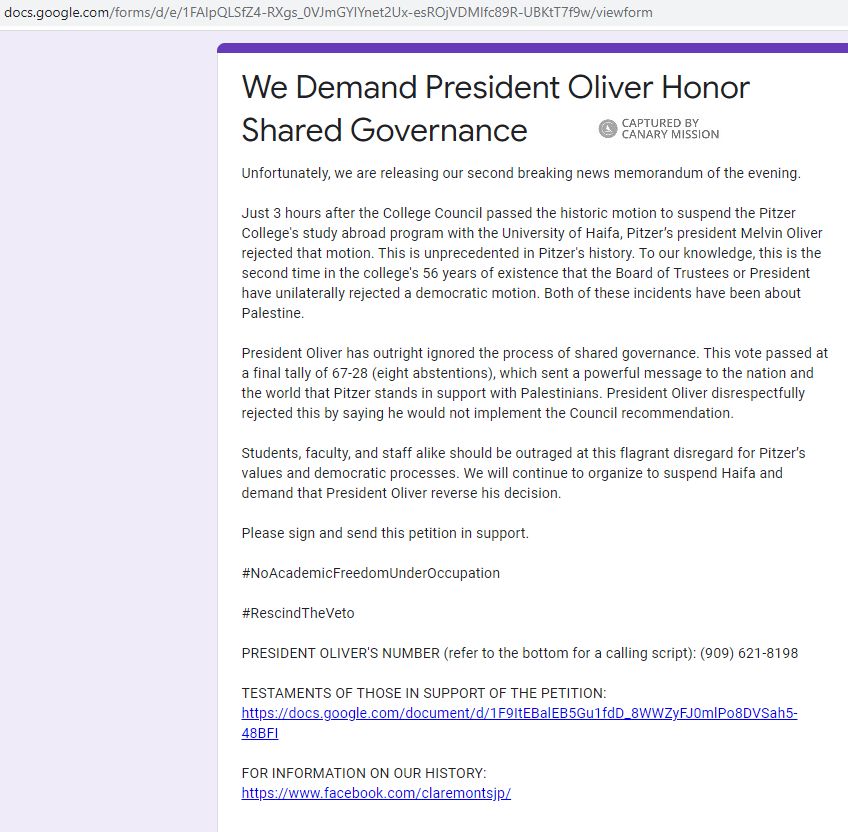
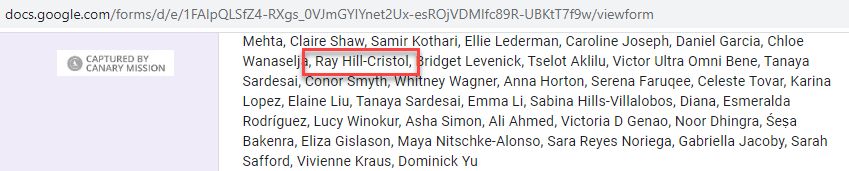
In March 2019, Hill-Cristol co-sponsored a Pitzer Student Senate resolution of “no confidence,” calling on Pitzer President Melvin Oliver to suspend the college’s semester abroad program with the University of Haifa in Israel. The resolution demanded that Oliver either resign or follow the Pitzer College Council’s recommendation to end the Haifa program.Hill-Cristol also signed a March 2019 Claremont SJP petition condemning Oliver’s veto and demanding its reversal. On November 8, 2018, Pitzer College faculty reportedly voted for a motion to suspend Pitzer’s Haifa program, which Pitzer had run since 2007. Professor Daniel Segal, the Claremont SJP and Claremont JVP faculty advisor, led the boycott campaign.The faculty motion was a non-binding recommendation to Pitzer President Melvin L. Oliver. The motion called for the “suspension of the College’s exchange with Haifa University, until (a) the Israeli state ends its restrictions on entry to Israel based on ancestry and/or political speech and (b) the Israeli state adopts policies granting visas for exchanges to Palestinian universities on a fully equal basis as it does to Israeli universities.”
After the faculty vote, the motion was sent to the Pitzer College Council (PCC), Pitzer’s “primary legislative body,” which “votes on policy recommendations forwarded by the faculty as well as committees.” The PCC includes faculty and student senators who issue recommendations to the Pitzer president. The president is then free to approve or disapprove the recommendations.
On November 18, 2018, Claremont SJP issued a statement supporting the pro-BDS faculty vote, saying that it was “imperative” to end the “deeply problematic” Haifa program. Claremont SJP also circulated a petition to the public titled, “No Academic Freedom Under Occupation,” which accused Israel of having “increasingly draconian policies” and employing a “systemic practice of racial discrimination.”
On November 29, 2018, President Oliver responded to the faculty recommendation, opposing it and calling it a “repudiation of our educational mission… an anathema to Pitzer’s core values.” Oliver also questioned the faculty in singling out Israel for special scrutiny among foreign countries like China and Nepal where Pitzer also has study abroad programs.
On March 14, 2019, the PCC passed an amended motion to end the Haifa program. Segal co-sponsored the motion along with Pitzer Professor Claudia Strauss, who served as the Chair of the Pitzer Faculty Executive Committee (FEC). Their motion was a non-binding recommendation for Oliver and it passed with 68 voting in favor, 25 against and eight abstentions.
The amended motion outlined a “uniform policy” ending study abroad programs in countries that “restrict entry on the basis of either (a) legally protected political speech or (b) race or ancestry (as distinct from citizenship).” The motion claimed that the Haifa program violated the “uniform policy” and would be suspended immediately.
Also on March 14, 2019, Oliver released a statement declining to implement the PCC motion, where he said: “By singling out Israel, the recommendation itself is prejudiced.”
In the statement, Oliver also said: “Although some claim that this is not an academic boycott of Israel, I disagree. The recommendation puts in place a form of academic boycott of Israel and, in the process, sets us on a path away from the free exchange of ideas, a direction which ultimately destroys the academy’s ability to fulfill our educational mission.”
On the same day, Pitzer’s student newspaper, The Student Life, reported: “In advance of the Haifa vote, the organization [Claremont SJP] has focused on outreach to Pitzer faculty and student senators, and on building a coalition of other campus groups.”
On March 15, 2019, Claremont SJP posted on Facebook that they would “continue to organize to suspend Haifa and demand that President Oliver reverse his decision.” Claremont SJP also posted an online petition demanding Oliver rescind his veto of the PCC motion and included the hashtag “#ProApartheidOliver.”
On March 25, 2019, Claremont SJP posted a Facebook event page for its “Palestine Freedom Weeks,” scheduled for March 25 to April 7, 2019. The event page promoted the BDS campaign against the Haifa program and used the hashtags “#SuspendPitzerHaifa” and “#MelvinWontListen.”
On March 31, 2019, the Pitzer College Student Senate, the student government,introduced two resolutions at an “Emergency Meeting” called to address the Haifa program boycott campaign.
Claremont SJP members Shay Lari-Hosain and Jorj Chisam-Majid were among the co-sponsors for the first resolution, which said: “The Pitzer College Student Senate votes no confidence in President Melvin Oliver and, if President Oliver does not retract his anti-democratic decision by the end of the day on April 11, 2019, call for his immediate resignation or removal from office.”
Pitzer Senate president Shivani Kavuluru and vice presidents Kamyab Mashian and Dawson Reckers were among the co-sponsors for the second resolution. Their resolution censured Oliver for keeping the Haifa program and demanded that Oliver reverse his veto.
On April 7, 2019, the Pitzer Senate reportedly voted down the resolution of no confidence with 12 for and 20 against. The resolution censuring Oliver passed 29-0.
5C JVP - Trivializing Anti-Semitism
On June 24, 2020, 5C JVP posted to Facebook a statement in support of Malak Afaneh, then Pomona’s senior class president, who was accused of sharing and endorsing an anti-Semitic Instagram post. The JVP statement claimed Afaneh was accused of reposting “a tweet and caption … that unintentionally delegitimized the gravity of the Holocaust … ”The prior week, Afaneh reportedly posted a graphic containing a tweet that suggested a comparison of the grave humanitarian situation in Yemen to the Nazi Holocaust. The image had a caption that suggested that Zionist Jews “hate brown ppl” and that they are “stuck-on comparing-Holocaust-to-racism WW2 [World War II]-worshipping-b**ches.” Afaneh wrote at the top of the image that the image’s text “put into words all I’ve been thinking!”
5C JVP’s statement in support Afaneh also featured a quote it said was from JVP National, calling Zionism a “settler-colonial movement” and claiming that Israel is an “apartheid state.” 5C JVP then stated: “We therefore reject Zionism and denounce all forms of state oppression and settler-colonialism.”
5C JVP - Promoting BDS
On April 21, 2021, 5C JVP co-hosted an official Pitzer College Zoom link event that featured Rabbi Ari Lev Fornari, who sits on the JVP Rabbinical Council. The event, titled “Developing a Jewish Theology of Liberation: A Conversation with Rabbi Ari Lev Fornari” included “a dialogue about Judaism, diaspora, abolition, Palestine solidarity organizing, the BDS movement, and more.”On February 6, 2020, 5C JVP shared to Facebook an event page promoting a talk by New York University Professor Andrew Ross. The event page said: “Ross is also a social activist and member of the organizing collective of USACBI, a US branch of the BDS movement.” As of October 2021, Ross was an advisory board member of the US Campaign for the Academic and Cultural Boycott of Israel (USACBI).
JVP
JVP was founded in Berkeley, California in 1996, as an activist group with an emphasis on the “Jewish tradition” of peace, social justice and human rights. The organization is currently led by Rebecca Vilkomerson and its board members include Israel critics Naomi Klein, Judith Butler, Noam Chomsky and Tony Kushner.
JVP, which generally employs civil disobedience tactics to disrupt pro-Israel speakers and events, consists of American Jews and non-Jewish “allies” highly critical of Israeli policies. A staunch supporter of the BDS movement, JVP claims to aim its campaigns at companies that either support the Israeli military (Hewlett-Packard) or are active in the West Bank (SodaStream).
Although several Jewish groups critical of Israeli policies, like J Street and Partners for a Progressive Israel, make efforts to operate within the mainstream American Jewish community, JVP functions outside. The group is often criticized for serving as a tokenized Jewish voice for the pro-Palestinian camp and is widely regarded as the BDS movement’s “Jewish wing.”
JVP denies the notion of “Jewish peoplehood” and has even gone so far as to refer to its own Ashkenazi (Jews who spent the Diaspora in European countries) leadership as “white supremacy inside of JVP.”
The Anti-Defamation League (ADL) has accused JVP of being “the largest and most influential Jewish anti-Zionist group in the United States,” and said the group “exploits Jewish culture and rituals to reassure its own supporters that opposition to Israel not only does not contradict, but is actually consistent with, Jewish value.”
The ADL also claimed that “JVP consistently co-sponsors rallies to oppose Israeli military policy that are marked by signs and slogans comparing Israel to Nazi Germany, demonizing Jews and voicing support for groups like Hamas and Hezbollah.”
According to the ADL website, JVP “uses its Jewish identity to shield the anti-Israel movement from allegations of anti-Semitism and provide it with a greater degree of legitimacy and credibility.”
BDS
The Boycott, Divestment, Sanctions (BDS) movement was founded by Omar Barghouti in 2005 to challenge “international support for Israeli apartheid and settler-colonialism.” BDS is an allegedly “Palestinian-led movement,” although leading BDS activists have admitted [00:01:01] this is not true.
One of the demands of BDS includes [point 3] what is generally known as the “right of return,” a demand discredited as a way to eliminate Israel. Barghouti said the “right of return” is a means to “end Israel’s existence as a Jewish state.”
Barghouti has said that BDS “aims to turn Israel into a pariah state, as South Africa once was.”
In his activism, Barghouti has also said [00:05:55] regarding Israel: “Definitely, most definitely, we oppose a Jewish state in any part of Palestine. No…rational Palestinian, not a sellout Palestinian, will ever accept a Jewish state in Palestine.”
The movement has been linked to numerous terrorist organizations and received a public endorsement from Hamas in 2017.
BDS initiatives include calling on institutions and individuals to divest from Israeli-affiliated companies, promoting academic and cultural boycotts of Israel, and organizing anti-Israel rallies, protests and campaigns.
The movement’s most notable achievement has been the infiltration of university campuses through lobbying for “BDS resolutions.” In these cases, student governments and student groups, backed by their own anti-Israel members and affiliates, have proposed resolutions on some form of boycott of, or divestment from, Israel and Israeli-affiliated entities.
Boycott resolutions, although non-binding, have been passed by student governments on numerous North American campuses.
BDS activity is often aggressive and disruptive. It has been noted that universities that pass BDS resolutions see a marked increase in anti-Semitic incidents on campus. On one campus, when the student government debated a BDS resolution, reports emerged of violent threats against those opposing it.
Social Media and Weblinks
Instagram: https://www.instagramHll.com/sweetbaby_rayhc [Private]LinkedIn: https://www.linkedin.com/in/ray-hill-cristol-15226019b [Deleted]
Soundcloud: https://soundcloud.com/ray-hill-cristol