Claudia Strauss
Overview
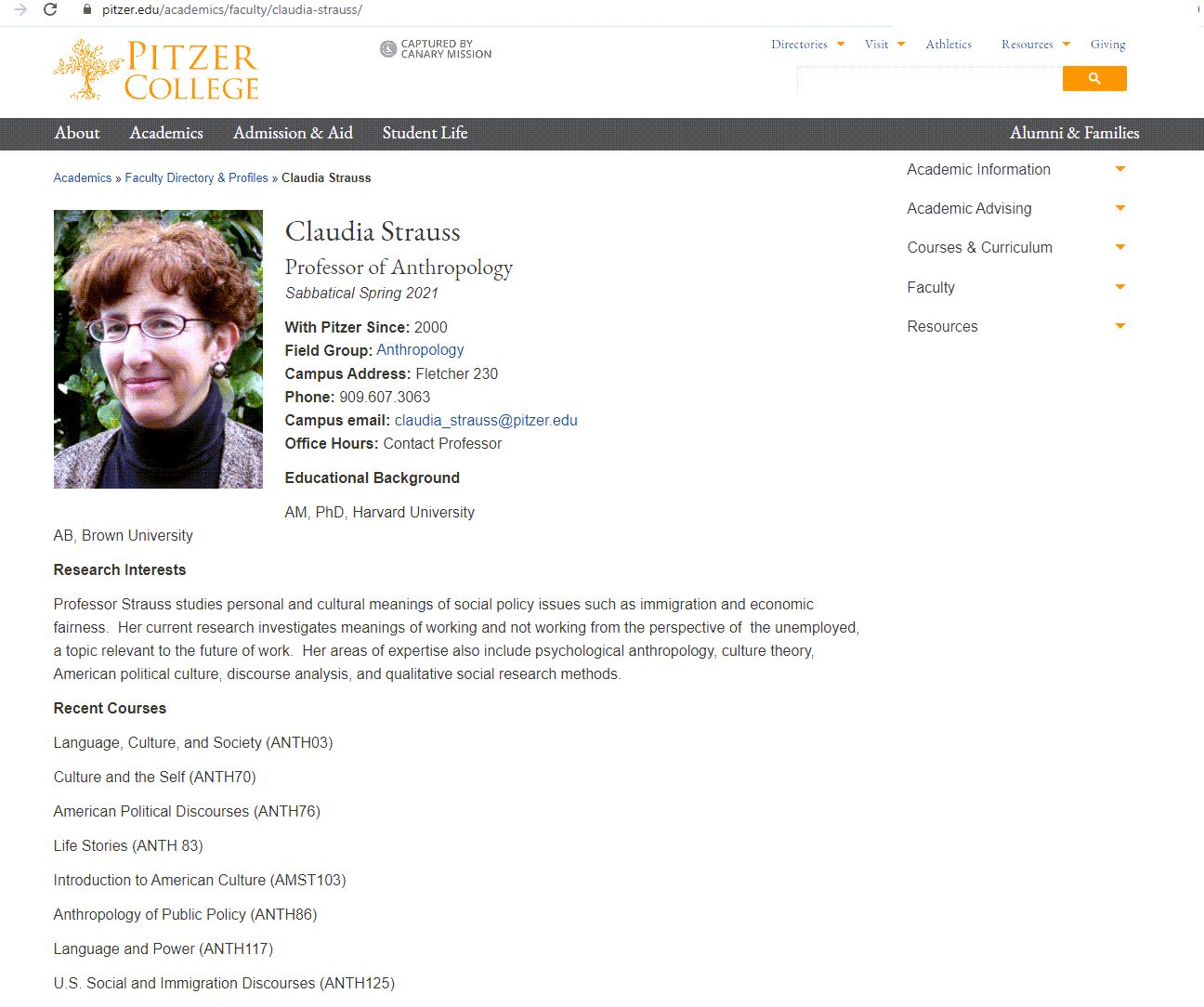
Claudia Strauss supported a Boycott, Divestment, Sanctions (BDS) campaign at Pitzer College (Pitzer) in 2018 and 2019. Strauss also organized anti-Israel activism at Pitzer.As of February 2022, Strauss’ LinkedIn page said she was a Professor of Anthropology at Pitzer, since 2000.
Pitzer is one of five undergraduate colleges and two graduate colleges that share a campus in Claremont, California. The colleges are a consortium called The Claremont Colleges (Claremont) and alternatively are known as “5Cs” or “7Cs.”
In 2019, Strauss served as the Chair of the Pitzer Faculty Executive Committee (FEC). The FEC has described itself as the “primary leadership committee for Pitzer College faculty members, designated for making final academic policy and implementing decisions to ensure the effective functioning of all college affairs.”
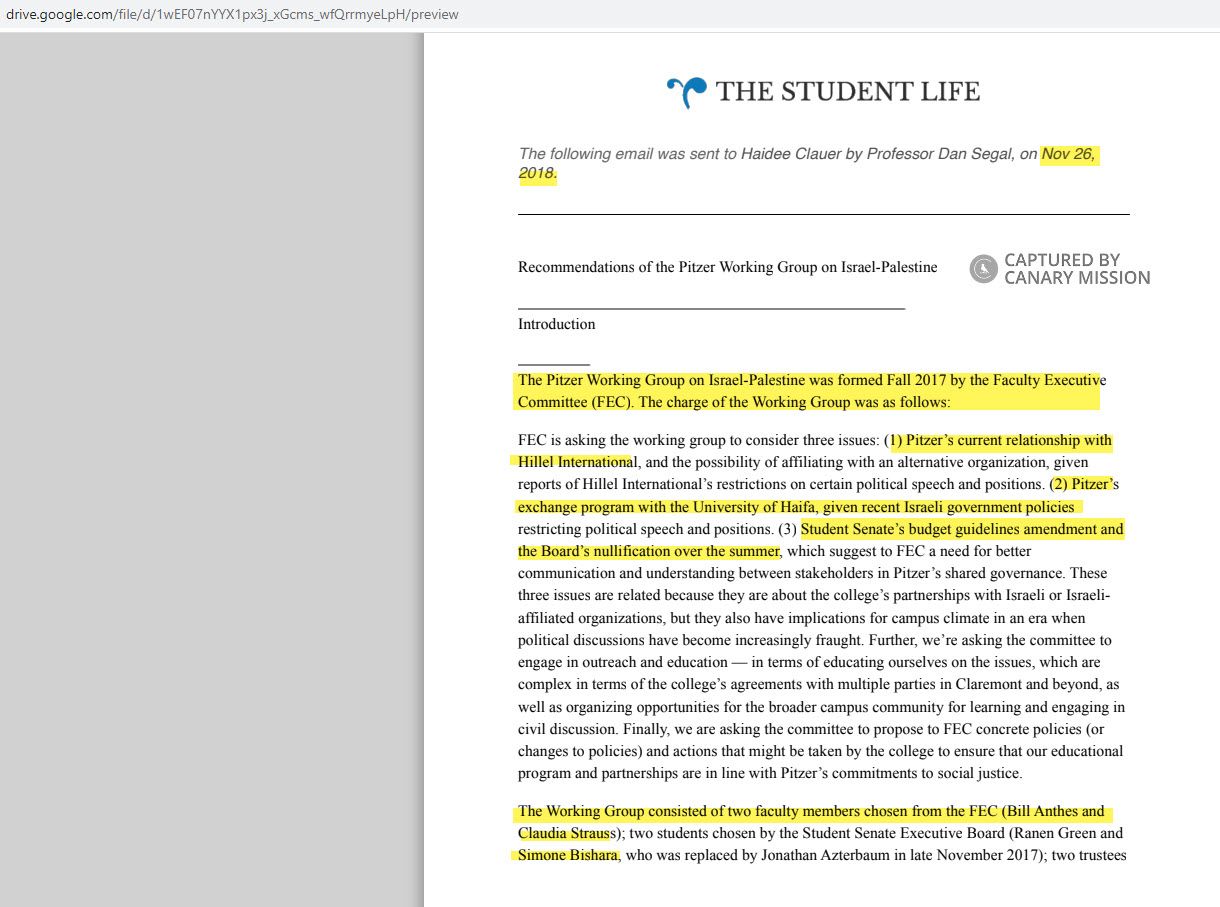
In 2017, Strauss chaired Pitzer’s “Working Group on Israel-Palestine,” which was formed by the Pitzer FEC to consider “the college’s partnerships with Israeli or Israeli-affiliated organizations.”
As of February 2022, Strauss wrote on Facebook that she lived in Claremont, California.
Supporting BDS at Pitzer
On November 8, 2018, Strauss reportedly voted in favor of a Pitzer faculty motion to suspend Pitzer’s study abroad program at the University of Haifa in Israel.The motion was reportedly brought forward by Professor Daniel Segal, the faculty advisor for the campus chapters of Students for Justice in Palestine (SJP) and Jewish Voice for Peace (JVP), Claremont SJP and Claremont JVP.
The motion called for the “suspension of the College’s exchange with Haifa University, until (a) the Israeli state ends its restrictions on entry to Israel based on ancestry and/or political speech and (b) the Israeli state adopts policies granting visas for exchanges to Palestinian universities on a fully equal basis as it does to Israeli universities.”
After the faculty vote, the motion was reportedly sent to the Pitzer College Council (PCC), Pitzer’s “primary legislative body,” which “votes on policy recommendations forwarded by the faculty as well as committees.”
Pitzer reportedly banned multiple news outlets from attending the PCC vote, including The Los Angeles Times and The Claremont Independent, which is a registered 5C club. Strauss cited “limited space” at the meeting as the reason for the ban, which excluded Claremont’s student newspaper The Student Life (TSL).
On November 29, 2018, Pitzer President Melvin Oliver rejected the faculty recommendation to cut ties with Haifa University, calling it a “repudiation of our educational mission” and “anathema to Pitzer’s core values.”
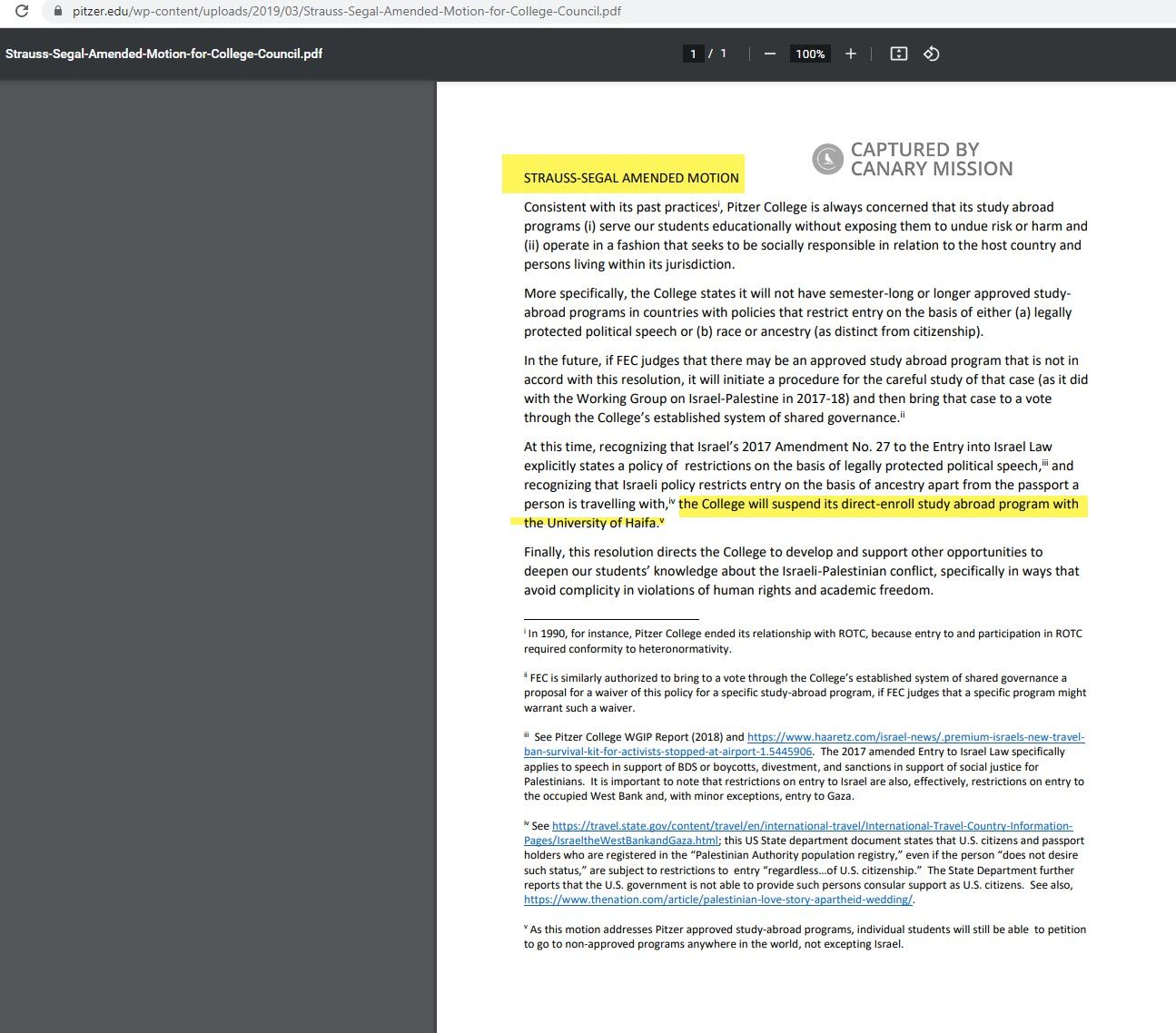
In March 2019, Strauss co-sponsored an amended motion with Segal, again seeking to suspend Pitzer’s Haifa program.
The amended motion outlined a “uniform policy” to end study abroad programs in countries that “restrict entry on the basis of either (a) legally protected political speech or (b) race or ancestry (as distinct from citizenship).” The motion claimed that the Haifa program violated the “uniform policy” and would be suspended immediately.
On March 14, 2019, Strauss reportedly participated in the PCC vote on the motion, which passed. Following the vote, Strauss reportedly praised student speakers who commented at the meeting in favor of the Haifa boycott.
Also on March 14, 2019, President Oliver released a statement declining to implement the PCC motion, where he said: “I am refusing to permit Pitzer College to take a position that I believe will only harm the College...By singling out Israel, the recommendation itself is prejudiced.”
Strauss also signed a March 2019, Claremont SJP petition demanding Oliver rescind his veto of the PCC vote to suspend the Haifa program.
Organizing Anti-Israel Activism
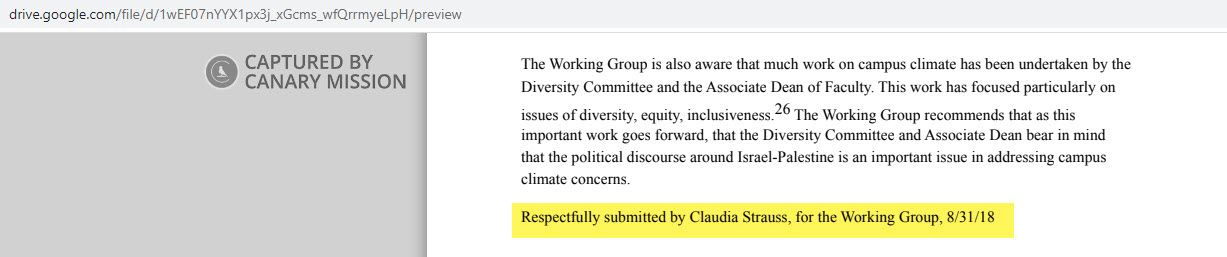
In 2017, Strauss served as the Chair of Pitzer’s “Working Group on Israel-Palestine,” which was formed by the Pitzer FEC to consider “the college’s partnerships with Israeli or Israeli-affiliated organizations.”On August 31, 2018, Strauss submitted [p.13] a report on behalf of the Working Group that addressed the school’s relationship with Claremont Hillel, which is affiliated with the global campus organization Hillel International.
The Working Group found [p.8] that Hillel International’s Standards of Partnership to be “contrary to Pitzer’s commitment to pluralism and inclusion.” The Hillel standards ban its chapters from partnering with groups that support BDS or “Deny the right of Israel to exist as a Jewish and democratic state with secure and recognized borders and/or Delegitimize, demonize, or apply a double standard to Israel.”
The International Holocaust Remembrance Alliance (IHRA) highlights as one possible contemporary example of anti-Semitism: “Denying the Jewish people their right to self-determination, e.g., by claiming that the existence of a State of Israel is a racist endeavor. Applying double standards by requiring of it a behavior not expected or demanded of any other democratic nation.”
The U.S. State Department adopted the IHRA’s working definition of anti-Semitism in 2016. Twenty-eight European countries, as well as Canada, Australia, Israel and Argentina, have also adopted the definition.
BDS
The Boycott, Divestment, Sanctions (BDS) movement was founded by Omar Barghouti in 2005 to challenge “international support for Israeli apartheid and settler-colonialism.” BDS is an allegedly “Palestinian-led movement,” although leading BDS activists have admitted [00:01:01] this is not true.
One of the demands of BDS includes [point 3] what is generally known as the “right of return,” a demand discredited as a way to eliminate Israel. Barghouti said the “right of return” is a means to “end Israel’s existence as a Jewish state.”
Barghouti has said that BDS “aims to turn Israel into a pariah state, as South Africa once was.”
In his activism, Barghouti has also said [00:05:55] regarding Israel: “Definitely, most definitely, we oppose a Jewish state in any part of Palestine. No…rational Palestinian, not a sellout Palestinian, will ever accept a Jewish state in Palestine.”
The movement has been linked to numerous terrorist organizations and received a public endorsement from Hamas in 2017.
BDS initiatives include calling on institutions and individuals to divest from Israeli-affiliated companies, promoting academic and cultural boycotts of Israel, and organizing anti-Israel rallies, protests and campaigns.
The movement’s most notable achievement has been the infiltration of university campuses through lobbying for “BDS resolutions.” In these cases, student governments and student groups, backed by their own anti-Israel members and affiliates, have proposed resolutions on some form of boycott of, or divestment from, Israel and Israeli-affiliated entities.
Boycott resolutions, although non-binding, have been passed by student governments on numerous North American campuses.
BDS activity is often aggressive and disruptive. It has been noted that universities that pass BDS resolutions see a marked increase in anti-Semitic incidents on campus. On one campus, when the student government debated a BDS resolution, reports emerged of violent threats against those opposing it.
Social Media and Weblinks
Facebook: https://www.facebook.com/claudia.strauss.98LinkedIn: https://www.linkedin.com/in/claudia-strauss-94723835/
University Website: https://www.pitzer.edu/academics/faculty/claudia-strauss/