


University of Texas Dallas Shuts Down Encampment
When sit-ins and rallies failed, protesters escalated
University of Texas Dallas Shuts Down Encampment
When sit-ins and rallies failed, protesters escalated
Share:

UT Dallas SJP Attempts Encampment
At 4:30 a.m. on May 1, 2024, anti-Israel protesters at the University of Texas at Dallas led by Students for Justice in Palestine (SJP) arrived on the university’s central outdoor mall and began constructing an illegal encampment. By the next day, the encampment consisted of about 10 tents and had gathered approximately 100 participants.
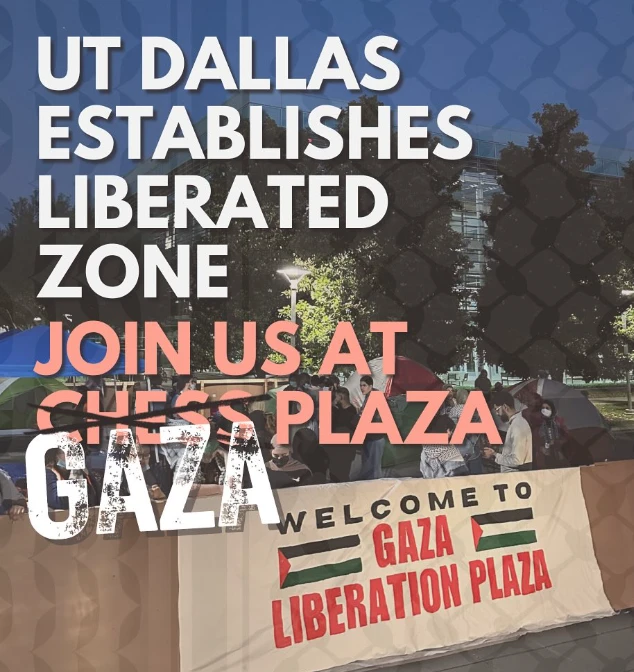
A banner, “Welcome to Gaza Liberation Plaza," announced the intention of the encampment and its demands to the university:
- Divest from corporations facilitating the war in Gaza and around the world
- Reject Texas Governor Greg Abbott’s executive order addressing antisemitism in institutions of higher learning, which singled out SJP (see below)
- Release a public statement calling for an immediate, permanent ceasefire in Gaza and denouncing the “ongoing genocidal campaign against the Palestinian people”
The same demands had been rejected by the administration in previous demonstrations and sit-ins leading up to the encampment (see below).
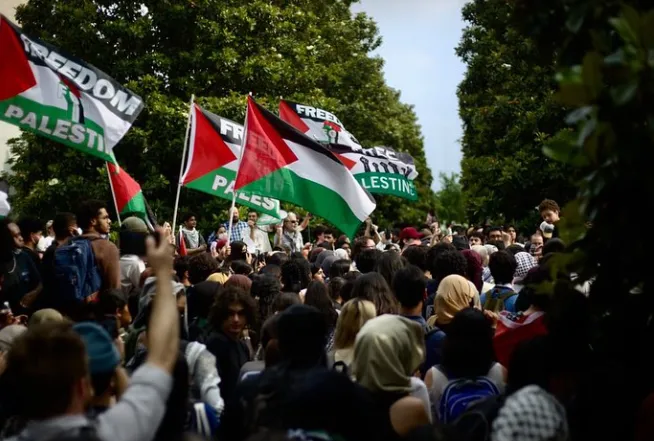
The protesters used tents, tarps, wooden structures, tires, chains and other materials to block a pedestrian walkway on Chess Plaza, located at the southern end of the mall.
Less than 12 hours later, university officials issued a statement stating that, while “individuals may peacefully assemble in the common outdoor areas of campus and exercise their right to freedom of speech,” setting up an encampment, including tents and barricades, is not permitted under UT System Policy.
The statement requested that all tents be immediately removed and warned that failure to comply could result in removal and criminal charges of trespassing. Kim Horner, a communications manager at UT-Dallas, noted that the protesters were given “the opportunity to comply.”
Throughout the day, campus police observed from a distance.
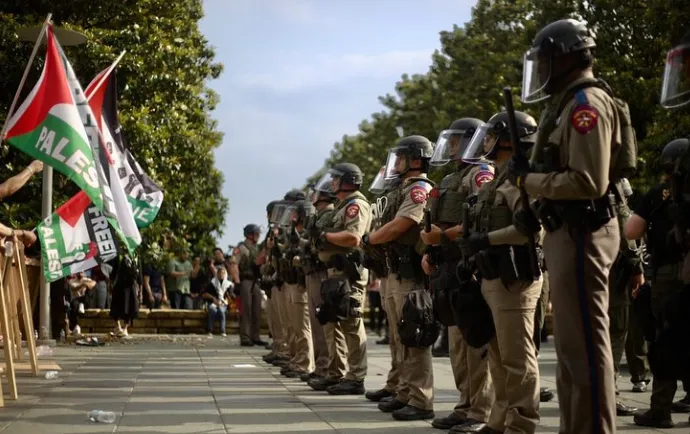
At 4 p.m., the university instructed them to disperse the crowd.
Many of the protesters dispersed, but a group of 14 sat down in an outward-facing circle, locked arms and refused repeated commands to clear the walkway. In the end, officers, with the help of county and state police, arrested 21 individuals and dismantled the encampment.
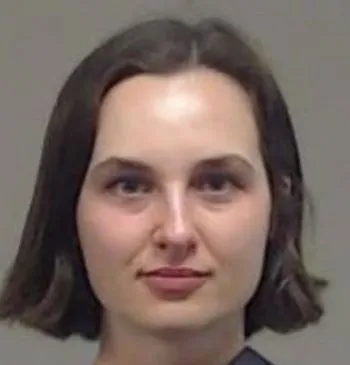
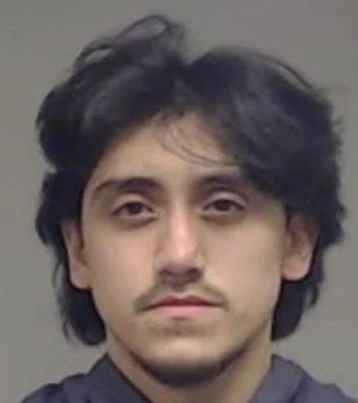
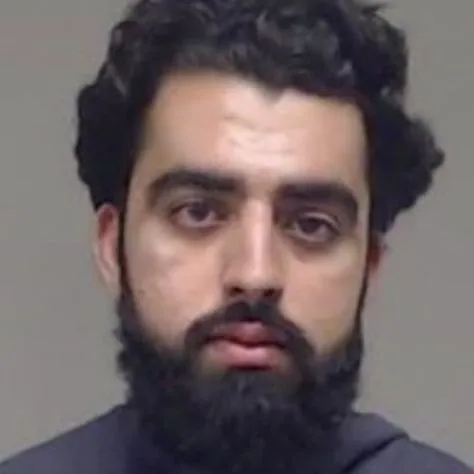
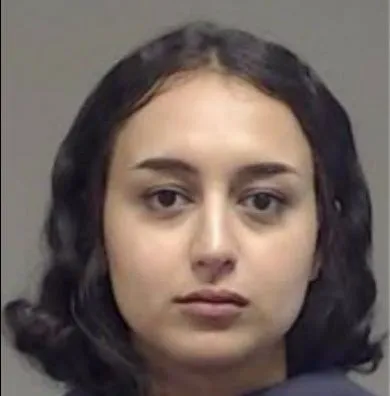
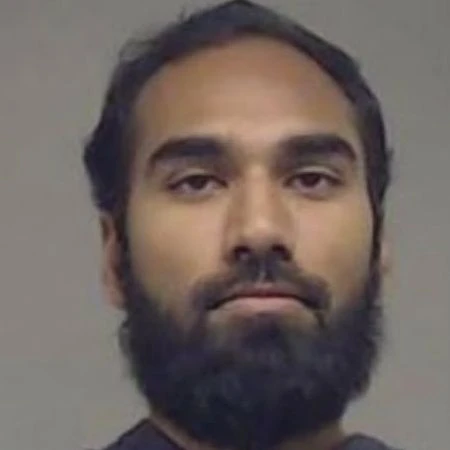
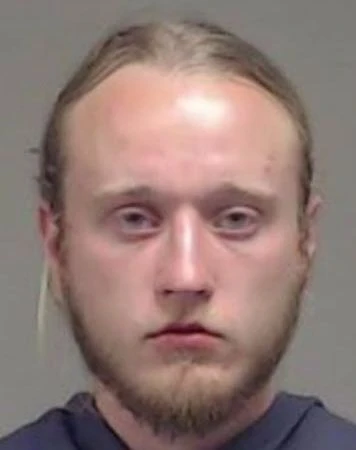
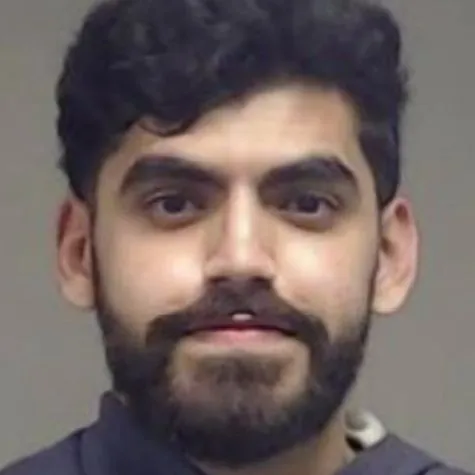
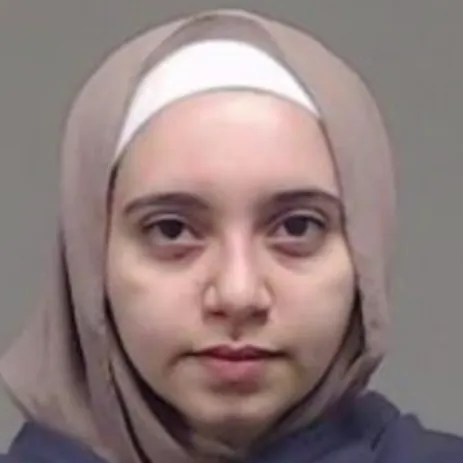
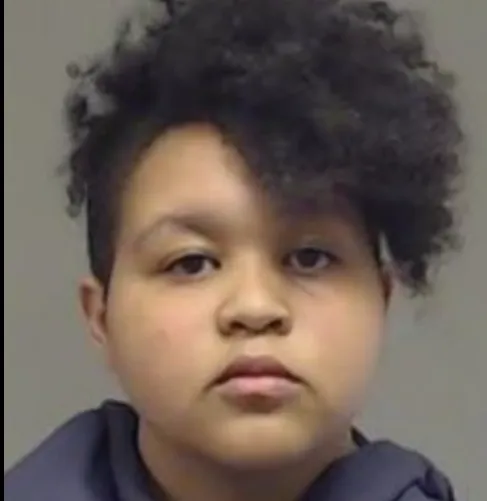
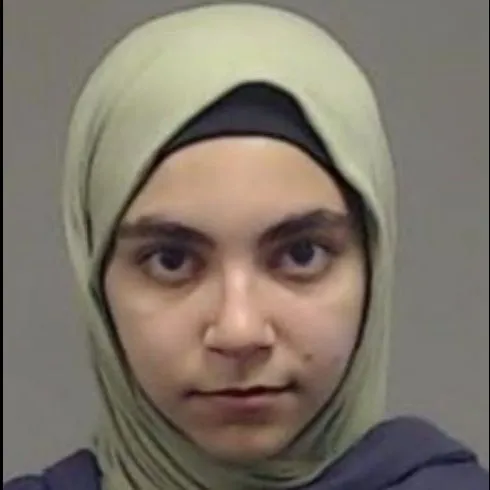
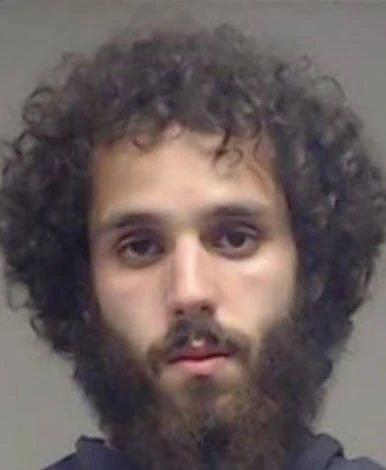
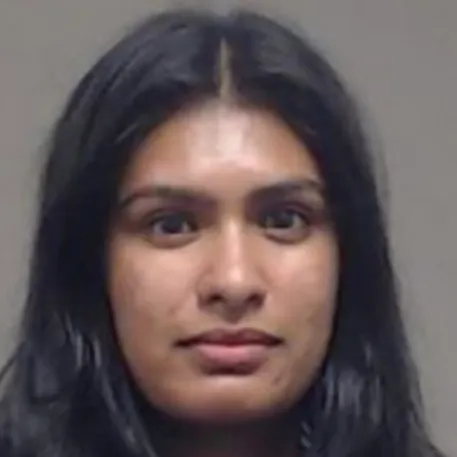
The arrestees included nine students and three faculty members. The rest were alumni and community members.
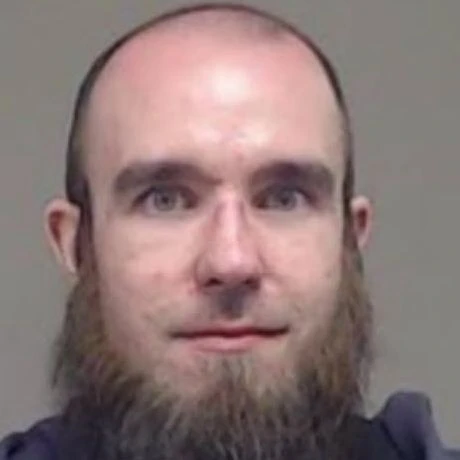
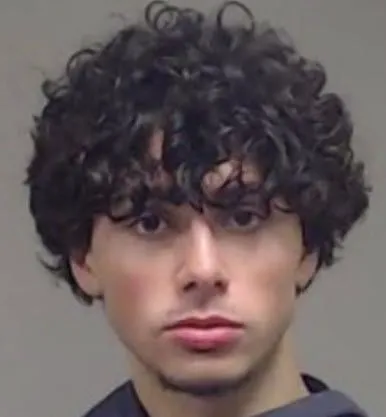
Arrestees




Criminal Charges
After spending the night in jail, all the arrestees were released the next day on bond to a jubilant group of supporters who, upon seeing the released protesters, repeatedly shouted “Allahu Akbar (God is great)!”
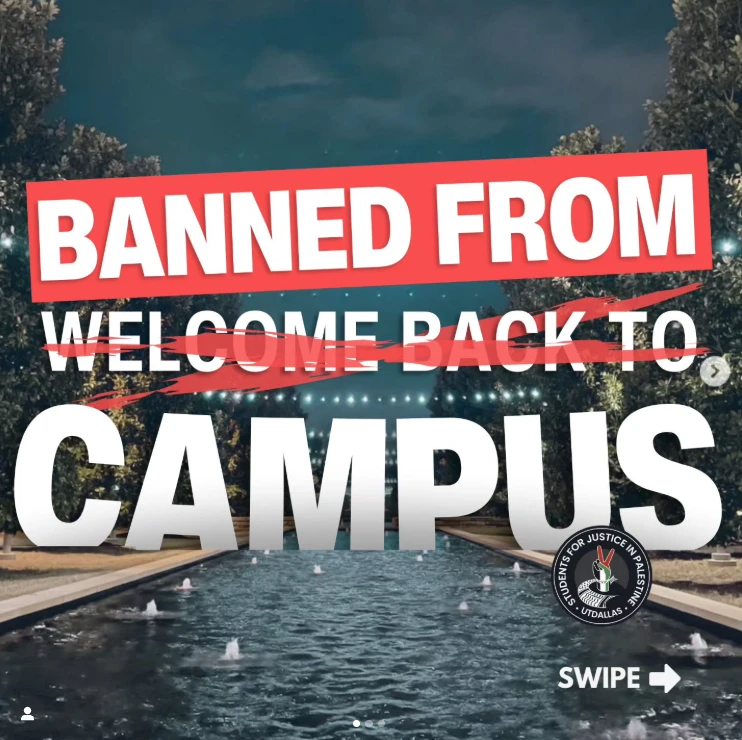
The bond conditions included being banned from campus, except for classes and class-related activities (or in the professors’ cases, work and work-related activities).
It took almost a year for the Collin County district attorney to announce that after reviewing the evidence, the cases had been presented to a grand jury, which had returned indictments for 14 people on charges of “obstruction of a passageway,” a Class B misdemeanor.
Under Texas law, if convicted, the charge is punishable by up to 180 days in jail, a fine of up to $2,000 or community supervision (probation).
While there is no publicly available information on the outcome of the individual cases (if there have been), precedent in similar cases suggests that, if convicted, the individuals would likely have been given only community supervision.
University ‘Punishments’
Students
Consequences at the university were equally lax. It appears that the harshest punishment the students received was being placed on “deferred suspension,” meaning that the suspension would only take effect if the student were found to be in violation of any other university rules during the deferred suspension period.
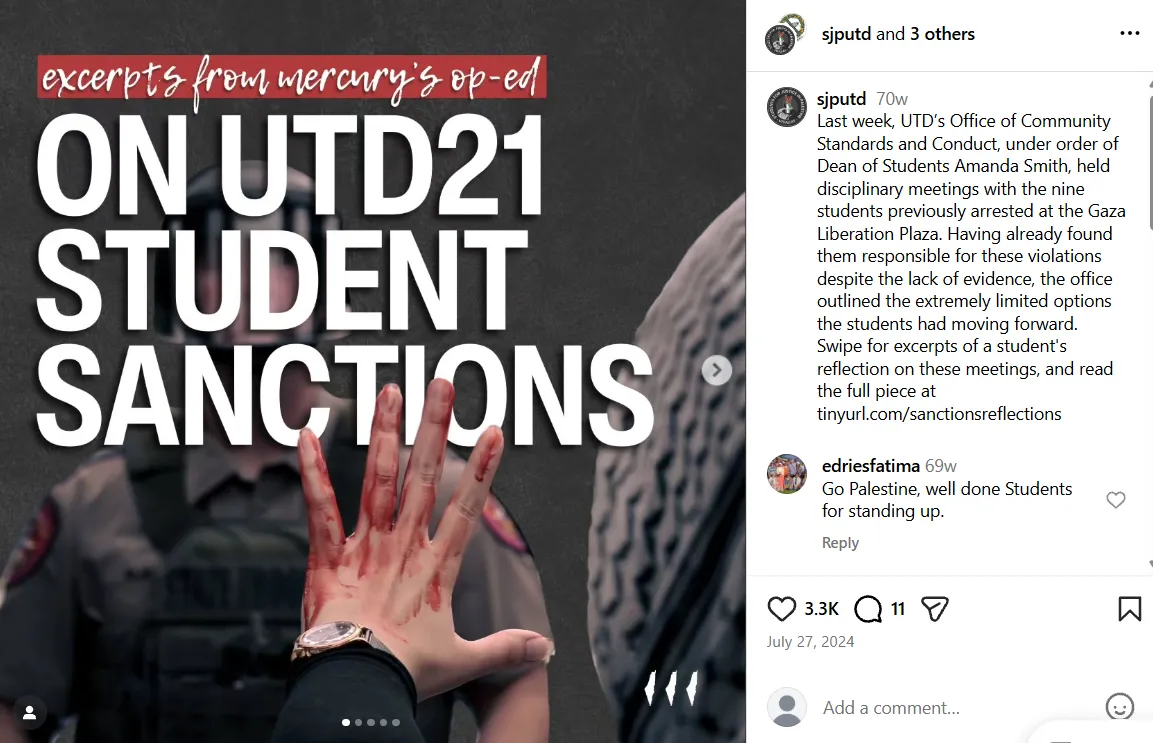
Some students may also have received a “denial of degree,” which means that a student can receive his or her degree on time, but the university may deny (for a specific amount of time) to outside parties that the student has graduated.
The university gave the arrested students three options: accept responsibility for breaking the school’s code of conduct and the accompanying punishment, accept responsibility and appeal their punishment or dispute both.
All nine students chose to dispute the allegations and their punishments; thus, during the week of July 15, 2024, the university conducted disciplinary hearings.
Although the outcomes of the hearings are not public, it appears that no students were expelled and were able to graduate on time. According to available information, here are the following outcomes:
- Mariam Lafi: Scheduled to graduate in 2027
- Imran Sitkoor: Graduated in 2024
- Faraz Sarwar: Scheduled to graduate in 2026
- Nouran Abusaad: Graduated in 2024
- Hadel Cato: Graduated in 2024
- Mousa Najjar: Graduated in 2024, despite being kicked off the stage at his graduation for waving a Palestinian flag. Najjar, who was a leading SJP activist, was escorted off campus by university police and arrested again for criminal trespass. While UTD mailed him a physical copy of his diploma, he reported that he would have “denial of degree” to third parties until at least December 2024.
- Suhaib Abdeljaber: Scheduled to graduate in 2027
- Nivedha Suresh: Scheduled to graduate in 2026. Suresh is also a UTD Student Government senator who holds the Diversity, Equity and Inclusion (DEI) Chair.
- Aliragett Barreh: Graduated with a master's degree in the history of ideas in December 2024. Barreh is currently pursuing a PhD at Georgetown University.
Professors
Beyond the initial consequence of being barred from campus except for work and work-related activities, the arrested professors appear to have received no further consequences:
- Rosemary Admiral, an assistant professor of history, is still employed as a professor by UT Dallas

Rosemary Admiral [Rosemary Grace Admiral] was arrested at the pro-Hamas encampment at the University of Texas at Dallas (UT Dallas) in May 2024.
The profilee's activism occurred during Israel’s war against Hamas in Gaza, which Israel launched after the October 7, 2023, terror attacks when Hamas murdered nearly 1,200 Israelis, injured thousands and kidnapped hundreds.
On May 2, 2024, FOX4 KDFW reported that Rosemary Admiral was arrested and charged with “misdemeanor criminal trespassing for setting up tents and barricades on the campus” at the UT Dallas encampment, which was against school policy.
The encampment was part of a national movement on college campuses in 2024, during Israel’s war against Hamas. The encampments were also in support of the Boycott, Divestment, Sanctions (BDS) movement.
The Students for Justice in Palestine (SJP) chapter at UT Dallas (SJP UTD) helped organize the encampment, which was in support of the BDS movement.
As of November 2025, Rosemary Admiral was listed as an assistant professor in the Harry W. Bass Jr. School of Arts, Humanities, and Technology at UT Dallas.
UT Dallas is located in Richardson, Texas.
- Ben Wright, a tenured associate professor of history, is still at UT Dallas. Wright was booked but was not charged. He stated that the encampment was “not a disruptive event,” but rather “an exciting opportunity for learning,” during which he shared readings on relevant subjects
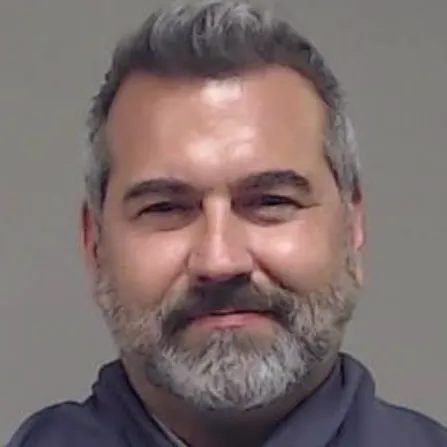
Ben Wright was arrested at the pro-Hamas encampment at the University of Texas at Dallas (UT Dallas) in May 2024.
The profilee's activism occurred during Israel’s war against Hamas in Gaza, which Israel launched after the October 7, 2023, terror attacks when Hamas murdered nearly 1,200 Israelis, injured thousands and kidnapped hundreds.
On May 2, 2024, FOX4 KDFW reported that Ben Wright was arrested and charged with “misdemeanor criminal trespassing for setting up tents and barricades on the campus” at the UT Dallas encampment, which was against school policy.
The encampment was part of a national movement on college campuses in 2024, during Israel’s war against Hamas. The encampments were also in support of the Boycott, Divestment, Sanctions (BDS) movement.
The Students for Justice in Palestine (SJP) chapter at UT Dallas (SJP UTD) helped organize the encampment, which was in support of the BDS movement.
As of November 2025, Ben Wright was listed on the UT Dallas website as an associate professor of history at the school.
UT Dallas is located in Richardson, Texas.
- Ali Asghar Alibhai, an assistant professor of art history, is still employed as a professor at UT Dallas
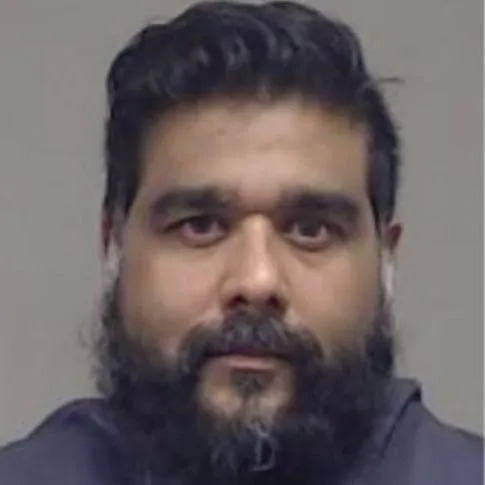
Ali Asgar Alibhai [Ali Asgar Hussamuddin Alibhai] was arrested at the pro-Hamas encampment at the University of Texas at Dallas (UT Dallas) in May 2024.
The profilee's activism occurred during Israel’s war against Hamas in Gaza, which Israel launched after the October 7, 2023, terror attacks when Hamas murdered nearly 1,200 Israelis, injured thousands and kidnapped hundreds.
On May 2, 2024, FOX4 KDFW reported that Ali Asgar Alibhai was arrested and charged with “misdemeanor criminal trespassing for setting up tents and barricades on the campus” at the UT Dallas encampment, which was against school policy.
The encampment was part of a national movement on college campuses in 2024, during Israel’s war against Hamas. The encampments were also in support of the Boycott, Divestment, Sanctions (BDS) movement.
The Students for Justice in Palestine (SJP) chapter at UT Dallas (SJP UTD) helped organize the encampment, which was in support of the BDS movement.
As of November 2025, Ali Asgar Alibhai was listed online by UT Dallas as an assistant professor in art history at the school's Harry W. Bass Jr. School of Arts, Humanities, and Technology. UT Dallas is in Richardson, Texas.
As of the same date, Ali Asgar Alibhai's LinkedIn profile said he received a PhD in Near and Middle Eastern Studies from Harvard University (Harvard) in 2018.
SJP Escalates Over Unmet Demands
Before the heinous October 7, 2023 terror attack in which Hamas terrorists murdered 1,200 Israeli men, women and children and kidnapped 250 more, anti-Israel protests at UT Dallas were relatively sporadic and low-profile.
Following October 7, there was a surge in demonstrations from UT’s SJP chapter, creating a contentious atmosphere on campus. The lead-in to the encampment occurred on April 23, 2025, when protesters staged a seven-hour sit-in in the administration building near the president’s office.
The group, organized by UT Dallas’ SJP chapter, Palestinian Youth Movement and UTD Divest, entered the building at 3 p.m. and left at 10 p.m. with the promise of a meeting with the president.
Because the group adhered to regular building hours and protest rules (no tents, no barricades, no overnight encampments or blocked passageways), the university treated the protest as permissible and not a policy violation.
While in the building, students made phone calls en masse to then UT Dallas President Richard C. Benson, the vice president of student affairs and the dean of students, attempting to force the administration to meet their demands.
Those demands consisted of the same three as at the encampment: divest from arms sales to Israel; call for a ceasefire between Israel and Hamas, and denounce the “genocide of Palestinians”; and reject Gov. Abbott’s executive order regarding antisemitism (see below).
Later that night, the administration confirmed that a meeting would be scheduled between Benson and representatives of SJP. In a statement to the press, the university said it would also meet with a Jewish student group.
During the meeting between university officials and SJP members, which occurred just a few days later, SJP members walked out when they realized their demands would not be met. Afterwards, the group expressed bitterness that the administration was unwilling to acquiesce to them, as well as outrage that the president was also meeting with a Jewish group.
“Benson was also organizing a meeting with a zionist organization, undermining the work of Palestinian and allied students and painting genocide as a two-sided issue,” SPJ said in a press release.

Governor Abbott’s Executive Order on Antisemitism
On March 27, 2024, as a result of the rampant antisemitism on college campuses, including in Texas, Governor Greg Abbott issued executive order GA-44 directing all Texas higher education institutions to:
- Review and update free speech policies to address the sharp rise in antisemitic speech and acts on university campuses and establish appropriate punishments, including expulsion from the institution
- Ensure that the policies are being enforced and that groups such as the Palestine Solidarity Committee and Students for Justice in Palestine are disciplined for violations
- Include in the definition of antisemitism Texas Government Code 448.001 to guide university personnel and students on what constitutes antisemitic speech

In response to the executive order, the UT system said it would “fully comply,” stating, “The University of Texas System is opposed to discrimination, bigotry and hatred in all forms — including antisemitism.”
In contrast, the Council on American-Islamic Relations (CAIR) condemned the order and called it “anti-Palestinian” and “blatantly unconstitutional.”