


The Price of a DSA Endorsement
The Price of a DSA Endorsement
- 1. What is a DSA Endorsement
- 2. The Weapon is a Label
- 3. The Price of Admission Only Rises
- 4. What Clears the Gate is Extreme by Design
- 5. Accountable to the Organization, not the Voters
- 6. Even their Most Famous Elected Official Can’t Clear it
- 7. What They said after They Won
- 8. The Host and the Affiliate
- 9. The Establishment Noticed the Wrong Thing
- 10. The Real Price
Share:

The Democratic Socialists of America just won a U.S. Senate nomination it didn’t endorse, and spent the same weeks deciding whether to abandon a councilwoman it already has. Both point to the same dysfunctions within the organization: a purity test that grows more severe every year, a volunteer operation dangled as ransom, and a movement whose real target is not the right wing of the Democratic Party but the progressives next door.
In the last stretch of August 2026, the Democratic Socialists of America (DSA), the largest socialist organization in American history, broke the first rule of politics: Back the candidate closest to you and claim every winner you can.
It did the opposite – twice. This behavior is not a bug in the DSA’s organizational structure; it’s a feature.
In Florida, one of its own members, state representative Angie Nixon, won the Democratic nomination for the United States Senate, the first time a DSA member has won a major-party nomination for statewide office. The National DSA had not endorsed her. She had joined the organization during the race but ran at arm’s length from it.
“I don’t believe in labels,” she told Axios.
By its own leaders’ account, the DSA neither backed the victory nor saw it coming. Meanwhile, 2,500 miles away, in Los Angeles, one of the organization’s largest chapters spent those same weeks in an anguished internal vote over whether to endorse Nithya Raman for mayor, a councilwoman it had initially helped elect but resorted to censuring in 2024.
Refuse to claim a winner; agonize over a member you already have. Such behavior reads as incoherent. Yet, it is the best way to see what a DSA endorsement actually is, and who it is really aimed at.
What is a DSA Endorsement
To the rest of American politics, an endorsement is a compliment. To the DSA, it is a contract, and the organization’s own leaders describe the terms without embarrassment.
A DSA endorsement “doesn’t mean ‘hey y’all vote for this candidate,’” wrote national committee member Cliff Connolly. “It means ‘we are going to sacrifice other work in order to spend hundreds of hours canvassing, phonebanking, and fundraising for this candidate.’ We don’t do that for capitalists.”
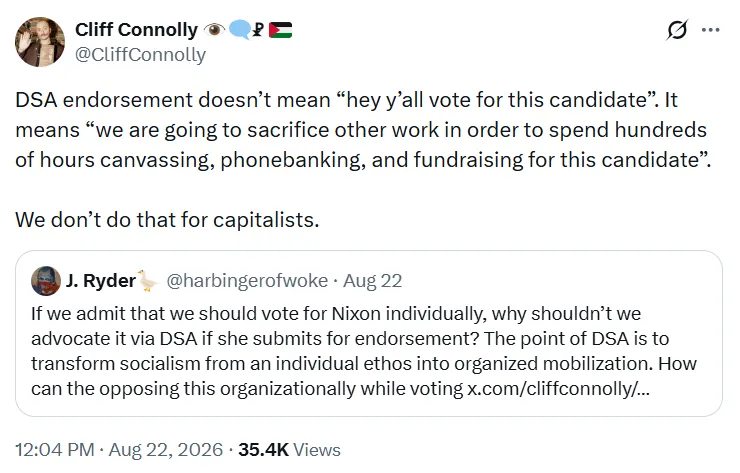
What the endorsement delivers is labor, a loan of volunteer canvassers, finite and expensive, the thing that decides a low-turnout primary. It is not sprinkled on allies. It’s an investment with an expected return.
What is that return? In a word, control. The DSA does not want friends in office. It wants what it calls, without irony, “socialists in office” – electeds bound into a pre-organized structure and expected to move as one.
One Indiana chapter put it plainly: An endorsement is “a continuing relationship of co-governance and party-building.” Moreover, the chapter wrote, “Our organization stakes its reputation and organizational capacity on the behavior of its endorsed electeds.”
NYC-DSA’s co-chair, Grace Mausser, was blunter about the point of it: A DSA elected official is “nearly useless if they aren’t using the legislative power, district services and platform to help us actually achieve our real goals.”
Candidates run on the leash and call it a virtue. One 2026 NY Assembly hopeful promised that “every move I make in Albany is going to be supported and checked by them.”
That is the deal: a loan of labor, secured by obedience, callable at will. Keep that in mind and the DSA machine begins to come into focus. First, though, the target.
The Weapon is a Label
On paper, an ordinary New York progressive and a DSA cadre candidate are nearly identical. Both talk about housing, labor, affordability, policing, Gaza and taxing the rich. You cannot separate them by their slogans or votes. The real difference is not what they believe. It is who they answer to.
A progressive answers to his district and his own conscience. A DSA candidate answers to the organization and the endorsement is how those terms are enforced. Because policy support is essentially the same, the difference is that the DSA is a brand that can be pinned on almost anyone.
Right now, the brand relies heavily on the “AIPAC” canard. Look at the race that made the DSA’s method plain. In June, in New York’s 7th Congressional District, the DSA’s Claire Valdez, a state assemblywoman backed by Mayor Zohran Mamdani and the United Auto Workers, won 58 percent to succeed the retiring Nydia Velázquez.
The man she beat by 33 percent was no conservative. He was Antonio Reynoso, the Brooklyn borough president, a lifelong progressive backed by Velázquez, the Working Families Party (WFP) and most unions.
DSA-aligned accounts cast him as a creature of the pro-Israel lobby anyway. It was false, and his own allies said so. Reynoso “has NEVER taken AIPAC money & never will,” WFP co-director Jasmine Gripper wrote; Velázquez demanded an apology for “these ridiculous and divisive attacks.”
When City & State traced the money behind the pro-Reynoso super PAC, it led to the teachers’ union, not AIPAC. The charge stuck anyway, because it was never about donors. “AIPAC” is the accusation.
The Price of Admission Only Rises
To take the endorsement is to sign on to the platform, yet with each winning cycle, the DSA demands stricter adherence than the last. The clearest proof is what it did to its own history.
The organization, co-founder Michael Harrington, built was once “the place to go on the left if you were a socialist and you were pro-Israel.” By 2025, that was an expellable offense.
At its 2025 convention, the DSA passed Resolution 22, making it grounds to expel a member or revoke an endorsement merely to say that “Israel has a right to defend itself.” The Palestine position is no longer an opinion in the DSA; it is a bylaw.
Other demands keep climbing as well. One of the movement’s own factions described this escalator without flinching. “The demand for us to condemn Hamas quickly becomes support Israel’s right to exist and then support Israel’s right to defend itself,” the Red Star caucus wrote.

An organizer who spent years pushing this line treated its arrival as a trophy: The movement had adopted “anti-Zionist redlines for electeds and members.” He called it “a win.”
The platform is, by design, hostile to the American order, which is why the bar sits so high. The platform the national committee adopted in 2026 commits the DSA to scrapping the Senate and replacing the presidency and Supreme Court with bodies “subordinate to Congress.”
National committee member Frances Gil put it plainly: “Abolish the Senate, abolish the Supreme Court, those are the things that need to happen.”
The Marxist Unity Group, a caucus with members on the national committee, campaigns to “abolish the Presidency and the Senate” and to “overthrow the Constitution.” This is the creed a candidate signs to get the loan. It is not a big tent the DSA is aiming for; rather, it is a gate. What sits behind it is purity.
What Clears the Gate is Extreme by Design
Darializa Avila Chevalier, a DSA organizer, recently beat five-term Democratic incumbent Adriano Espaillat in New York’s 13th District. Espaillat, a progressive, sat on the Congressional Progressive and Medicare for All caucuses.
When CNN’s KFile examined the deleted account of Chevalier, it found thousands of posts backing the abolition of police, prisons and borders, the seizure of private property, the nationalization of industry, and questioning Israel’s right to exist. That explains why she was the DSA candidate.
This rising litmus test behind DSA endorsements does not necessarily favor the most electable candidates. Rather, it chooses the pure, and who emerges is telling. In this case, Chevalier prevailed.
Accountable to the Organization, not the Voters
For the DSA, its endorsement’s most valuable feature is not votes but obedience, which the organization enforces in real time – even on its stars, even mid-campaign, even during the canvass. Because this “privilege” can be recalled at any time, politicians are policed while the race is still running.
Consider the movement’s own mayor. During his 2025 campaign, Mamdani said, at a forum, “I believe Israel has a right to exist” (not necessarily as a Jewish state, but “with equal rights for all”).
It is the most anodyne sentence in New York politics, but inside the DSA it was a huge problem.
A member of the national committee, Sidney Carlson White, later boasted that “MUG [Marxist Unity Group] and Emerge members had some disagreements with statements Zohran made regarding ‘Israel’s right to exist.’ We used our power as organizers to cash in our goodwill and ask that he stop saying that. We succeeded.” (MUG and Emerge are two of the more extremist internal caucuses within the DSA.)
The enforcement also reaches the rank and file. When the DSA-endorsed congressional nominee Melat Kiros went on PBS and defended Israel from a wave of antisemitism mid-campaign, with the movement’s canvassers still knocking doors for her, the base did not send a memo. It sent a mob.
She should be “condemned” for the “rhetoric,” one account demanded; another told supporters to “rage” against her in the street. Within days, she recanted, “I fumbled this line.” No committee had to act. Her own volunteers reminded her, while she was still their candidate, that she answered to them and not to the voters she was courting.
What DSA enforces is not moderation but its opposite, especially concerning its red line, anti-Zionism. For example, the Red Star caucus published an essay called “We Do Not Condemn Hamas, and Neither Should You.” The DSA’s own national statement after the October 7, 2023, attack, blamed the massacre on Israel’s “apartheid regime.”
Even their Most Famous Elected Official Can’t Clear it
DSA’s rising litmus test has produced strange results. Now, the most famous democratic socialist in America cannot satisfy her own movement and doesn’t even seem entirely sure how it works. Asked on ABC whether she remained a DSA member, Alexandria Ocasio-Cortez answered, “Of the New York City chapter.”
A friendly, DSA-covering reporter found this answer incoherent: “It makes no sense to say she’s only a member of NYC-DSA and not national DSA.”
The sticking point, again, is Palestine. When the national committee offered AOC a conditional endorsement in 2024 tied to backing the boycott of Israel and opposing military aid, she declined the terms. To avoid a public rupture, her own New York chapter asked the national committee to withdraw the request for a national endorsement altogether.
City & State accurately called it what it was, a retreat, a movement not yet ready to be seen expelling its biggest star. The pressure on AOC never lifted. New York DSA organizer Kareem Elrefai wrote in The Nation that AOC “has never addressed or apologized” for a DNC convention speech in which she praised Harris and Biden for “‘working tirelessly’ to end the genocide in Gaza.” Elrefai called the speech a betrayal, and at the 2025 DSA Convention, members filed a resolution to formally censure her and “review the membership of Alexandria Ocasio-Cortez.”
It was a fight the convention debated but did not resolve.
The same expectation that hangs over AOC now plagues LA mayoral candidate Nithya Raman. DSA-LA endorsed Raman’s council run in 2020 only to censure her in 2024 after she accepted the endorsement of Democrats for Israel-Los Angeles. Two DSA women in office, two disciplinary files, and the word at the top of each is the same – not “capitalism” but “Palestine.”
The distrust also cuts the other way. If straying gets you punished, joining late gets you doubted. Angie Nixon signed up to DSA during her campaign, but the movement never fully claimed her. The DSA is “not a cargo cult for elected officials and candidates,” Connolly ruled. “Angie Nixon is not a socialist and should not be endorsed,” clearly sending the message that a candidate can’t buy into the organization; he or she has to be built inside it.
What They said after They Won
After the June sweep, the movement’s own people said the quiet part out loud. A DSA organizer summed up Brooklyn Borough President Antonio Reynoso's race for Congress, which he lost to DSA candidate Claire Valdez: “NY-7 was almost entirely a proxy fight between DSA and WFP and DSA won.”

A DSA labor writer suggested the older party should accept life as a junior partner. Others dropped the diplomacy. “The days of the NGO left are over,” one prominent account declared. A Seattle DSA account captioned the portraits of two sitting progressive Democrats, one of them the former Progressive Caucus chair Pramila Jayapal, with the message “your days are numbered.”
The contempt extends to the Democratic Party itself. When the centrist Josh Gottheimer warned that the socialists would not “hijack” the party, the DSA’s official account replied that the “commonsense” Democrats served the “Billionaire class.” When alarmed moderates began to organize, one of the loudest DSA voices waved them off: “We don’t need them,” posted BlackRedGuard. These are not the words of a faction trying to join a coalition. They are the words of a faction trying to inherit it.
The Host and the Affiliate
Follow the logic to its end, and you reach an institution, not a person: the Working Families Party, the vehicle the DSA is now displacing. For a generation, the WFP was the country’s most influential third party. It was built on New York’s fusion ballot and a creed it stated without embarrassment. “It is not our job to move to the middle,” it declared, “it is our job to move the middle to the left.”
WFP elected Letitia James as New York's attorney general and seeded a generation of progressives. The DSA was once its ally. As late as 2018, its state director welcomed the socialists’ “incredible resurgence.” Then its founding unions walked away, leaving what Jacobin called “the Alphabet Left,” a coalition of NGOs that the DSA now pronounces finished.
In 2026, the affiliate beat the host, and the host is still trying not to say so. “I don’t see my job as defeating the DSA,” the WFP’s state director told Hell Gate after their losses. The DSA’s organizers are under no such restraint.
The Establishment Noticed the Wrong Thing
The reaction from the center of the Democratic Party has been loud and mostly beside the point. Governor Josh Shapiro reported “profound differences” with Avila Chevalier. Gottheimer called the socialists a “cancer.” Even CNN commentator and lawyer Van Jones said, “the roof is collapsing on the Democratic Party establishment.”
Yet all of these establishment Democrats missed the real point: The dangerous thing about the June primaries was not that socialists beat a couple of moderates. It was that they beat the progressives, and announced that beating the progressives was the plan.
The Real Price
We should retire the image of a wave. What happened recently was not an expansion but a substitution – a disciplined organization lending out a finite amount of labor to convert progressive seats into socialist ones, then threatening the yet-to-be displaced that their days are numbered.
Notice, at the end, what the reality is. Angie Nixon is a small-business owner who calls herself a capitalist. “I’m a small business owner. I like to make money. I don’t see the problem,” she said. She is further from the DSA’s economics than most of the party, and the DSA wishes her well. Its national leaders say they will vote for her; they simply will not spend on her.
Nithya Raman is a dues-paying socialist the DSA put in office, and the DSA censured her. If socialism were the real test, the capitalist would be the heretic and the socialist the champion. Yet, it is the reverse.
Nixon is tolerated, and Raman is disciplined, because the price of a DSA endorsement was never really socialism – it is submission, with “Palestine” as its red line. That is what a DSA victory looks like up close. It is not the Left growing. It is the Left being captured, disciplined and narrowed, one progressive at a time.