


The Transformation of Democratic Socialists of America
How and why the DSA went from pro-Israel to supporting terror
The Transformation of Democratic Socialists of America
How and why the DSA went from pro-Israel to supporting terror
Share:

DSA on the Rise
The Democratic Socialists of America (DSA) is on the rise – and with it, a particularly virulent strain of antisemitism. The organization recently claimed victory in the election of one of its most vocal and high-profile members, Zohran Mamdani, as the mayor of New York City.
DSA’s active base, schooled and skilled in grassroots organizing, fanned out to bring in one of the most astonishing political wins in U.S. history – not only electing a socialist to govern the financial center of the world but a vitriolic anti-Israel ideologue in a city that houses 25 percent of the U.S.’ total Jewish population.
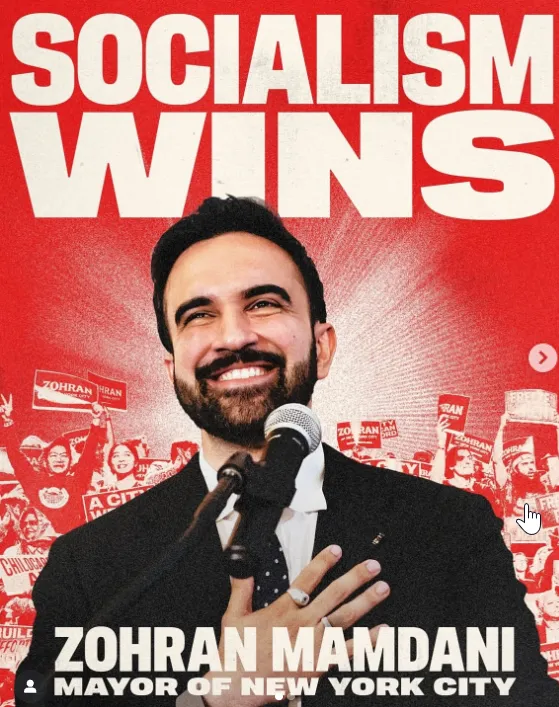
While Mamdani has not evolved in his views about the Jewish state since his childhood (his parents are both uncompromising anti-Israel activists), DSA has, in a dramatic way.
How and why did this happen?
DSA’s Zionist Foundation
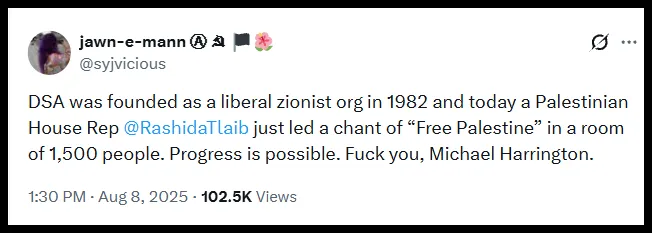
DSA was established in 1982 as a 6,000-member, pro-Israel group with the modest goals of progressive socialist reform within the Democratic Party. It is now a 90,000-member-strong, virulently anti-Israel, anti-American revolutionary movement that aims to completely dismantle the U.S. political system and replace it with Marxism.
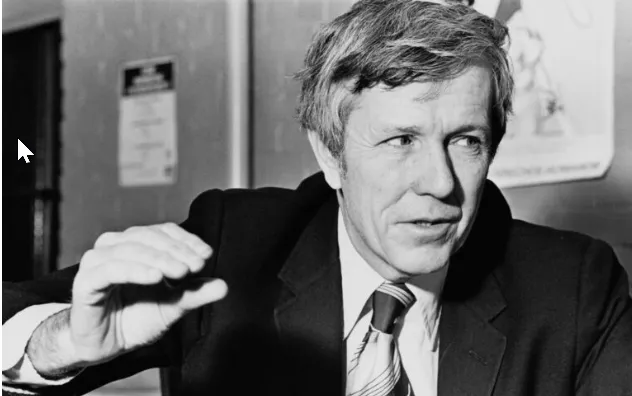
DSA was founded by Michael Harrington, an intellectual, firm anti-Communist and supporter of Israel. Harrison merged two groups to form DSA: the Democratic Socialist Organizing Committee (DSOC) and the New American Movement (NAM).
The DSOC was an outgrowth of a faction led by Harrington within the defunct Socialist Party of America. NAM was a small socialist group dedicated to feminism and the replacement organization for Students for a Democratic Society (SDS), which dissolved in 1969 amid internal strife.
Harrington believed in grassroots organizing and working within the system, namely the Democratic Party, which he hoped to gradually win over to his agenda. He eschewed the radicalism of SDS but continued the group’s anti-war and anti-imperialism objectives.

While Harrington advocated for gradual change through electoral politics, his long-term vision included collective ownership of key industries and expanded social welfare programs. The organization’s early platform reflected these goals and also spoke to racial and gender equality.
Today, the political legacy of Harrington’s DSA is non-existent, and the man who started the organization is reviled.
Entryists
The DSA’s descent into militant anti-Israel politics has been neither accidental nor sudden. It has been the product of years of internal battles, power plays and an escalating litmus test on the “Palestinian question” driven by hardline factions and their allies.
DSA's shift from its moderate and pro-Israel beginnings to its current revolutionary, pro-Marxist, anti-Israel platform is due to what Maurice Isserman – a DSA co-founder, former SDS member and now a history professor at Hamilton College – refers to as “entryists.”
“In left-wing parlance, the term [entryists] refers to tightly organized groups who, without sharing the beliefs of larger and more loosely organized bodies, join and proceed to either wreck or, where possible, capture them for ends at odds with the spirit and purpose of the original members,” Isserman writes in an article in The Nation explaining why he left the DSA after 41 years.
Today, the “entryists” in the DSA, says Isserman, have pushed anti-Israel activism into a “singularly important role” in the organization.
Entryists have “also served other purposes for DSA’s new sectarian leadership,” he says, “furnishing a convenient stick to beat DSA’s moderate wing if it wasn’t willing to embrace the most extreme positions on the Palestinian question—up to and including denying Israel’s right to continued existence.”
Isserman writes that he resigned from the DSA “to protest the DSA leadership’s politically and morally bankrupt response to the horrific Hamas October 7 anti-Jewish pogrom that took the lives of 1,400 people, mostly civilians, and saw over 200 hostages carried off to Gaza, both groups of victims including children and infants.”
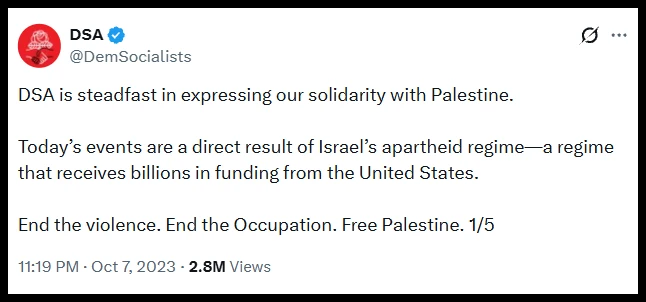
On October 7, 2023, the DSA’s powerful National Political Committee issued a statement declaring, “Today’s events are a direct result of Israel’s apartheid regime—a regime that receives billions in funding from the United States.” No mention was made of Hamas or the terror group’s victims.
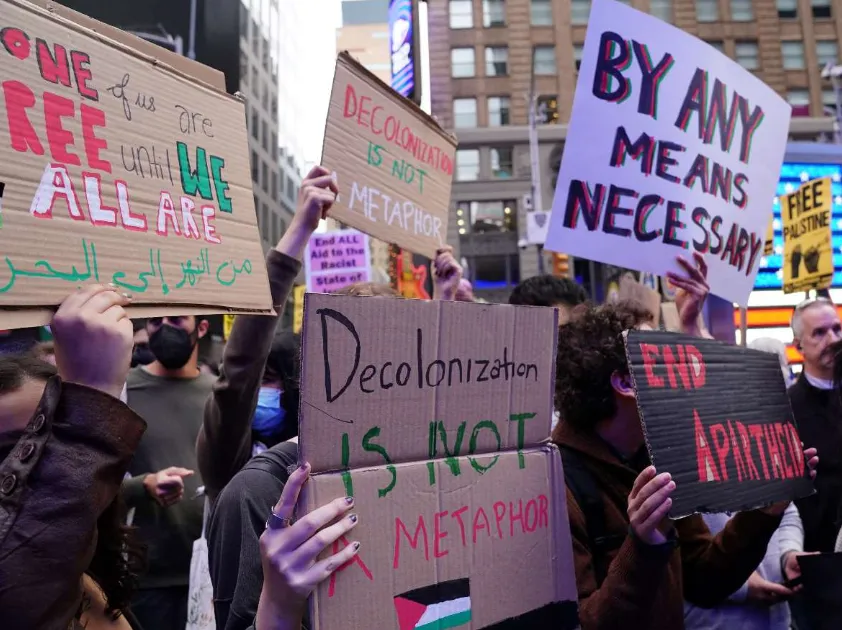
The same day, the DSA’s New York City chapter promoted an October 8, 2023 rally called “All Out for Palestine.” At the event, with terrorists still active in Israel, speakers glorified the killings, including the slaughter by Hamas of hundreds of young Israelis attending a music festival.
On October 7, 2023, the DSA’s powerful National Political Committee issued a statement declaring, “Today’s events are a direct result of Israel’s apartheid regime—a regime that receives billions in funding from the United States.” No mention was made of Hamas or the terror group’s victims.
The same day, the DSA’s New York City chapter promoted an October 8, 2023 rally called “All Out for Palestine.” At the event, with terrorists still active in Israel, speakers glorified the killings, including the slaughter by Hamas of hundreds of young Israelis attending a music festival.
To the laughing crowd, one speaker celebrated the killings at the festival, which took the lives of at least 300, saying, “...the resistance came in electrified hang gliders and took at least several dozen hipsters.”
Where did the “entryists” come from?
The Politics of Intersectionality
DSA’s devolution into strident anti-Zionism was a function of two critical political events and a burgeoning academic foundation whose groundwork had been laid for at least two decades.
In the sections below, the following events that triggered the stark change in the DSA will be explained:
First, in 2012, in the lead-up to his second presidential run, then President Barack Obama created the “coalition of the oppressed.” Second, four years later, Senator Bernie Sanders, the inheritor of this coalition, was sidelined by the Democratic Party machine that favored then-candidate Hillary Clinton.
Finally, these two political events did not happen in a vacuum. The seeds of these transformative events were being taught at universities under the umbrella of Critical Race Theory since 1989.
Coalition of the Oppressed
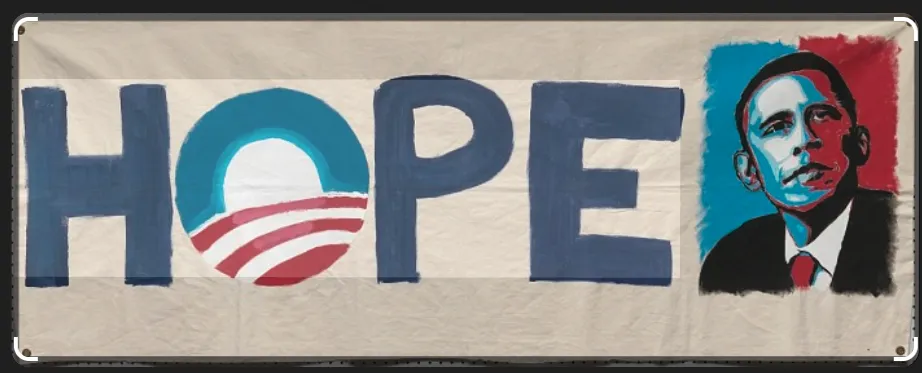
In his first presidential run, Barack Obama’s messaging focused on unity. He particularly downplayed divisions between racial groups in America. Yet, during his reelection bid and throughout his second term, Obama zeroed in on identity politics. Addressing specific racial and “marginalized” groups, Obama created what was later dubbed a “coalition of the oppressed” to garner his second electoral win.
In his second term, it was not uncommon for Obama to invoke America’s history of racism, for example, in his reaction to the death of Trayvon Martin or the Ferguson riots. His exhortations to the Hispanic community – whom he urged to tell themselves, “We’re gonna punish our enemies, and we’re gonna reward our friends” – became a hallmark of his presidency.
Polling indicates that Obama’s divisive messaging resulted in significant damage to race relations in the U.S.
Critical Race Theory
The concept of a “coalition of the oppressed” was not unfamiliar to generations of Americans who had been schooled for decades in universities whose professors were once the radicals of the sixties.
Tal Fortgang, writing in Commentary magazine, notes,
“Communist militant Angela Davis. Davis, now an emeritus professor in California, was a central figure …. She became a progressive darling by ranting about capitalism, patriarchy, and racism in the West (and providing guns to Black Panthers) while doing Soviet PR. Her view that all those -isms were part of one overarching system that needed to be overthrown for “justice” became an article of faith for critical theorists like Kimberlé Crenshaw.”
Fortgang aptly describes Crenshaw as the “matriarch of intersectionality” and outlines how Crenshaw envisioned all “marginalized” groups banding together to overthrow their oppressors.
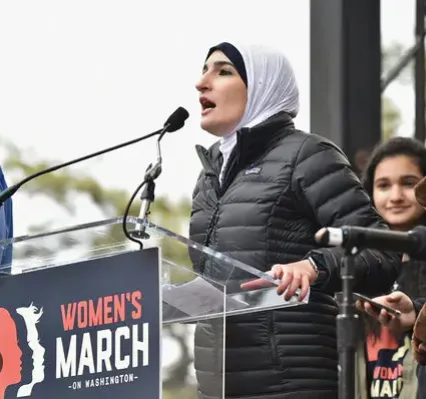
The term “intersectionality” entered the popular lexicon in 2017 at the Women’s March protesting Donald Trump’s election, Fortgang contends, when “Organizer Linda Sarsour—who would later step down for tolerating rampant anti-Semitism—clarified that the march was about feminism, police surveillance, and, of course, the need to boycott Israel.”
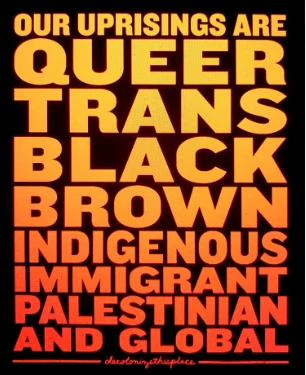
Sarsour’s pronouncements were supported by then Representative and “Squad” member Cori Bush (D-MO), who also found common ground in these causes. “The fight for Black lives and the fight for Palestinian liberation are interconnected. We oppose our money going to fund militarized policing, occupation, and systems of violent oppression and trauma,” Bush railed, evoking the “Deadly Exchange” lie concocted the same year by the anti-Israel group Jewish Voice for Peace (JVP).
The Deadly Exchange conspiracy theory essentially blamed the Israeli military for police violence in America. JVP seized on the fact that "exchange" programs existed between the Israeli military and American police. The group then falsely claimed that these programs had brought American police to Israel to learn the Israeli military’s “racist policies” to be used against black and brown communities in America.
Intersectionality and Antisemitism
“Activist intersectionality made progressive politics a team sport .... But it led to two nasty habits. It suggested that anyone who wanted to be part of the movement would be subjected to regular purity testing … Ensuring that anyone who agreed with one element of contemporary progressivism agreed with every element … [This] affirmed the intersectional principle but made leftism less a political movement and more an inquisitorial mob,” Fortgang explained.
The second “nasty habit” correctly identified by Fortgang is that intersectionality led to rampant conspiracy theorizing due to the fact that activists in these coalitions encouraged a literal interpretation of the interconnectedness of all oppression:
“... if the various 'common enemies' serve one overarching apparatus of oppression, someone or something must be behind it all. In addition to the usual left-wing ‘enemies’—whites, capitalists, imperialists—vulgar intersectionality tempted its devotees to find one group that could embody all sources of oppression at once. And who could be more white, capitalist, and imperialist than the Jews and the Jewish state?”
For the intersectional crowd, Israel became branded as the oppressor and the Palestinians as the oppressed.
“Students would learn that Palestinian liberation is intertwined with other social-justice movements. Gender theorist Judith Butler argued in 2006 that ‘understanding Hamas, Hezbollah as social movements that are progressive, that are on the Left, that are part of a global Left, is extremely important.’ Intersectional thinking fundamentally reframed the way young Americans would analyze the Middle East, positioning Israel not as a nation with its own distinct history, but as part of a global power-relations matrix. And not in a good way,” Fortgang writes.
Bernie Sanders and the Rise of Democratic Socialists of America
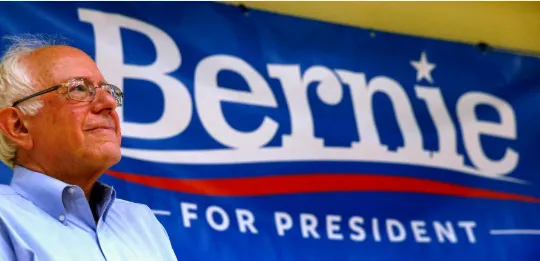
The rise of intersectional politics coincided with a new surge of political activists energized by Bernie Sanders and his presidential campaign.
Sanders, a socialist and progressive, was poised to win the Democratic Party’s nomination. As his supporters watched in dismay and disbelief, his candidacy was ultimately crushed by the party’s establishment in favor of Hillary Clinton.
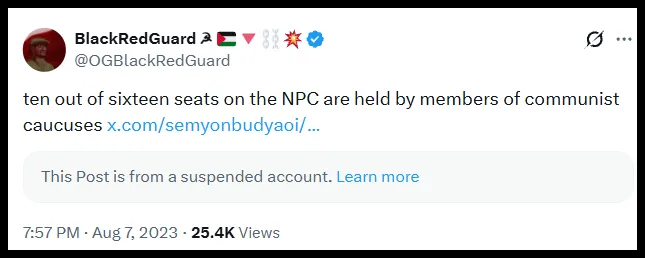
In the aftermath of the Democrats’ sidelining Sanders for Clinton, DSA’s membership quadrupled. The infusion into DSA of new, younger, angrier members, steeped in intersectional politics and feeling betrayed by the “system,” pulled the organization to the Far Left.
By 2017, the new membership base, which DSA founder Isserman labeled as “entryists,” officially endorsed the Boycott, Divestment, and Sanctions (BDS) movement. Since that time, anti-Israel activism has been one of the DSA’s central, defining principles.
In the wake of the widespread social unrest following George Floyd's death in 2020, the epithet that garnered the most sting in America was “racism.” Conveniently for radical anti-Israel groups such as Within Our Lifetime (WOL) and Decolonize This Place (DTP), the Soviets had already successfully branded Zionism as racism.
These groups worked hard to capitalize on the Black Lives Matter movement to further their fight against Israel.
The anti-Israel cause also dovetailed perfectly with Critical Race Theory, which posits that racism is the fundamental organizing principle of American society and had, by that time, become prominent in mainstream American culture.
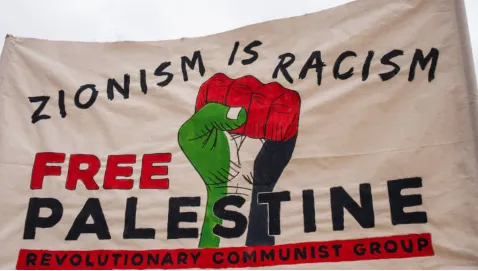
Institutions, ranging from schools to corporations, government agencies and the media, bought into the theory and made radical changes in their operations accordingly. This included adopting a negative attitude toward Israel, which, due to the slur of racism, had come to be looked upon as part of the “Patriarchal White Supremacist” oppressor class.
Led by firebrands Nerdeen Kiswani and Amin Husain, respectively, WOL and DTC took the fight to the next level, launching the “Globalize the Intifada” movement in 2021 and positioning the Palestinian cause at the pinnacle of the intersectional struggle.
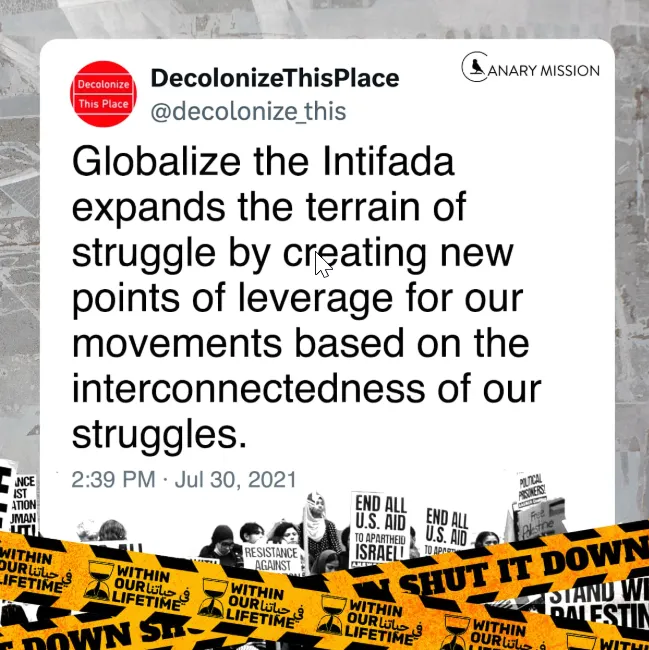
“Palestinian liberation” (i.e., the destruction of Israel) was now marketed as the quintessential kingpin to world liberation. In Kiswani and Husain’s worldview, if Israel falls, all other injustices in the world will cease to exist.
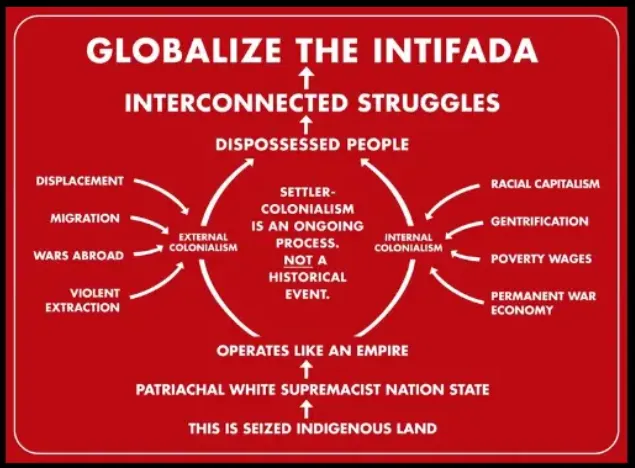
Today, “Globalize the Intifada” – essentially a call the kill Jews worldwide – is a slogan that even New York City’s new mayor and DSA member Zohran Mamdani will not formally denounce.
Indeed, Mamdani made his anti-Israel activism a cornerstone of his political career. And, in keeping with the accepted narrative of his intersectional allies, Mamdani views “Palestine as being a central part of the struggle” for “liberation.”
DSA Bows to PYM and SJP
In 2022, two prominent anti-Israel groups, Palestinian Youth Movement (PYM) and Students for Justice in Palestine (SJP), along with other anti-Israel groups, issued a formal boycott of DSA, charging that DSA was too soft in disciplining its member and then-Rep. Jamaal Bowman (D-NY) for voting in favor of U.S. aid to Israel, taking a trip to the country and meeting with its prime minister.
Faced with pressure from these groups, the DSA immediately backed down.
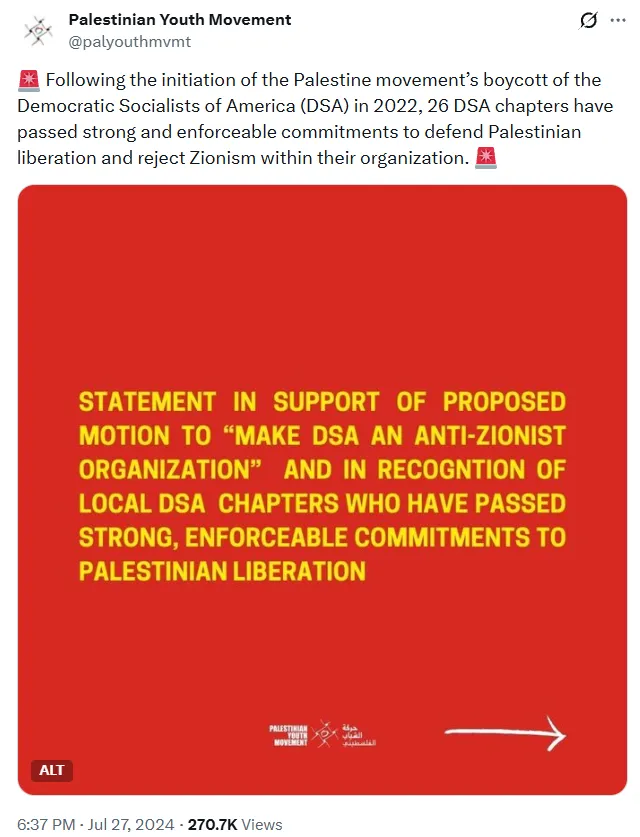
By 2024, DSA leadership had passed a resolution denouncing Zionism and set standards for political candidates seeking an endorsement from the DSA.
At its most recent convention in August 2025, the DSA adopted its strongest and most militant anti-Israel resolution to date, titled “For a Fighting Anti-Zionist DSA.”
The 2025 resolution:
- Frames Zionism as a "racist, imperialist, settler-colonial project" and calls for expelling Zionism from DSA's foundational documents
- Demands accountability for DSA-endorsed politicians who do not support BDS or who have voted to give military aid to Israel
- Requires candidates seeking a DSA endorsement to publicly support BDS and reject ties with Zionist lobbying groups such as AIPAC and J Street
- Stipulates that members actively supporting Zionist interests through lobbying, anti-BDS activism or affiliation with Zionist organizations face membership expulsion unless they demonstrate "public reckoning" and commit to anti-Zionist activism
- Moves anti-Zionism from a principle into concrete action, explicitly connecting it with fighting U.S. imperialism and settler colonialism, and positioning Palestinian liberation as central to DSA's struggle
- Includes enforcement measures
Today, anti-Zionism is the organization’s driving principle and is at the center of its agenda. Buoyed by the win of one of their own, Zohran Mamdani, as mayor of New York City, who ran on an explicitly and virulently anti-Zionist platform in the heavily Jewish city, the group is confident that such policies will not harm their future electoral prospects. In fact, judging by the current political climate, they will only help them.