Susan Akram
Overview
Susan Akram has equated Palestinians to Holocaust victims, praised violent protesters and was a speaker at multiple anti-Israel events. She has demonized Israel, as well as Zionists and is a supporter of the Boycott, Divestment and Sanctions (BDS) movement.In 2004, Akram was a guest lecturer at Birzeit University, whose student body celebrated terrorists since at least 2003. Also in 2003, Birzeit’s student body elected Hamas’ student wing to power.
In March 2020, Akram taught a course as part of Oxford University’s (Oxford) Refugee Studies Center, titled: “Palestine Refugees and International Law,” in Istanbul, Turkey.
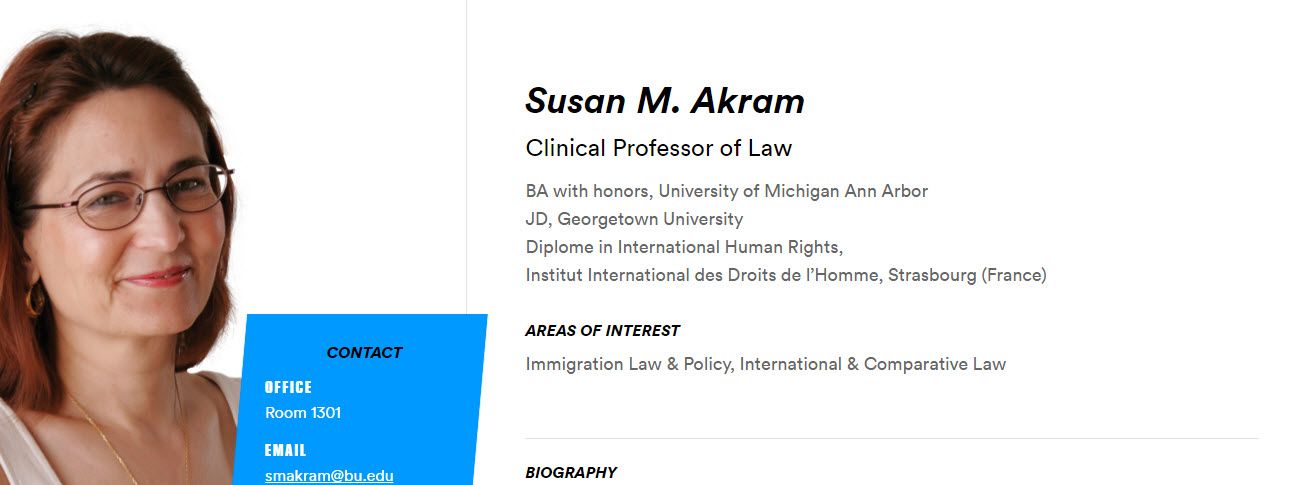
As of April 2020, Akram was a Clinical Professor of law at Boston University (BU), as well as the director of “BU Law’s International Human Rights Clinic, in which she supervises students engaged in international advocacy in domestic, international, regional, and UN fora.”
Equating Palestinians to Holocaust Victims
In an article published on November 23, 2014, Akram suggested that “Using Jewish claims of Holocaust victims as precedent, Palestinians residing in third states can seek property restitution from organizations that are part of the Zionist establishment and parastatal institutions like the Jewish National Fund and banks that hold the accounts of such institutions.”Praising Violent Protesters
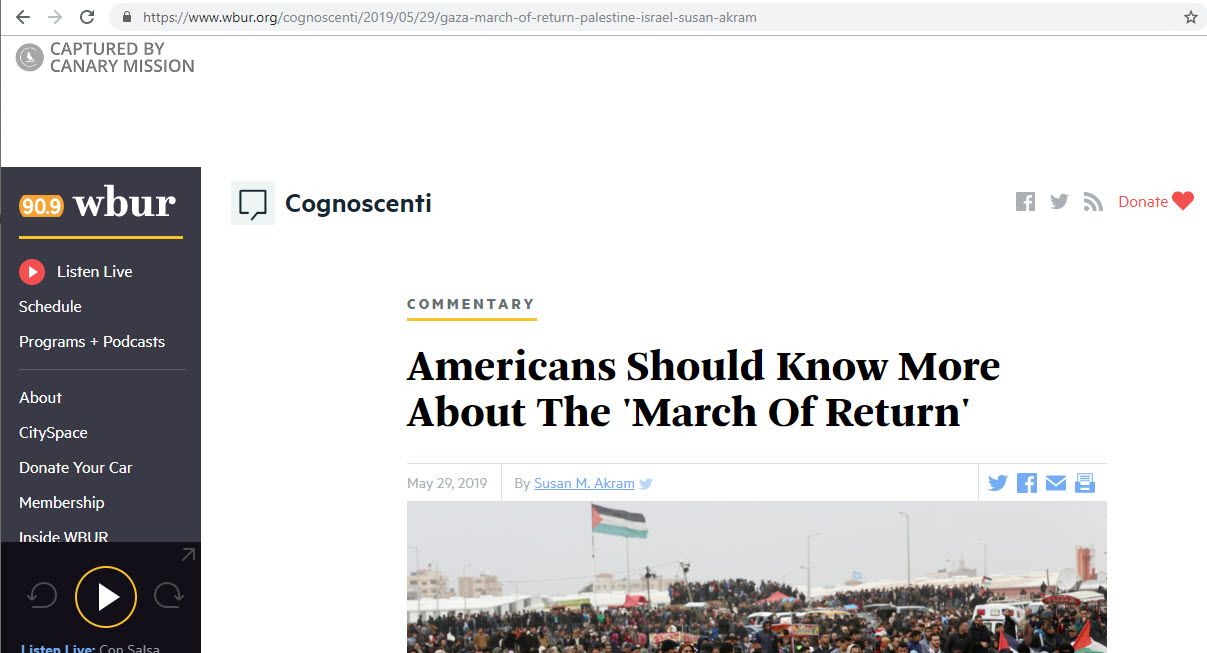
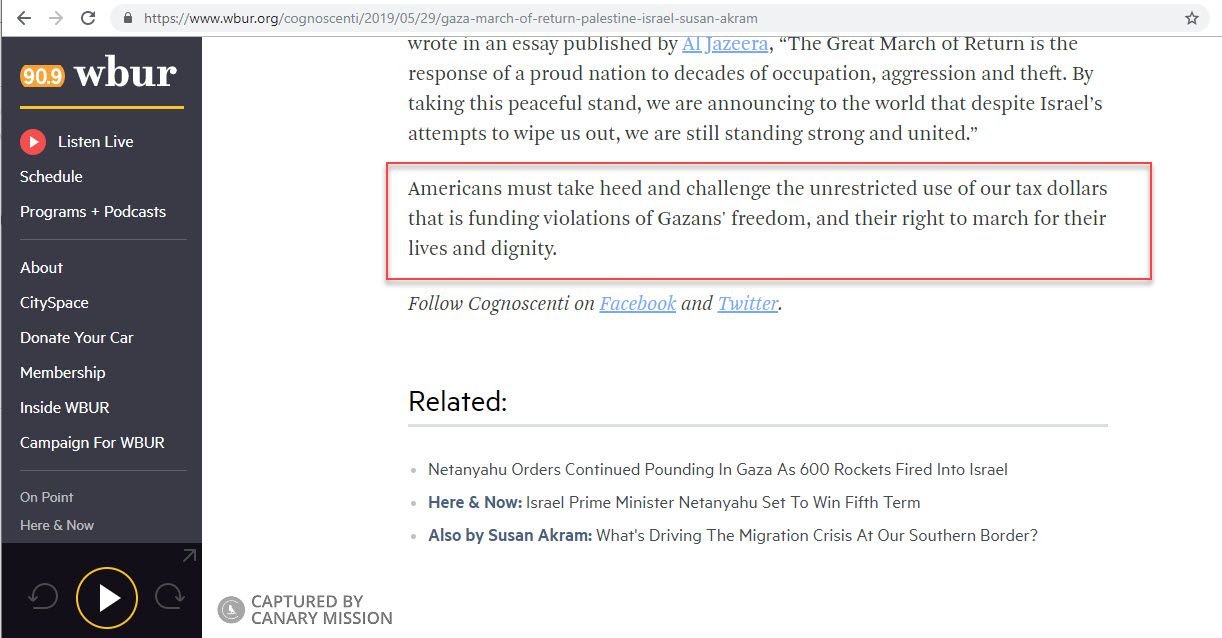
In an article published on May 29, 2019, Akram praised violent protests then-occuring on Israel’s border with Gaza. In her article, Akram wrote: “Americans must take heed and challenge the unrestricted use of our tax dollars that is funding violations of Gazans' freedom, and their right to march for their lives and dignity.”On March 30, 2018, some 30,000 Palestinians in Gaza approached Israel’s border to take part in “Land Day Protests” or the “March of Return.” The violent demonstrations were instigated by Hamas on the Israeli-Gaza border. Participants declared their intention to harm Jews across the border under the pretext of “peaceful resistance.”
March participants sent scores of kites bearing explosive devices across Israel’s border to burn Israeli crops and homes. Rioters also made numerous attempts to breach Israel’s border fence, which caused the Israeli Defense Forces to respond with live fire.
The violent riots during the “March of Return” continued into 2019 and included armed protesters using gunfire, penetrating Israeli territory, launching incendiary kites into Israel and throwing IEDs, hand grenades and Molotov cocktails. Some of the attacks were carried out by Hamas operatives.
Speaking at Anti-Israel Events
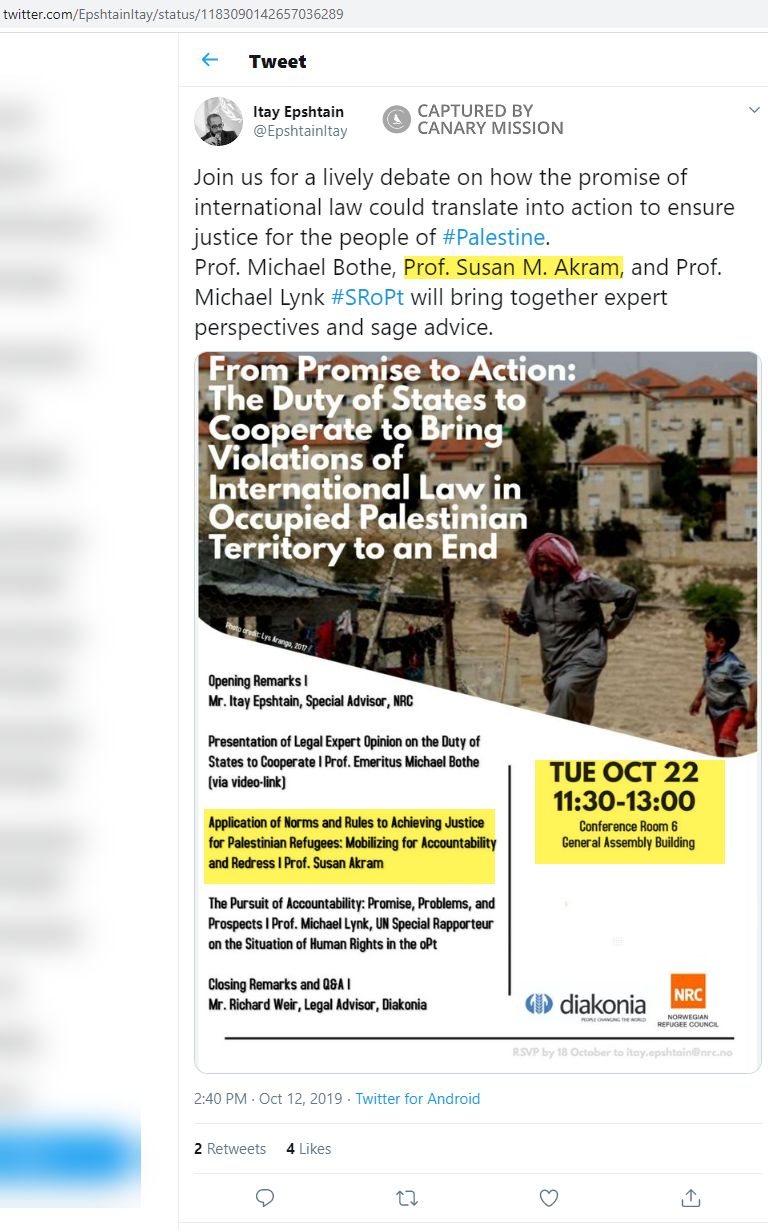
On October 22, 2019, Akram was scheduled to speak at an event titled: “From Promise to Action: The Duty of States to Cooperate to Bring Violations of International Law in Occupied Palestinian Territory to an End.”Akram’s lecture was titled: “Application of Norms and Rules to Achieving Justice for Palestinian Refugees: Mobilizing for Accountability and Redress.”
Also speaking at the event was Michael Lynk, who is an associate professor at the Faculty of Law, Western University.
Lynk, who promotes an anti-Israel narrative as Special Rapporteur on “the situation of human rights in the Palestinian Territories occupied since 1967” for the United Nations Human Rights Council (UNHRC), is also a member of “Faculty for Palestine” (F4P) which is part of the broader Coalition Against Israeli Apartheid.
In 2016, the Canadian government condemned Lynk’s appointment to Special Rapporteur based on Lynk’s long history of anti-Israel activities.
In 2019, Akram spoke on a panel at the Edward Said Lecture, sponsored by the Mosaic Rooms and the London School of Books (LSB) and that took place in London, UK. The event’s description said that “Israel and its supporters continually act against” the human rights of Palestinians.
On May 2, 2019, Mosaic Rooms tweeted: “Susan M Akram opens with a reflection on the legal history of Palestinian nationality from colonisation to Balfour and the continuing denial of Palestinian right of return #SaidLondonLect.”
The “right of return” is a Palestinian demand discredited as a means to eliminate Israel. International law mandates no absolute right of return and UN Resolution 194, which defined principles for “refugees wishing to return to their homes,” was unanimously rejected by Arab nations following the 1948 Arab-Israeli War.
During her speech, Akram referred [00:05:35] to Zionist interpretation of British endorsement of the Balfour Declaration as a “commitment to the Jewish people for the creation of a Jewish state in Palestine” as having “serious deficiencies.”
The 1917 Balfour Declaration favored the establishment of a Jewish National home in British Mandate Palestine.
These deficiencies included [00:06:00] that “there was no legal concept of the Jewish people as a political entity with recognized rights, separate from the religious or cultural identity of the Jewish people” and that the British government did not believe that the Zionists represented [00:06:16] the “rights or interests of the Jewish people.”
Akram insisted [00:06:38] that the drafting history of the Balfour Declaration reflects that Britain intended to provide a home for Jews in Palestine but not a Jewish state and [00:06:50] that there is no support for the claim that “the Balfour declaration recognized Jewish nationality attached to a distinct population of individuals entitled to self-determination in Palestine.”
Akram also claimed [00:12:30] that Israel’s law of return rendered Palestinians, as well as their children, who could not meet “very stringent requirements” set by Israel, as “stateless.” Akram continued that this “statelessness” caused by Israel applied to all Palestinians of the time.
The Israeli Law of Return grants Jews worldwide the right to Israeli citizenship.
Akram also described [00:13:35] Israel’s Law of Return and its “denial of Palestinian return” as “illegal acts” and against International law.
On June 11, 2019, the Mosaic Rooms published videos of the event, including Akram’s speech, on Twitter.
Demonizing Israel
In an article published on September 11, 2017, Akram wrote about Israel’s security barrier and claimed that “The Wall is both a physical reality and a metaphor for the apartheid regime that Israel has established in the West Bank.”Israel’s security barrier, 97 percent of which is a low chain-link barrier, was built as a deterrent to Palestinian terror attacks. The concrete portions of the fence were built in response to Palestinian sniper attacks.
On November 23, 2014, Akram published an article in which claimed that “the elements of systematic racial discrimination and apartheid readily apply to Israel” and made reference to what she called “Israel’s institutionalized racial discrimination/apartheid against Palestinians.”
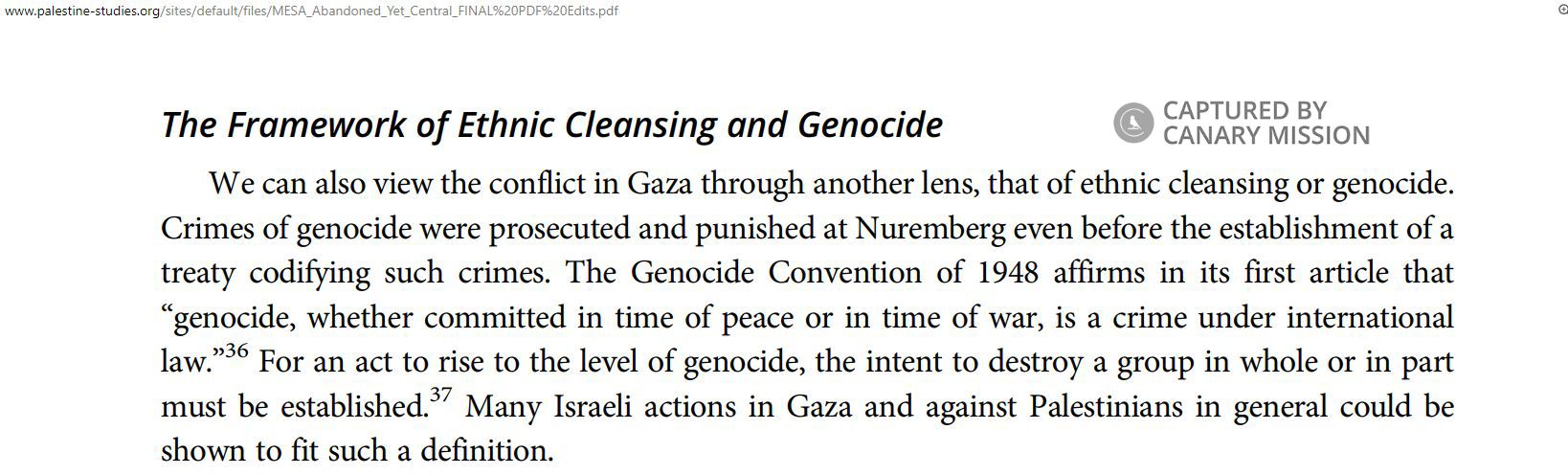
Later in the same article, Akram suggested: “We can also view the conflict in Gaza through another lens, that of ethnic cleansing or genocide.”
She elaborated on this by stating: “For an act to rise to the level of genocide, the intent to destroy a group in whole or in part must be established. Many Israeli actions in Gaza and against Palestinians in general could be shown to fit such a definition.”
Upon this basis, Akram noted that “The Genocide Convention is perhaps the most important treaty for the Palestinian case, in general, and for Gazan victims of Israeli attacks, in particular.”
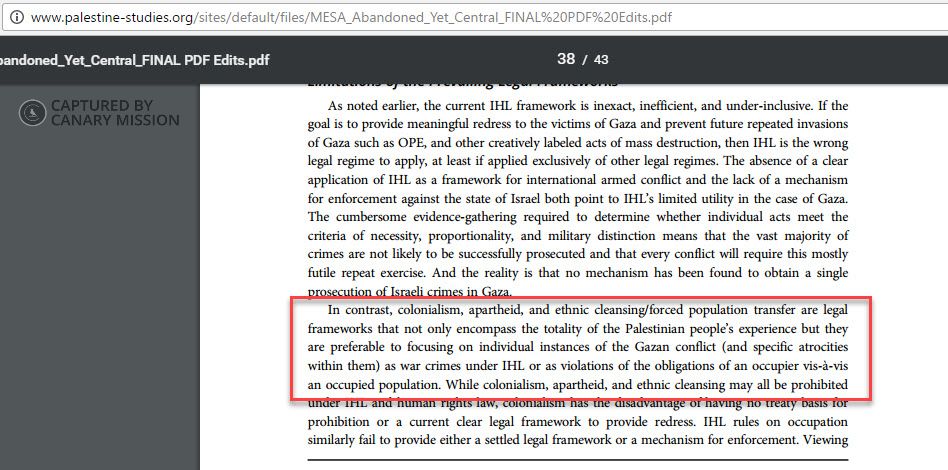
Akram concluded her article stating that “Colonialism, apartheid, and ethnic cleansing/forced population transfer are legal frameworks that not only encompass the totality of the Palestinian people’s experience but they are preferable to focusing on individual instances of the Gazan conflict… as war crimes...”
Akram was listed as a speaker at a March 2012 “One-State Conference” held at Harvard University from March 3 - 4, 2012. Akram was reportedly quoted as saying: “Israel’s claim of a state, on the basis of exclusive and discriminatory rights to Jews, has never been juridicially recognized. In other words, the concept of the Jewish people as a national entity with extraterritorial claims has never been recognized under international law.”
The “one-state solution” has been denounced from the Right and the Left as a scheme to dissolve Israel as the Jewish State.
Other speakers at the conference included anti-Israel activists Professor Sa’ed Atshan, Rabbi Brant Rosen, Professor Duncan Kennedy, founder of the anti-Israel publication Electronic Intifada (EI) Ali Abunimah, Dalit Baum and Professor Ilan Pappe, among others.
The conference’s subject was the dissolution of Israel as a Jewish state. Despite the university’s insistence that it was an entirely student-run initiative and not officially supported by the institution, several professors took leading roles in the planning and execution of the event.
In a lecture delivered on May 14, 2010, Akram said: “Population transfer was key to Zionist thinking since its inception in the late 19th century, and remains central to both left and right wings of contemporary Zionism.”
In the same speech, Akram stated that “Israel’s massive denationalization of Palestinian Arabs on the basis of their national/ ethnic origin was a violation of law in 1948, and Israel remains bound today, despite the long passage of time, to remedy the denationalization and expulsion by implementing the right of return.”
In a 2004 article, Akram wrote: “Palestinians, particularly in the West Bank and Gaza, have been subjected to heightened oppression and terror tactics by their Israeli occupiers. The escalating Israeli violence, directed at a Palestinian population held captive in towns and villages by curfews and checkpoints, as well as the ongoing Israeli policy of ethnic cleansing, is causing a renewed exodus of Palestinian refugees.”
In the same article, Akram claimed that “more than half a century of persecution inside Palestinians’ historic homeland has produced a chronic pattern of forced displacement that can be characterized as a form of forced population transfer or ethnic cleansing.”
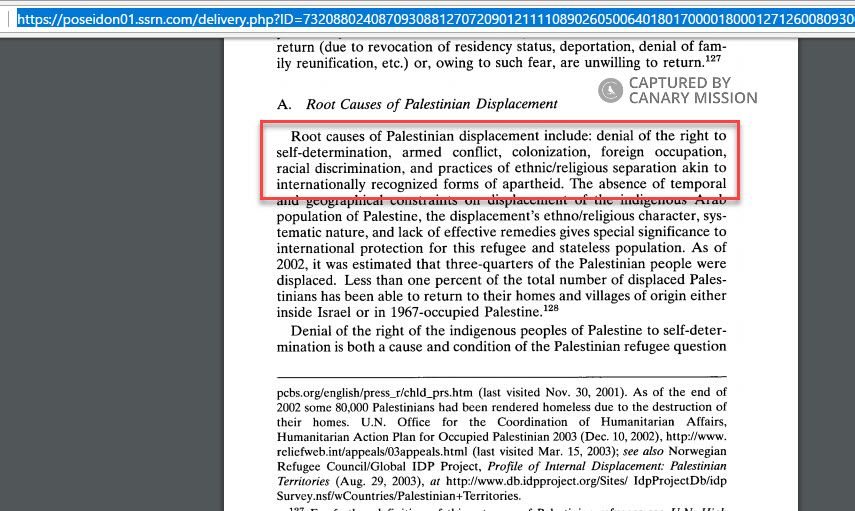
She went on to state that “Root causes of Palestinian displacement include: denial of the right to self-determination, armed conflict, colonization, foreign occupation, racial discrimination, and practices of ethnic/religious separation akin to internationally recognized forms of apartheid.”
Akram concluded: “The reasons for the recent and renewed exodus of Palestinians from the West Bank and Gaza are a continuation of all of the reasons they have been forced to flee in large and small numbers over time: denial of the right to self-determination; armed conflict, colonization, and foreign occupation; ethnic cleansing and racial discrimination; at apartheid at the hands of the Zionist Israeli state.”
Demonizing Zionists
In 2014, Akram published an article in which she cited “Zionist Colonization” and “foreign occupation,” as main causes of “Palestinian displacement.”In that same article, Akram claimed that “During the first half of the twentieth century, Zionist colonization of strategic areas of the country created a pattern of internal displacement and urban migration affecting tens of thousands of Palestinian peasant farmers.”
Later in the article, Akram discussed “Jewish colonization,” “the establishment of new Jewish colonies” and described how areas of the country were “targeted by the Zionist movement for intensive colonization.”
Reiterating these claims in an article published on November 23, 2014, Akram implied that Israel is a colonialist state. On this basis, Akram went on to question Israel’s legitimacy, suggesting that the state exists only because it was established before colonization was prohibited by international law and that that prohibition cannot be applied retroactively.
Supporting BDS
In an article published on September 11, 2017, Akram endorsed the BDS movement, “The BDS movement could systematically formulate a strategy for a state-by-state campaign to pressure for sanctions (the ‘S’ in the BDS) as the anti-apartheid movement did on South Africa.”In an article written in 2008, Akram referred to BDS as a “promising international campaign” and encouraged international efforts to isolate Israel through economic sanctions.
BDS
The Boycott, Divestment, Sanctions (BDS) movement was founded by Omar Barghouti in 2005 to challenge “international support for Israeli apartheid and settler-colonialism.” BDS is an allegedly “Palestinian-led movement,” although leading BDS activists have admitted [00:01:01] this is not true.
One of the demands of BDS includes [point 3] what is generally known as the “right of return,” a demand discredited as a way to eliminate Israel. Barghouti said the “right of return” is a means to “end Israel’s existence as a Jewish state.”
Barghouti has said that BDS “aims to turn Israel into a pariah state, as South Africa once was.”
In his activism, Barghouti has also said [00:05:55] regarding Israel: “Definitely, most definitely, we oppose a Jewish state in any part of Palestine. No…rational Palestinian, not a sellout Palestinian, will ever accept a Jewish state in Palestine.”
The movement has been linked to numerous terrorist organizations and received a public endorsement from Hamas in 2017.
BDS initiatives include calling on institutions and individuals to divest from Israeli-affiliated companies, promoting academic and cultural boycotts of Israel, and organizing anti-Israel rallies, protests and campaigns.
The movement’s most notable achievement has been the infiltration of university campuses through lobbying for “BDS resolutions.” In these cases, student governments and student groups, backed by their own anti-Israel members and affiliates, have proposed resolutions on some form of boycott of, or divestment from, Israel and Israeli-affiliated entities.
Boycott resolutions, although non-binding, have been passed by student governments on numerous North American campuses.
BDS activity is often aggressive and disruptive. It has been noted that universities that pass BDS resolutions see a marked increase in anti-Semitic incidents on campus. On one campus, when the student government debated a BDS resolution, reports emerged of violent threats against those opposing it.
Social Media and Weblinks
University Website:https://www.bu.edu/law/profile/susan-m-akram/Facebook: https://www.facebook.com/726262260
LinkedIn:https://www.linkedin.com/in/akram-susan-07037812/

- Status:
- Professor
- University:
- Boston
- Organizations:
- BDS
- Related Profiles:
- Nicholas Fuentes,
- Last Modified:
- 05/04/2026
Photos & Screenshots