Jailene Levya
Overview
Jailene Levya has promoted a terrorist, expressed support for violent protestors and demonized Israel. Levya was an activist with Students for Justice in Palestine (SJP) at DePaul University (DePaul) in 2020.Levya attended the 2019 National SJP Conference.
Promoting a Terrorist
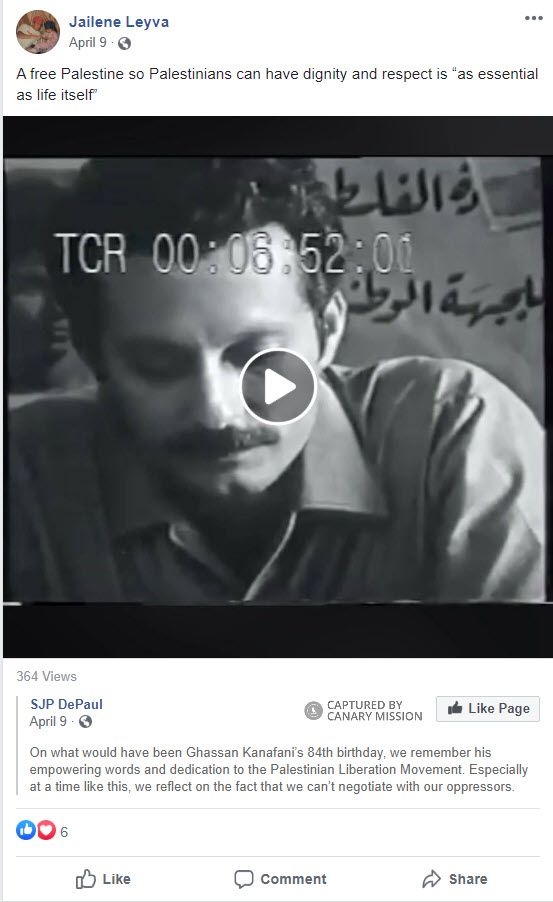
Levya attached an SJP DePaul post that said: “On what would have been Ghassan Kanafani’s 84th birthday, we remember his empowering words and dedication to the Palestinian Liberation Movement. Especially at a time like this, we reflect on the fact that we can’t negotiate with our oppressors.” The post attached a video interview of Kanafani.
Kanafani was a leading member and spokesperson for the Popular Front for the Liberation of Palestine (PFLP) during the terrorist organization’s early years. Kanafani announced the PFLP’s responsibility for the Lod Airport Massacre of May 1972 and was linked to the airport attackers. The attack killed 26 people and wounded 80 others.
Supporting Violent Protests
The post added: “The Since March 30th, 2018, Israel has killed 316 protestors in the #GreatReturnMarch & injured more than 30,000. Israel threw tear gas & shot rubber & live sniper bullets, killing and injuring dozens of children, medics & journalists, & damaging ambulances. #PalestineLandDay.”
Most of the Gazans who died between March 30 and April 6, 2018, were identified as terror operatives who were killed while carrying out terrorist attacks, rioting against IDF forces or attempting to breach the border fence between Israel and the Gaza Strip.
March participants sent scores of kites bearing explosive devices across Israel’s border to burn Israeli crops and homes. Rioters also made numerous attempts to breach Israel’s border fence, which caused the Israeli Defense Forces to respond with live fire.
Demonizing Israel
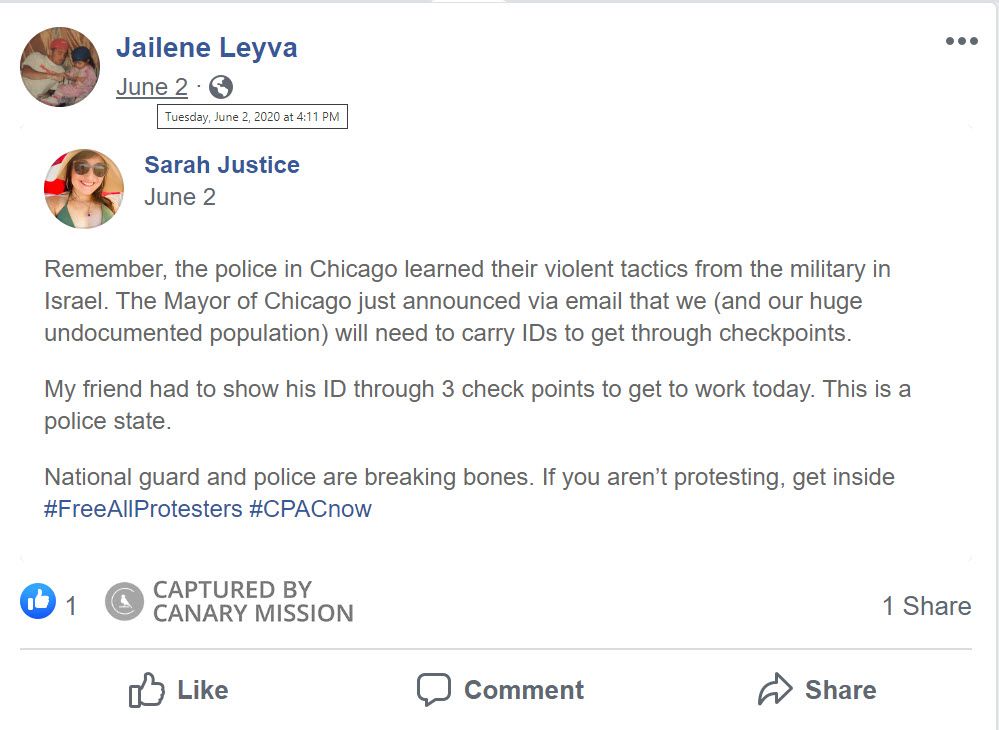
The post added: “This is a police state. National guard and police are breaking bones. If you aren’t protesting, get inside #FreeAllProtesters #CPACnow.”
On May 25, 2020, George Floyd, a black man, was arrested and killed by a white police officer in Minneapolis, Minnesota.
Following Floyd’s death, demonstrations and protests were held in over 400 American cities, as well as internationally. Many of the demonstrations devolved into riots, resulting in injury and deaths of civilians and police officers, as well as widespread destruction and looting of property.
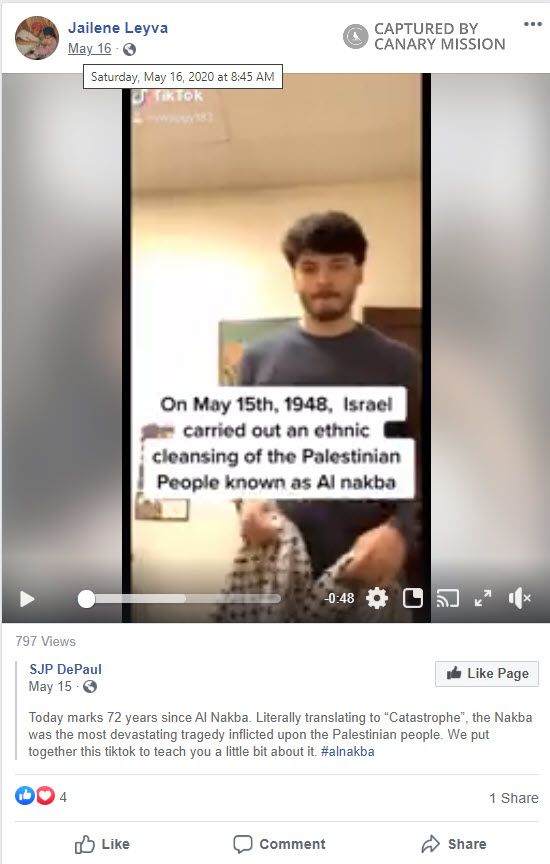
On May 16, 2020, Levya shared a May 15, 2020 SJP DePaul TikTok video to Facebook, with the caption: “Today marks 72 years since Al Nakba. Literally translating to ‘Catastrophe’, the Nakba was the most devastating tragedy inflicted upon the Palestinian people. We put together this tiktok to teach you a little bit about it. #alnakba.”
During the video, SJP DePaul activists posed with captions that stated [00:00:01]: “On May 15th, 1948, Israel carried out an ethnic cleansing of the Palestinian People known as Al Nakba,” and [00:00:47] “Israel’s ethnic cleansing continues to this day, with ongoing murders…”
The term “Nakba” is generally translated as “catastrophe” in Arabic, referring to the outcome of the 1948 Arab-Israeli War. It is a term often used to delegitimize the creation of the State of Israel by defining it as a catastrophe.
BDS Support
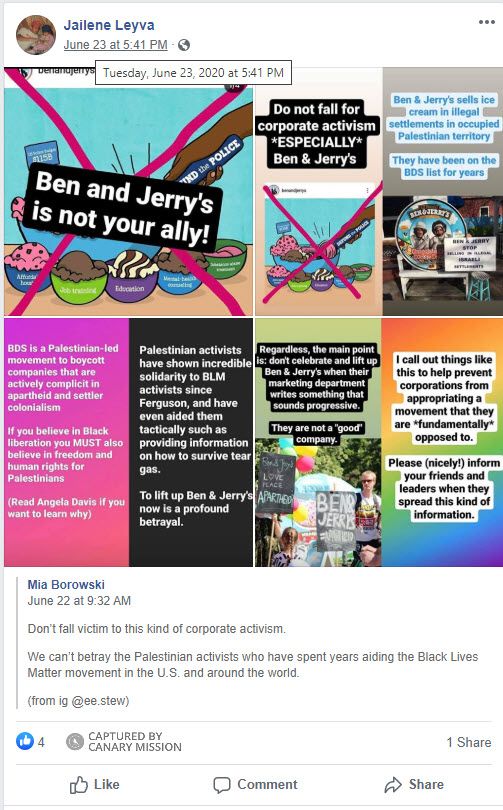
A separate caption stated: “BDS is a Palestinian-led movement to boycott companies that are complicit in apartheid and settler colonialism. If you believe in Black liberation you must also believe in freedom and human rights for Palestinians.”
SJP DePaul Activism
Attending the National SJP 2019 Conference
The Conference partnered with numerous anti-Israel organizations and conducted their event in a clandestine manner.
2019 National SJP - Supporting BDS
The Conference website called to capitalize on shifts in the political climate, represented by the elections to the U.S. Congress of Representatives Ilhan Omar and Rashida Tlaib, who both support BDS. National SJP speakers also reportedly drew attention to Rep. Omar’s support for the BDS movement as the Representative for UMN’s Congressional district.During the Conference, National SJP speakers reportedly “noted the success of past divestment campaigns at the University [UMN], which ultimately resulted in the passing of a campus-wide [BDS] referendum in 2018.”
The UMN resolution passed in 2018 by a margin of 3.4 percent of those students who voted, translating to approval by 6.18% of all eligible voters. Less than 13% of the eligible voters actually voted on UMN’s BDS referendum.
2019 National SJP - Rejecting Israel and Zionism
The 2019 National SJP Conference website indicated that the goal of their “solidarity movement” was to push for policies that “demanded the end of” the state of Israel, referred to as “the Israeli occupation.”The website clarified that “the Palestinian struggle against Zionism, extends beyond the confines of 1967, and well before the Nakba,” and was based on the rejection of Jewish national self-determination in Israel.
Nakba is an Arabic term for “catastrophe” and refers to the outcome of the 1948 Arab-Israeli War. It is a term often used to delegitimize the creation of the State of Israel.
2019 National SJP - Heightened Secrecy
The 2019 National SJP Conference required attendees to be “verified and vouched for” by an SJP chapter to which they belonged and required each chapter to register as a group. The conference also required each group to be verified by a “reference––someone who is NOT going to this conference but who is or has recently been a part of your SJP.”2019 National SJP - Partnering Organizations
National SJP partnered with other anti-Israel organizations to table, sell merchandise and lead workshops, including CODEPINK, Palestine Youth Movement (PYM), Jewish Voice for Peace (JVP), US Palestinian Community Network (USPCN), Palestine Legal, Watan Palestine and the Adalah Justice Project.Keynote speakers included Loubna Qutami, Chair of PYM, as well as Taher Herzallah of American Muslims for Palestine (AMP). Other speakers included Miko Peled, Sandra Tamari, Suhad Katib, Chris Gazaleh, Clarissa Bitar, Tariq Luthun, Maytha Alhassen and Sima Shakhsari.
SJP
SJP is a student organization engaged in anti-Israel activity on North American college and university campuses.
The first chapter of SJP was founded in 2001 at the University of California at Berkeley by Professor Hatem Bazian. Bazian has spread classic anti-Semitism, reportedly promoted religious anti-Semitism and defended the Hamas terror group. In 2004, Bazian called for “intifada” in America.
SJP organizes anti-Israel campaigns, including running annual Israel Apartheid Weeks, often in collaboration with Jewish Voice for Peace (JVP) and Muslim Students Association (MSA) campus chapters.
SJP has been a major force in pushing the anti-Semitic Boycott, Divestment, Sanctions (BDS) movement on campuses. Chapters have initiated dozens of BDS resolutions in student governments, which have been proposed on or around Jewish holidays, a time when many Jewish students are off-campus.
SJP activists have reportedly physically assaulted, intimidated and harassed Jewish students, disrupted pro-Israel campus events and demonized pro-Israel campus organizations.
Chapters have often endorsed and campaigned for numerous terrorists and whitewashed terrorism.
BDS
The Boycott, Divestment, Sanctions (BDS) movement was founded by Omar Barghouti in 2005 to challenge “international support for Israeli apartheid and settler-colonialism.” BDS is an allegedly “Palestinian-led movement,” although leading BDS activists have admitted [00:01:01] this is not true.
One of the demands of BDS includes [point 3] what is generally known as the “right of return,” a demand discredited as a way to eliminate Israel. Barghouti said the “right of return” is a means to “end Israel’s existence as a Jewish state.”
Barghouti has said that BDS “aims to turn Israel into a pariah state, as South Africa once was.”
In his activism, Barghouti has also said [00:05:55] regarding Israel: “Definitely, most definitely, we oppose a Jewish state in any part of Palestine. No…rational Palestinian, not a sellout Palestinian, will ever accept a Jewish state in Palestine.”
The movement has been linked to numerous terrorist organizations and received a public endorsement from Hamas in 2017.
BDS initiatives include calling on institutions and individuals to divest from Israeli-affiliated companies, promoting academic and cultural boycotts of Israel, and organizing anti-Israel rallies, protests and campaigns.
The movement’s most notable achievement has been the infiltration of university campuses through lobbying for “BDS resolutions.” In these cases, student governments and student groups, backed by their own anti-Israel members and affiliates, have proposed resolutions on some form of boycott of, or divestment from, Israel and Israeli-affiliated entities.
Boycott resolutions, although non-binding, have been passed by student governments on numerous North American campuses.
BDS activity is often aggressive and disruptive. It has been noted that universities that pass BDS resolutions see a marked increase in anti-Semitic incidents on campus. On one campus, when the student government debated a BDS resolution, reports emerged of violent threats against those opposing it.