David McCleary
Overview
David McCleary was an activist with Students for Justice in Palestine (SJP) and an advocate of the Boycott, Divestment and Sanctions (BDS) movement at the University of California, Berkeley (UC Berkeley).McCleary was also a member of the anti-Israel Jewish Voice for Peace (JVP) organization.
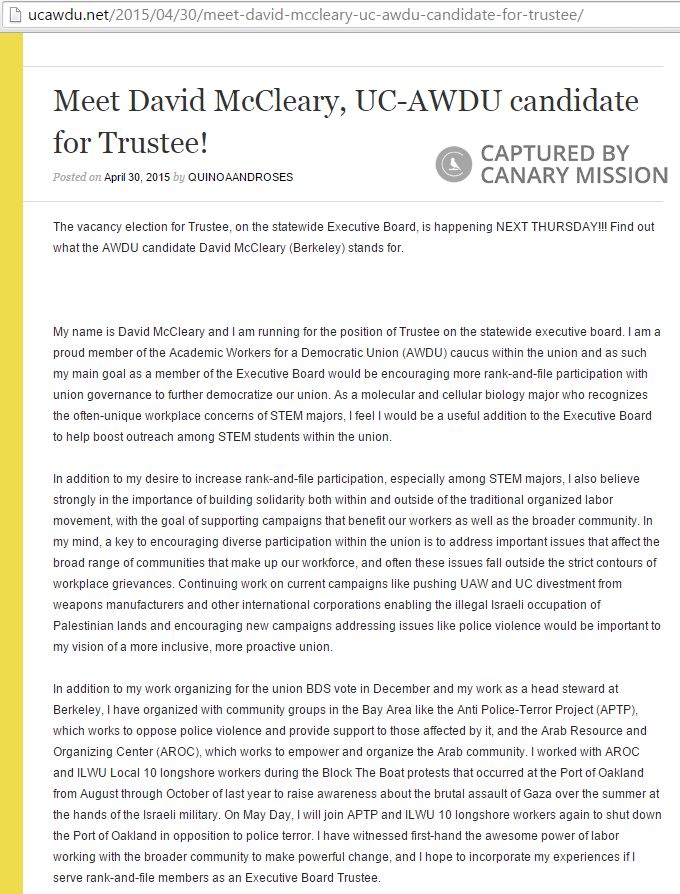
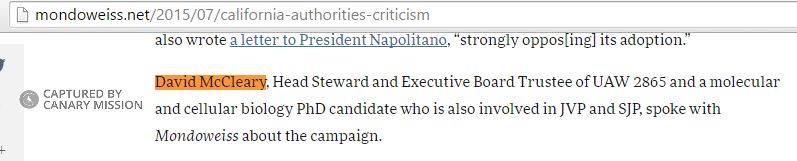
In 2015, McCleary was a trustee of UAW 2865, a union representing 13,000 Academic Student Employees (ASEs), including teaching assistants, tutors and graders, at the nine teaching campuses of the University of California (UC). He also served as UAW Northern Vice President from October 2015.
In July 2015, McClearly opposed resolution SCR 35 passed by the UC Senate condemning anti-Semitism on UC campuses.
McCleary worked with the Arab Resource and Organizing Center (AROC) in the San Francisco Bay Area from August to October 2014 during Block the Boat, an anti-Israel campaign organized by AROC to prevent a Zim container ship from unloading its cargo of Israeli trade items at the Port of Tampa. He also participated in Block the Boat protests.
A Facebook photo posted on September 29, 2018, indicated that McCleary was still involved with UAW 2865 and a Facebook photo posted on November 8, 2018, indicated he was involved in UAW Local 5810, the UC union for postdoctoral researchers.
As of February 2019, McCleary’s LinkedIn page said he was pursuing a Ph.D. at UC Berkeley and he was listed as a graduate student at UC Berkeley’s Rine Lab of Molecular Biology.
SJP Activism
On February 24, 2015, SJP at UC Berkeley put mock eviction notices under the doors of almost 600 students in the UC Berkeley student dorms. In an opinion piece McCleary co-authored for The Daily Californian titled “Injustices against Palestinian students go unreported,” he claimed that SJP at UC Berkeley “had been the target of harassment and racism” and he defended the mock eviction notices as part of a campaign to highlight “an ongoing project of ethnic cleansing” by the Israeli government.On February 25, 2015, McCleary was interviewed by The Daily Californian and said he set up a “mock apartheid wall” and a “mock checkpoint” with SJP at UC Berkeley, in front of one of the University gates. The wall was intended to represent Israel’s security barrier.
Israel’s security barrier, 97 percent of which is a low chain-link barrier, was built as a deterrent to Palestinian terror attacks. The concrete portions of the fence were built in response to Palestinian sniper attacks.
The wall included text that read: “Israeli Apartheid” and “Resist State Violence.” Activists also portrayed Israeli Defense Forces clashing with Palestinians.
On October 14, 2015, during the “Knife Intifada,” McCleary organized a SJP at UC Berkeley event titled: “International Day of Action on University Campuses for Palestine.”
In October 2015, there was an upsurge in violence across Israel incited by Palestinian political and religious leaders. The wave of stabbings, known as the “Knife Intifada,” was characterized by young Palestinians throughout the country stabbing and attempting to stab Israeli civilians.
At the event, McCleary stood [00:01:23]next to Unis Barakat, an SJP at UC Berkeley affiliate, who led protesters in chanting: “Intifada, Intifada! We support the Intifada!”
On February 29, 2016, McCleary was featured in a series of photos at an apartheid wall erected by SJP at UC Berkeley during the group’s 2016 Palestine Awareness Week.
Palestine Awareness Week (PAW) is a re-branding for American audiences of Israel Apartheid Week (IAW), originally presented as “an international series of events that seek to raise awareness of Israel’s settler-colonial project and apartheid system over the Palestinian people” and build support for the Boycott, Divestment, Sanctions (BDS) movement.
Pushing BDS
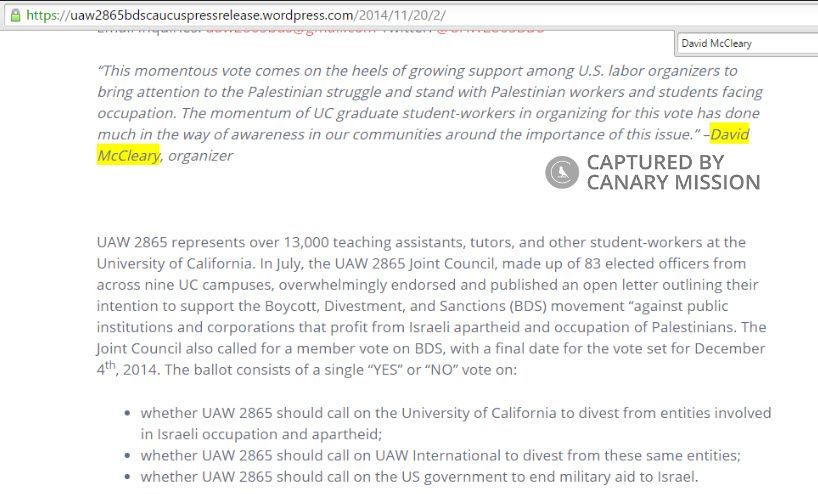
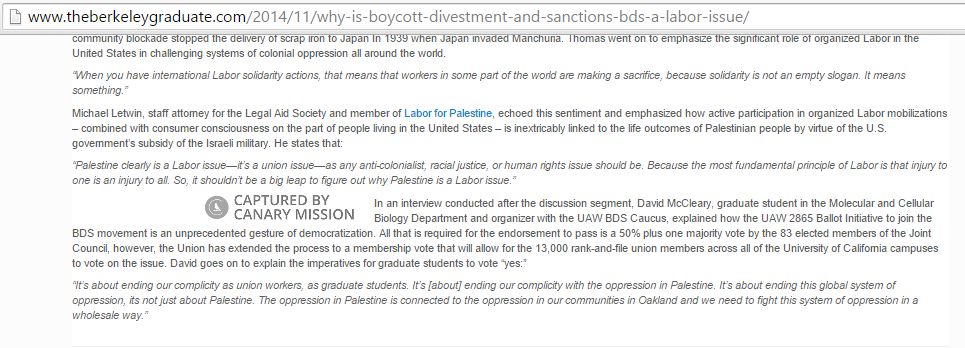
In December 2014, McCleary was listed as a press contact for the UAW BDS Caucus that launched a campaign to have the UAW 2865 vote for divestment.After the vote was proposed in July 2014, UC’s Office of the Provost circulated a cautionary letter to all Chancellors. The letter clarified the University’s position on ASEs advocating for BDS in class, stating: “the university should remain aloof from politics and never function as an instrument for the advance of partisan interest.”
On November 12, 2014, at a “BDS Caucus event,” the UAW 2865 BDS Caucus brought BDS advocates, including Arab Resource and Organizing Center (AROC) organizer Lara Kiswani, to UC Berkeley to promote the vote.
Kiswani declared: “BDS is about isolating Israel economically, politically and culturally.” She also claimed [00:00:20]: “bringing down Israel will really benefit everyone in the world, everyone in society, particularly the workers.”
In November of 2014, UAW International issued a letter reiterating its firm opposition to BDS and the California Teamsters Union, representing nearly 250,000 workers statewide, sharply criticized UAW 2865 Executive Board’s involvement with BDS.

The Teamsters said: “we cannot conceive of an action more hostile to the interests of our [Teamsters] members and more antithetical to the most basic principles of the union movement.”
UAW 2865’s BDS proposal, voted on December 4, 2014, stated: “UAW 2865 should call on the University of California (UC) and UAW International to divest their investments, including pension funds, from Israeli state institutions and international companies complicit in severe and ongoing human rights violations as part of the Israeli oppression of the Palestinian people.”
The proposal also called upon the U.S. government to end military aid to Israel.
The divestment proposal passed. However, in December 2015, UAW International overturned the UAW 2865 boycott resolution.
McCleary co-authored an article published in Mondoweiss on November 7, 2014, titled: “Unionizing solidarity with Palestine: Support grows for BDS among grassroots labor movement.”
The authors accused Israel of massacre and ethnic cleansing of Palestinians. They also praised the Block the Boat protests and UAW 2865’s BDS proposal.
Opposing A Resolution Condemning Anti-Semitism
In June 2015, McCleary opposed resolution SCR 35 that was passed by the University of California (UC) Senate, condemning anti-Semitism.The resolution, which referred to and quoted the U.S. State Department’s definition of anti-Semitism, was initiated following a series of incidents across UC campuses targeting Jewish students, including campus divestment initiatives and the vandalism of a Jewish fraternity with Nazi swastikas at UC Davis.
McCleary objected to the resolution claiming it “threatens my ability as a graduate student instructor, and the abilities of fellow student workers in the classroom, by limiting what we can say in the classroom in regards to Israel and Palestine.” He also claimed that it "vilifies Jews of a certain political orientation like myself."
SJP
SJP is a student organization engaged in anti-Israel activity on North American college and university campuses.
The first chapter of SJP was founded in 2001 at the University of California at Berkeley by Professor Hatem Bazian. Bazian has spread classic anti-Semitism, reportedly promoted religious anti-Semitism and defended the Hamas terror group. In 2004, Bazian called for “intifada” in America.
SJP organizes anti-Israel campaigns, including running annual Israel Apartheid Weeks, often in collaboration with Jewish Voice for Peace (JVP) and Muslim Students Association (MSA) campus chapters.
SJP has been a major force in pushing the anti-Semitic Boycott, Divestment, Sanctions (BDS) movement on campuses. Chapters have initiated dozens of BDS resolutions in student governments, which have been proposed on or around Jewish holidays, a time when many Jewish students are off-campus.
SJP activists have reportedly physically assaulted, intimidated and harassed Jewish students, disrupted pro-Israel campus events and demonized pro-Israel campus organizations.
Chapters have often endorsed and campaigned for numerous terrorists and whitewashed terrorism.
JVP
JVP was founded in Berkeley, California in 1996, as an activist group with an emphasis on the “Jewish tradition” of peace, social justice and human rights. The organization is currently led by Rebecca Vilkomerson and its board members include Israel critics Naomi Klein, Judith Butler, Noam Chomsky and Tony Kushner.
JVP, which generally employs civil disobedience tactics to disrupt pro-Israel speakers and events, consists of American Jews and non-Jewish “allies” highly critical of Israeli policies. A staunch supporter of the BDS movement, JVP claims to aim its campaigns at companies that either support the Israeli military (Hewlett-Packard) or are active in the West Bank (SodaStream).
Although several Jewish groups critical of Israeli policies, like J Street and Partners for a Progressive Israel, make efforts to operate within the mainstream American Jewish community, JVP functions outside. The group is often criticized for serving as a tokenized Jewish voice for the pro-Palestinian camp and is widely regarded as the BDS movement’s “Jewish wing.”
JVP denies the notion of “Jewish peoplehood” and has even gone so far as to refer to its own Ashkenazi (Jews who spent the Diaspora in European countries) leadership as “white supremacy inside of JVP.”
The Anti-Defamation League (ADL) has accused JVP of being “the largest and most influential Jewish anti-Zionist group in the United States,” and said the group “exploits Jewish culture and rituals to reassure its own supporters that opposition to Israel not only does not contradict, but is actually consistent with, Jewish value.”
The ADL also claimed that “JVP consistently co-sponsors rallies to oppose Israeli military policy that are marked by signs and slogans comparing Israel to Nazi Germany, demonizing Jews and voicing support for groups like Hamas and Hezbollah.”
According to the ADL website, JVP “uses its Jewish identity to shield the anti-Israel movement from allegations of anti-Semitism and provide it with a greater degree of legitimacy and credibility.”
BDS
The Boycott, Divestment, Sanctions (BDS) movement was founded by Omar Barghouti in 2005 to challenge “international support for Israeli apartheid and settler-colonialism.” BDS is an allegedly “Palestinian-led movement,” although leading BDS activists have admitted [00:01:01] this is not true.
One of the demands of BDS includes [point 3] what is generally known as the “right of return,” a demand discredited as a way to eliminate Israel. Barghouti said the “right of return” is a means to “end Israel’s existence as a Jewish state.”
Barghouti has said that BDS “aims to turn Israel into a pariah state, as South Africa once was.”
In his activism, Barghouti has also said [00:05:55] regarding Israel: “Definitely, most definitely, we oppose a Jewish state in any part of Palestine. No…rational Palestinian, not a sellout Palestinian, will ever accept a Jewish state in Palestine.”
The movement has been linked to numerous terrorist organizations and received a public endorsement from Hamas in 2017.
BDS initiatives include calling on institutions and individuals to divest from Israeli-affiliated companies, promoting academic and cultural boycotts of Israel, and organizing anti-Israel rallies, protests and campaigns.
The movement’s most notable achievement has been the infiltration of university campuses through lobbying for “BDS resolutions.” In these cases, student governments and student groups, backed by their own anti-Israel members and affiliates, have proposed resolutions on some form of boycott of, or divestment from, Israel and Israeli-affiliated entities.
Boycott resolutions, although non-binding, have been passed by student governments on numerous North American campuses.
BDS activity is often aggressive and disruptive. It has been noted that universities that pass BDS resolutions see a marked increase in anti-Semitic incidents on campus. On one campus, when the student government debated a BDS resolution, reports emerged of violent threats against those opposing it.
Social Media and Weblinks
Facebook:https://www.facebook.com/3329912
- Status:
- Student
- University:
- California-Berkeley
- Organizations:
- BDS,
- JVP,
- more...
- Related Profiles:
- Hatem Bazian,
- Last Modified:
- 05/04/2026
Videos

Photos & Screenshots