


What Happened to the Value of Judicial Fairness?
A Look Back on the Anniversary of the Goldstone Report in Light of Today's New Generation of Anti-Israel Lawyers
September 15, 2022, marks the 13th anniversary of the Goldstone report, the UN-commissioned judicial investigation into the 2008 Israel-Hamas conflict. The report was a full-on hit job of Israel based on erroneous facts and distortions.
Despite the fact that Hamas barraged Israeli communities with rocket fire, which they launched from Gaza’s civilian centers, the Goldstone report concluded, astonishingly, that it was Israel that was guilty of war crimes.
The report marked a stunning manipulation of the judicial process by the commission members, most of whom were lawyers. It is a case worth remembering as we face a new generation of anti-Semitic and anti-Israel lawyers. These professionals, including law professors, are similarly busy using their skills to attack the only Jewish nation in the world.

Nerdeen Kiswani
Within Our Lifetime Leader and Newly Graduated Lawyer
Nerdeen Kiswani [Nerdeen Mohsen] has called for the death of Zionists and for Israel’s destruction and spread incitement to violence as the chairperson of Within Our Lifetime (WOL), an anti-Israel activist group in New York City.

Carlton E. Williams
Israel “Lobby” Conspiracy Theorist and Law Professor
Carlton E. Williams [Carl Edward Williams] has spread hatred of Israel and America and expressed support for terrorists. Williams has also demonized Israel, endorsed anti-Israel agitators and engaged in anti-Israel activism.

Lamis Deek
Boycott Divestment and Sanction (BDS) Activist and Lawyer
Lamis Deek expressed support for terror organizations and terrorism, glorified terrorist leaders and called for intifada in America. Deek spread hatred of Zionists and Zionism, propagated anti-Israel conspiracy theories, compared Israel to Nazi Germany and expressed hatred of Israel.
Rocket Fire on Israel
The Goldstone report was commissioned by the UN as a judicial investigation of the 2008 Israel-Hamas war.
The conflict, dubbed Operation Cast Lead by Israel, began on December 27, 2008. It was then that Israel reached its limit of rocket fire on its civilian population from terrorists in Gaza. Since Israel’s pullout from Gaza in 2005, Hamas and other terror groups rained incessant rocket fire on Israel’s civilian population.
Israel’s attack on Gaza’s terrorists caught them by surprise. Israel bombarded Hamas by land, air and sea in targeted strikes. They chose their targets based on solid intelligence about the origin of the attacks.
According to the Israel Air Force, 80 percent of the bombs used were precision weapons. In addition, 99 percent of the air strikes hit their targets.
While Israel made every effort to minimize civilian casualties, Hamas operatives hid and stored weapons in civilian areas. The terrorists regularly dressed in civilian clothing and used children as human shields. Shockingly, Hamas commanders directed their operations from at least 10 Gaza hospitals.
These facts were well known at the time of the conflict.
By the end of the 22-day conflict, 1,166 Palestinians were killed, according to Israel Defense Force statistics. Of that number, at least 709 were terrorists with another 162 unidentified. A number of the Gazans who died were killed by misfired rockets launched by Hamas.
Israel sustained 13 losses (10 of which were soldiers) and rocket fire from more than 571 rockets. Terrorists also sent 205 mortar shells to Israel targeting the civilian population.
For the first time, rocket fire from Gaza reached major Israeli cities including Ashdod, Beersheba and Gedara. That put one-eighth of Israel’s civilian population in rocket fire range. The rocket fire damaged over 1,500 Israeli homes and buildings – including synagogues and schools – and destroyed 327 vehicles. Numerous agricultural fields also sustained damage.
A Distorted Judicial Mission
The conflict incensed the anti-Israel members of the UN Human Rights Council. Cuba, Egypt, and Pakistan called for a special session of the council and a resolution against Israel was subsequently passed. With the support of Russia, China and the usual anti-Israel countries, the council empowered a judicial fact-finding mission.
The judicial process was tarnished from the start. Instead of investigating Hamas for attacking Israel, the UN directed the investigators:
"to investigate all violations of international human rights law, and international humanitarian law by the occupying power, Israel, against the Palestinian people throughout the Occupied Palestinian Territory, particularly in the occupied Gaza Strip, due to the current aggression."
Shockingly, there was no mention of the cause of the war. Israel was named as “the occupying power” despite withdrawing from Gaza three years prior to the conflict. The council all but excused Hamas for the incessant and unprovoked rocket fire they aimed at Israel’s civilians.
Due to the prejudicial bias of the mission, Israel declined to cooperate with the investigation. instead, it conducted its own.
Judicial Bias by Mission Members
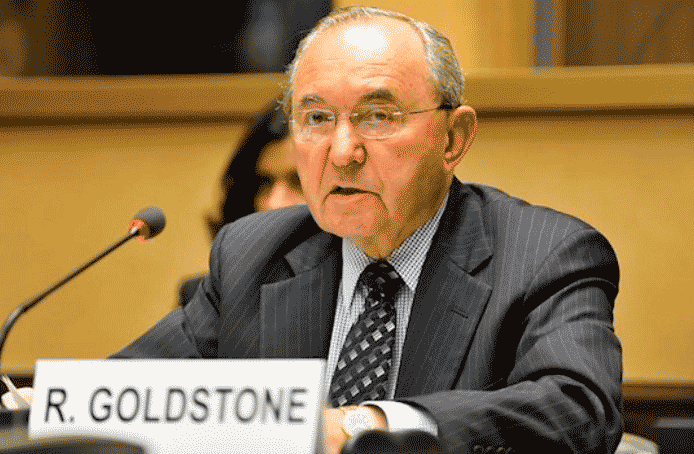
Judge Richard Goldstone at a UN Human Rights Council Meeting in Geneva (Photo: UN-Geneva)
In addition to the mission’s head, lawyer and judge Richard Goldstone, there were three other members of the UN fact-finding mission to Gaza:
Christine Chinkin, a lawyer and international law professor at the London School of Economics
Hina Jilani, an advocate of the Supreme Court of Pakistan and member of the International Commission of Inquiry on Darfur in 2004
Desmond Travers, a teacher of military affairs who was on the board of directors of the Institute for International Criminal Investigations in The Hague
Before the mission even set off, Chinkin signed an editorial published in the Sunday Times calling Operation Cast Lead a war crime.
Travers gave an interview in the Middle East Monitor rejecting the concept of “asymmetric warfare.” Namely, he dismissed the fact that when terrorists embed themselves in civilian populations, it changes the nature of warfare. To him, hospitals, residential areas, mosques and schools remain civilan even if they are being used as launching pads for rocket fire.
After his Gaza visit, Travers asserted in Harper’s Magazine:
“We found no evidence that mosques were used to store munitions. Those charges reflect Western perceptions in some quarters that Islam is a violent religion.”
Yet, when Travers visited Gaza, he only inspected two mosques. His lack of sufficient investigation was possibly due to his ideological bias.
After the visit, he concluded there was “no evidence that mosques were used to store munitions.”
Yet as noted by the Jerusalem Center for Public Affairs (JCPA),
“He did not even think that he needed to be more thorough, for he dismissed the very possibility that anyone would hide munitions in a place of worship. In contrast, earlier this year, Col. Tim Collins, a British veteran of the Iraq War, visited Gaza for BBC Newsnight and actually inspected the ruins of a mosque that Israel had destroyed because it had been a weapons depot. He found that there was evidence of secondary explosions caused by munitions stored in the mosque cellar.”
Hamas Guides the Mission
The Goldstone panel visited Gaza with only Hamas operatives as their guides. A typical example of their investigation can be seen in the case of Muhammad Abu Askar, a long-standing Hamas member.
Askar complained to the Goldstone commission that his house was unjustly blown up. (He did admit that Israel warned him in advance.) As just one of the “war crimes” the commission accused Israel of, the report deemed Askar’s house was of an “unmistakably civilian nature.”
However, we are privy to the bigger picture. The Goldstone commissioners posted videos of their investigations. In the case of Askar, one sees the commissioners asking Askar many detailed questions. They ask him many details – about the warning, the location of his house and more. However, as the JCPA notes,
“The most pivotal question that would help them determine whether Abu Askar’s house was purely civilian in nature or was a legitimate military target was not asked. No one bothered to confront him with the unpleasant but necessary question of whether Hamas munitions were being stored in his house.”
And in fact, they were. This was a fact known to Israeli forces, hence the targeting of his house. According to a January 2010 Israel Defense Force investigation,
“ … It turned out that the cellar and other parts of Abu Askar’s house served as a storage facility for large stockpiles of weapons and ammunition, including Iranian-supplied Grad rockets that had been used against Israeli cities like Ashkelon, Ashdod, and Beersheba. Indeed, the area around the house had been used as a launch site for attacking many Israeli towns and villages.”
Accusations of War Crimes
Askar’s case was typical of the incidents enumerated in the Goldstone Report. Specifically and throughout the report, the fact that Hamas was operating in civilian areas was not taken into consideration by the commissioners.
Thus, it was easy for the commissioners to conclude that Israel was guilty of war crimes. Between their willful blindness to the facts and pre-conflict ideological convictions, It was a foregone conclusion.
Goldstone’s Retraction
Astonishingly and to his credit, Judge Richard Goldstone, the report’s namesake and chief commissioner, later repudiated the report. Writing in The Washington Post less than two years after the publication of the Goldstone Report, the judge stated,
“If I had known then what I know now, the Goldstone Report would have been a different document.”
In his retraction, Goldstone claimed,
“The allegations of intentionality by Israel were based on the deaths of and injuries to civilians in situations where our fact-finding mission had no evidence on which to draw any other reasonable conclusion.”
It’s an ingenuous claim from someone who allowed Hamas to set the narrative for the investigation and subsequently believed it. Still, it was a welcome admission.
In his article, Goldstone implied that the Israeli military’s independent investigation of the incidents outlined in the report were crucial:
“While the investigations published by the Israeli military and recognized in the U.N. committee’s report have established the validity of some incidents that we investigated in cases involving individual soldiers, they also indicate that civilians were not intentionally targeted as a matter of policy.”
Goldstone claimed to have had no knowledge of the distortions of the facts at the time of his investigation. Yet, if not for the judicial bias clouding the investigation, simple logic would have dictated that Hamas guides would not be objective.
After Goldstone’s retraction, the three other commissioners doubled down on the veracity of the report.
For the radical anti-Israel crowd wedded to their distorted ideology – both those participating in Goldstone’s mission and today’s new crop of lawyers and professors – judicial fairness is not a consideration.