Overview
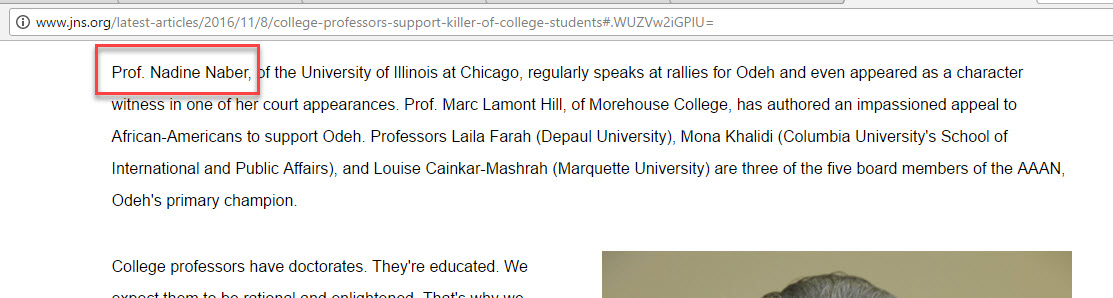
Nadine Naber has
collaborated with and
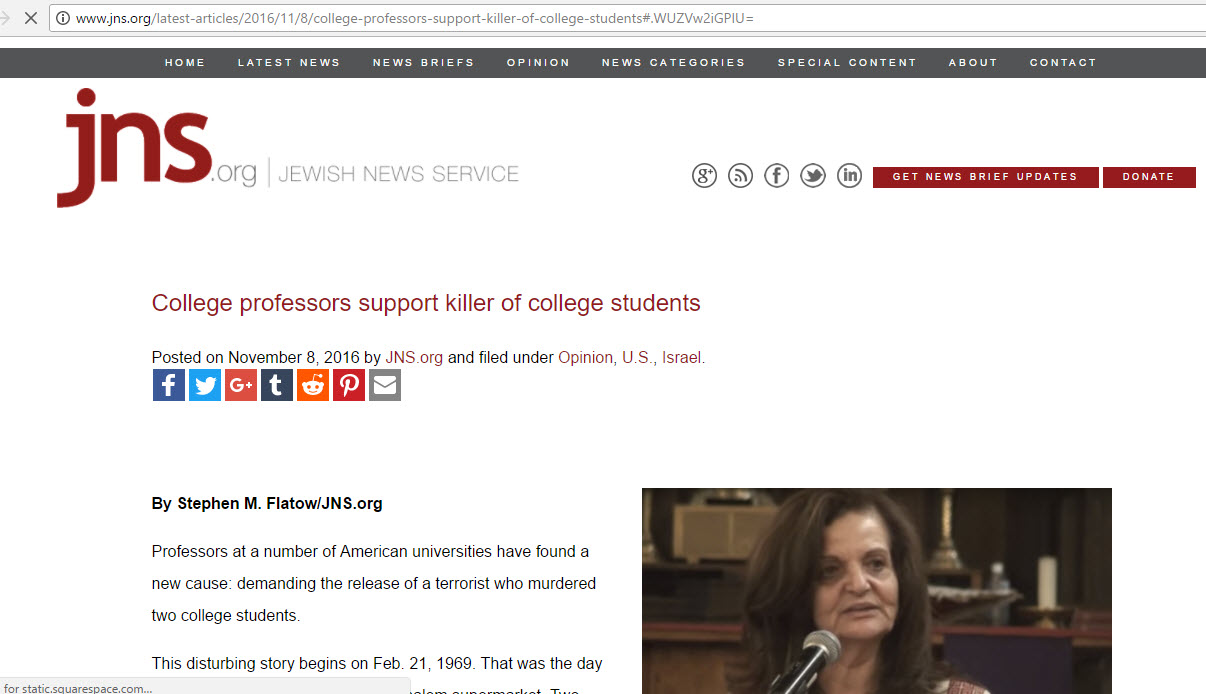
defended convicted terrorist Rasmea Odeh and
spoke as a character witness at one of Odeh’s court appearances.
In her writing, Naber has conflated
feminism and the Black
struggle in the United States with Palestinians in Israel,
denied the Jewish connection to the land of Israel and suggested a conspiracy between the United States and Israel to subjugate Arabs and other minorities.
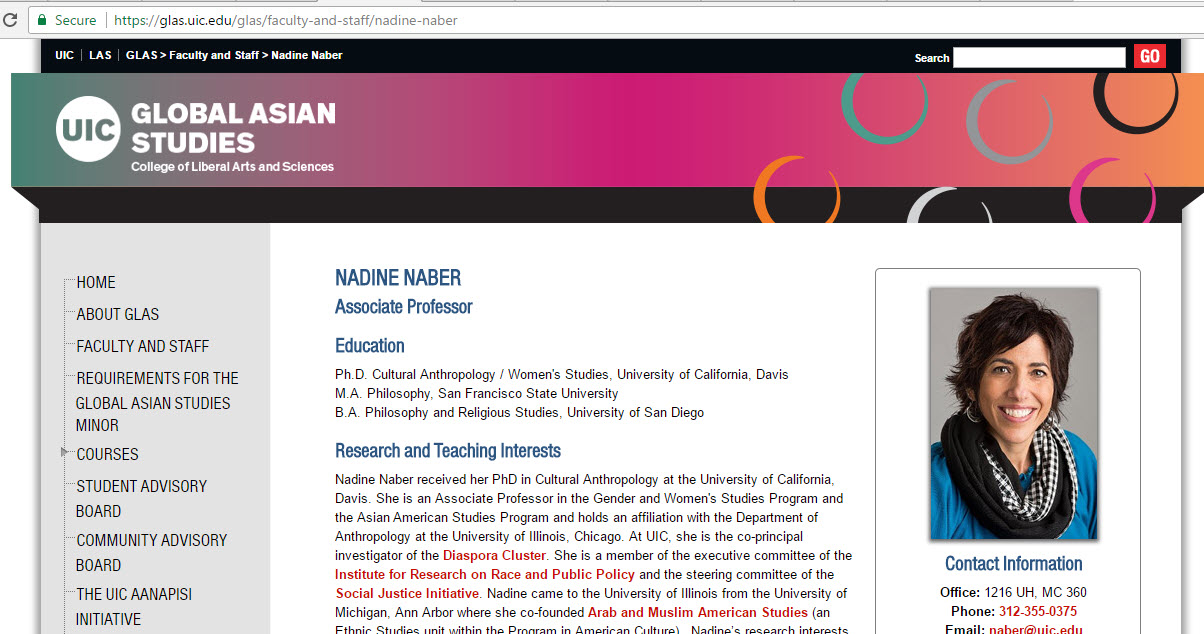
Naber is a
professor in the Global Asian Studies department at the University of Illinois at Chicago (U of I).
Defending Rasmea Odeh
Naber
spoke as a character witness at a court appearance for convicted terrorist Rasmea Odeh.
On January 14, 2015, Naber published an article in which she
defended Odeh.
In the article, Naber suggested that Odeh’s 2014 conviction was the result of an anti-Palestinian conspiracy, stating that “Rasmea Odeh is a dedicated community leader and Palestinian-American activist.
No wonder the US government went after her.” In the article, Naber also mentioned workshops she conducted alongside Odeh.
On October 19, 2016, Naber published another article
defending Odeh.
In the article, Naber stated that “all Palestinians are threatened by the same acts of violence [Odeh] has endured, including military invasion, ethnic cleansing of villages, multiple forced displacements, and torture and sexualized violence in Israeli prison.”
Later in the article, Naber attributes Odeh’s conviction to her claim that “U.S. backed Israeli colonization works hand in hand with the U.S. criminal justice and immigration systems.”
Naber was a speaker at an
event on March 8, 2016, whose purpose was “to celebrate the granting of the appeal of Rasmea Odeh’s unjust conviction and learn about ways to organize in her defense.”
On May 15, 2017, Naber
participated in a lecture alongside Odeh. The event was sponsored by
SJP, as a part of their Israel Apartheid Week program.
Support for BDS
On April 9, 2017, Naber
co-authored an article entitled, “Why Voting Matters: The American Anthropological Association’s Upcoming Vote to Boycott Israeli Academic Institutions.”
In the article, the authors accuse Israel of settler colonialism and call upon all members of the AAA to vote in favor of the BDS petition.
Naber was one of the AAA members who
submitted the petition to boycott Israeli academic institutions.
In an article discussing the AAA petition, Naber was
cited comparing BDS to the bus boycotts for civil rights in America.
Naber
signed a petition, published on January 8, 2014, in support of the American Studies Association’s (ASA) decision to join in the academic boycott of Israel.
On February 22, 2014, Naber was
featured on a panel discussion entitled, “Ending the Occupation: A panel on the academic & cultural boycott of Israel.”
In an article, published on November 25, 2013 about the ASA boycott, Naber is
quoted praising the petition, stating that "This is just one way the resolution creates new openings for academic freedom and the perspectives that dominant U.S. and Israeli discourses systematically ignore, crush, and silence."
Naber
signed a petition, published on January 28, 2009, entitled “International Writers and Scholars Endorse Academic Boycott of Israel.”
The petition, published by the Palestinian Campaign for the Academic and Cultural Boycott of Israel (PACBI) claimed that “the Israeli state has systematically dispossessed, starved, tortured, and economically exploited the Palestinian people.”
Demonizing Israel
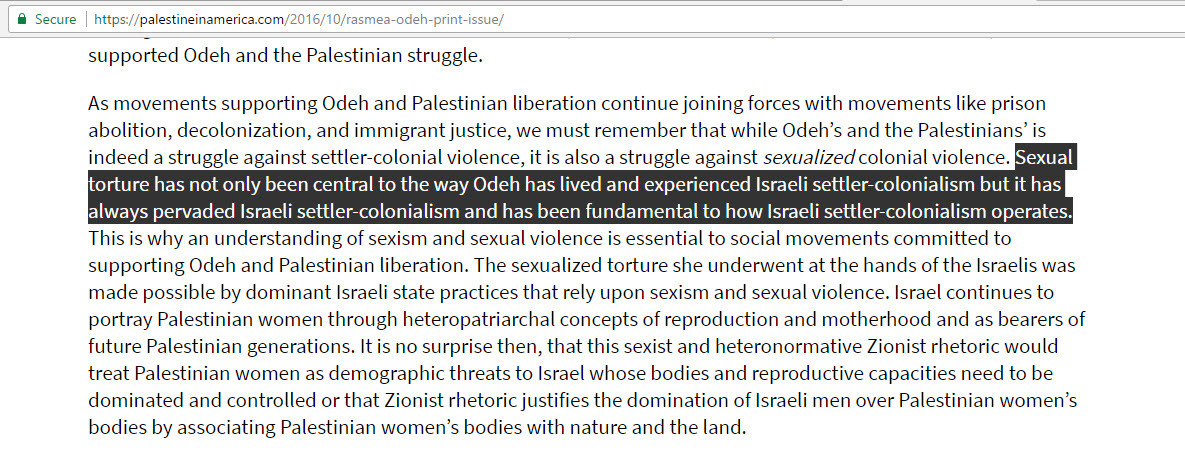
In an article
published on October 19, 2016, Naber claimed “Sexual torture… has always pervaded Israeli settler-colonialism and has been fundamental to how Israeli settler-colonialism operates.”
In the same article, Naber went on to state that, “Zionist rhetoric justifies the domination of Israeli men over Palestinian women’s bodies by associating Palestinian women’s bodies with nature and the land.”
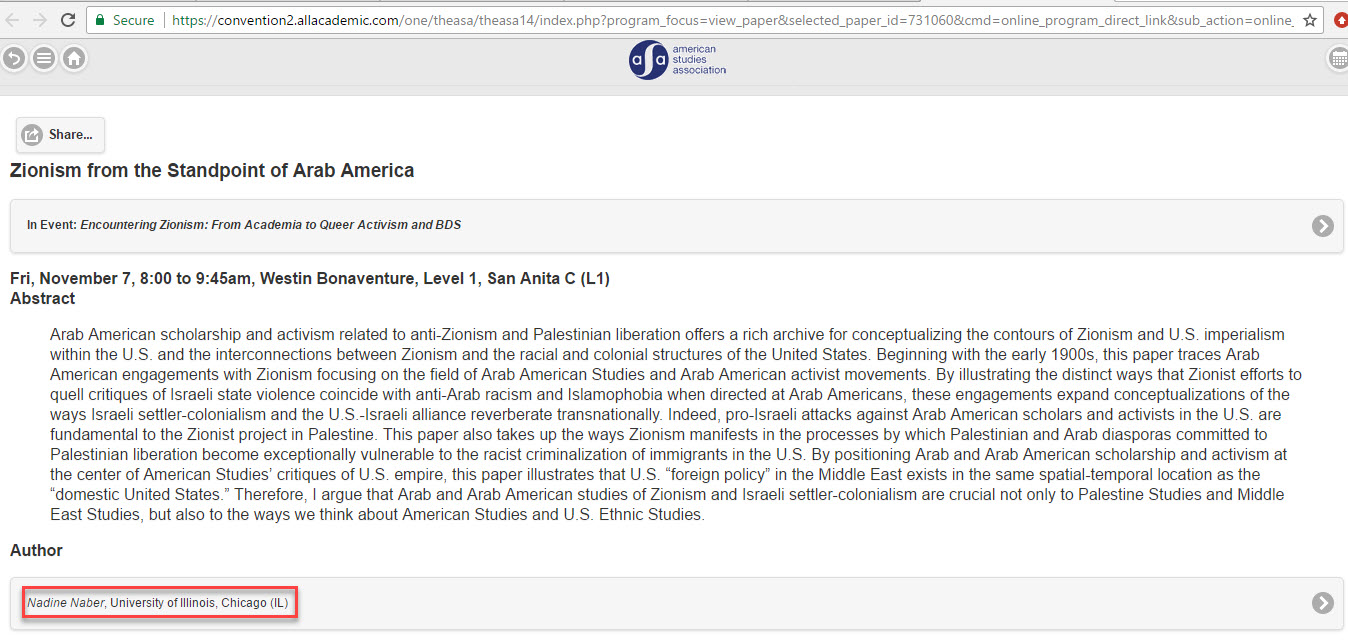
On November 7, 2014, Naber
presented a lecture on an article she had written, entitled “Zionism from the Standpoint of Arab America.”
In her presentation, Naber accused Israel of settler colonialism and imperialism and claimed that “pro-Israeli attacks against Arab American scholars and activists in the U.S. are fundamental to the Zionist project in Palestine.”
In 2001, Naber
co-authored an article entitled, “The Forgotten ‘ism’: An Arab American Women’s Perspective on Zionism, Racism and Sexism.”
In the article, the authors claim that “Zionism is a form of racism not only in Palestine, but internationally. As a political project, Zionism sought to establish itself as a colonial implant on Arab land.”
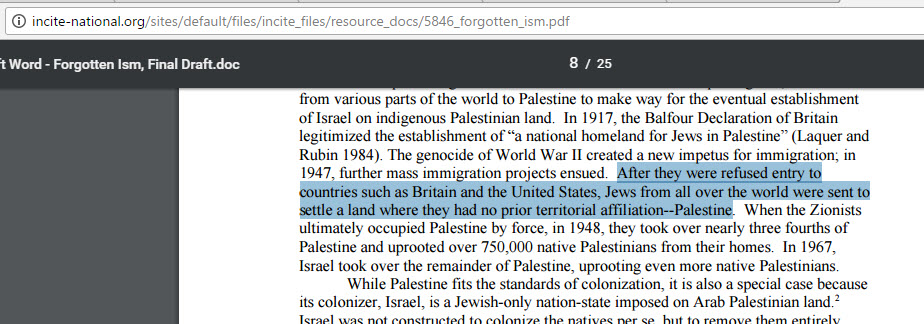
Later, the authors deny Jewish connection to Israel, stating that “After they were refused entry to countries such as Britain and the United States, Jews from all over the world were sent to settle a land where they had no prior territorial affiliation--Palestine.”
The authors went on to describe an international conspiracy in which “Israel has shared its military expertise with other abusive, undemocratic regimes across the globe, and Israeli intelligence training has been central to the development of oppressive regimes throughout much of the global south.”
Conflating the Palestinian Cause with American Political Struggles
On May 31, 2016, Naber published an article
conflating the Black struggle in the U.S. to the Palestinian cause in Israel.
Naber
expounded upon this idea, adding to it the feminist movement, in her article, “Arab and Black Feminisms Joint Struggle and Transnational Anti-Imperialist Activism.”
In the article, Naber spoke about her personal involvement in the effort to define Zionism as racism and charged that in Israel, “sexualized state violence against the Palestinians has been a systematic and deliberate strategy of colonization.”
SJP
SJP is a student organization engaged in anti-Israel activity on North American college and university campuses.
The first chapter of SJP was founded in 2001 at the University of California at Berkeley by Professor Hatem Bazian. Bazian has spread classic anti-Semitism, reportedly promoted religious anti-Semitism and defended the Hamas terror group. In 2004, Bazian called for “intifada” in America.
SJP organizes anti-Israel campaigns, including running annual Israel Apartheid Weeks, often in collaboration with Jewish Voice for Peace (JVP) and Muslim Students Association (MSA) campus chapters.
SJP has been a major force in pushing the anti-Semitic Boycott, Divestment, Sanctions (BDS) movement on campuses. Chapters have initiated dozens of BDS resolutions in student governments, which have been proposed on or around Jewish holidays, a time when many Jewish students are off-campus.
SJP activists have reportedly physically assaulted, intimidated and harassed Jewish students, disrupted pro-Israel campus events and demonized pro-Israel campus organizations.
Chapters have often endorsed and campaigned for numerous terrorists and whitewashed terrorism.
BDS
The Boycott, Divestment, Sanctions (BDS) movement was founded by Omar Barghouti in 2005 to challenge “international support for Israeli apartheid and settler-colonialism.” BDS is an allegedly “Palestinian-led movement,” although leading BDS activists have admitted [00:01:01] this is not true.
One of the demands of BDS includes [point 3] what is generally known as the “right of return,” a demand discredited as a way to eliminate Israel. Barghouti said the “right of return” is a means to “end Israel’s existence as a Jewish state.”
Barghouti has said that BDS “aims to turn Israel into a pariah state, as South Africa once was.”
In his activism, Barghouti has also said [00:05:55] regarding Israel: “Definitely, most definitely, we oppose a Jewish state in any part of Palestine. No…rational Palestinian, not a sellout Palestinian, will ever accept a Jewish state in Palestine.”
The movement has been linked to numerous terrorist organizations and received a public endorsement from Hamas in 2017.
BDS initiatives include calling on institutions and individuals to divest from Israeli-affiliated companies, promoting academic and cultural boycotts of Israel, and organizing anti-Israel rallies, protests and campaigns.
The movement’s most notable achievement has been the infiltration of university campuses through lobbying for “BDS resolutions.” In these cases, student governments and student groups, backed by their own anti-Israel members and affiliates, have proposed resolutions on some form of boycott of, or divestment from, Israel and Israeli-affiliated entities.
Boycott resolutions, although non-binding, have been passed by student governments on numerous North American campuses.
BDS activity is often aggressive and disruptive. It has been noted that universities that pass BDS resolutions see a marked increase in anti-Semitic incidents on campus. On one campus, when the student government debated a BDS resolution, reports emerged of violent threats against those opposing it.
Social Media and Weblinks