Lara Deeb
Overview
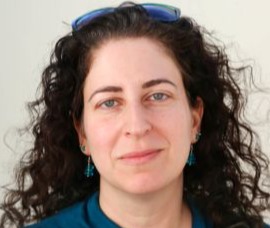
Lara Deeb is a supporter of the Boycott, Divestment, Sanctions (BDS) movement and often defends Hezbollah in her scholarly work.
Deeb’s areas of research and study are gender and sexuality, Islam and the Middle East. Much of her Middle East-related academic work focuses on the Shia Muslim suburbs of Beirut, Lebanon, which serve as a power base for Hezbollah. Deeb urges her students to support BDS, claiming she is a “responsible model of solidarity and political action” for them.
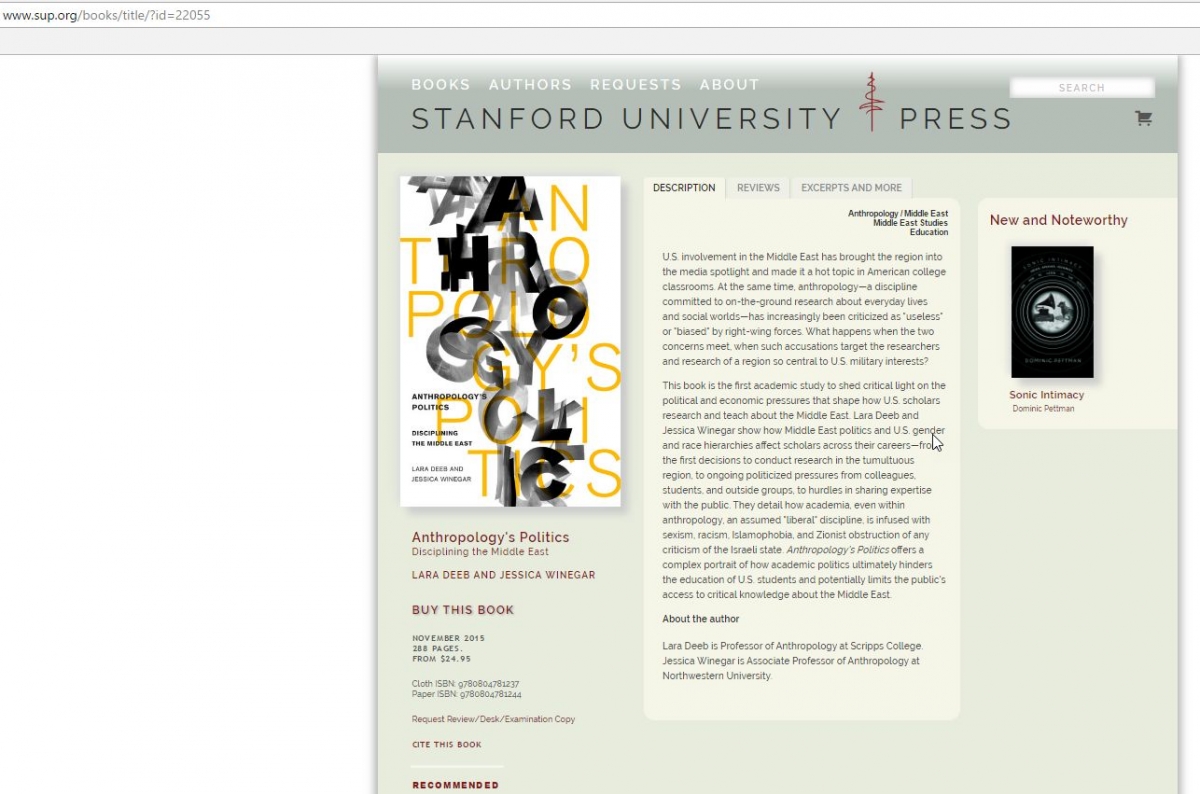
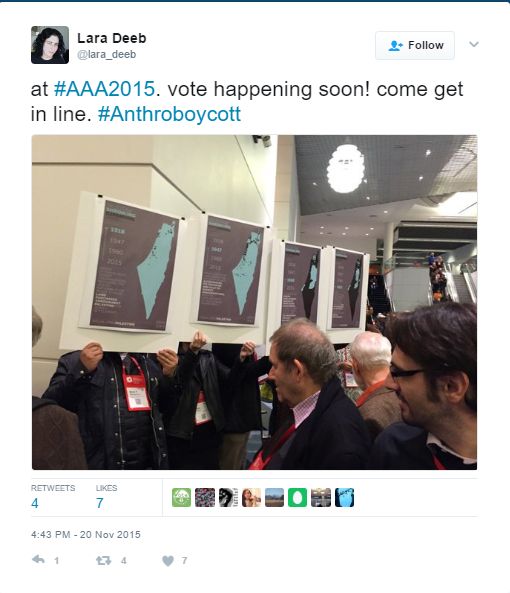
In November of 2015, Deeb co-authored a book with Professor Jessica Winegar titled “Anthropology’s Politics — Disciplining the Middle East.” In the book, they discussed how academia and the field of Middle Eastern anthropology “is infused with sexism, racism, Islamophobia, and Zionist obstruction of any criticism of the Israeli state.”Deeb is a member of the American Anthropological Association (AAA) and was part of a group that unsuccessfully lobbied in 2016 for an AAA boycott of Israeli academic institutions.
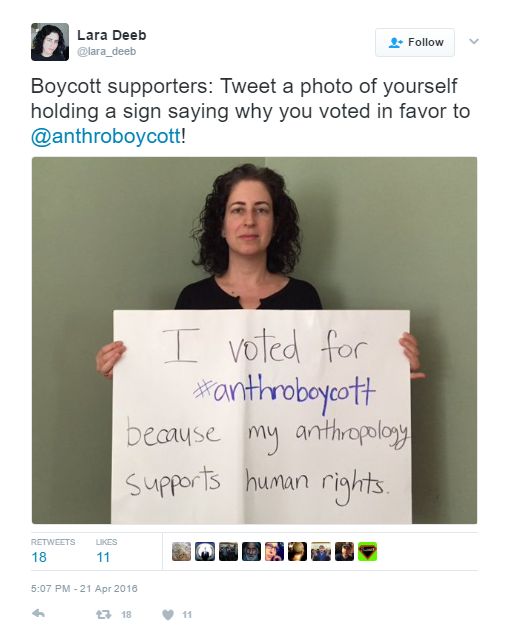
Deeb is a member of the eight-person organizing collective of Anthropologists for the Boycott of Israeli Academic Institutions (Anthro Boycott), which was the primary body advocating for the boycott.
Deeb uses her Twitter account to promote BDS, having posted the hashtag “#anthroboycott” to Twitter hundreds of times. She is a member of the Facebook groups Al-Awda News and Al-Awda Los Angeles.
Deeb is the Department of Anthropology chair at Scripps College (Scripps), part of the Claremont Colleges in Claremont, California.
Deeb received her Ph.D and master’s degrees in Anthropology from Emory University. She received her bachelor’s degree in Medical Anthropology from Brown University in 1995.
Deflecting Hezbollah’s Anti-Semitism
In the spring of 2011 — in a review of a book about Hezbollah — Deeb defended the anti-Semitism of Hezbollah leader Sheikh Hassan Nasrallah. Deeb referenced a 1998 Nasrallah statement that Israel is “the state of the Zionist Jews, the descendants of apes and pigs” and that Israel’s founding was a “historic catastrophe and tragic event,” claiming that the quotes were not proof that Nasrallah is an anti-Semite.
Deeb admitted that the “lines do appear in the text” of a Hezbollah publication. She claimed, however, that the quote did not prove the book author’s statement that Nasrallah espouses “racist hatred of Jews” since the author took the quote from a “collection of Nasrallah’s speeches” where the Shia leader also “emphasizes that Hizballah’s fight is with Israel and not with Jews.”
Despite Deeb’s assertions, Nasrallah in the same speech used classic anti-Semitic tropes in the context of Israel, saying: “To the murderers of the prophets, the grandsons of apes and pigs,' we say: ... 'Death to Israel...'" Deeb wrote in the same article: “Hence, since the 1990s Nasrallah has been customarily clear in distinguishing between the state of Israel and its Zionist supporters, including Zionist Jews, on one side, and the Jewish people in general on the other.”
On February 23, 2006, Nasrallah praised Holocaust denier David Irving for having “denied the existence of gas chambers.” This sentiment was consistent with an April 9, 2000 statement, where Nasrallah said: “Jews invented the legend of the Holocaust.”
On October 23, 2002, Nasrallah said: “If they (the Jews) all gather in Israel, it will save us the trouble of going after them worldwide.”
Deeb also claimed that Israel is to blame for Arab anti-Semitism. She wrote: “Anti-Semitic prejudice is not limited to Hizballah supporters or to Shi‘i Muslims in Lebanon. The Israeli state’s own conflation of Zionism, Judaism and Israeli identity (as with Israel’s granting of citizenship on the basis of religion) has contributed to the conflation between Zionists, Israelis and Jews in Lebanon and the Arab world.”
Deeb added that Hezbollah’s 2009 manifesto is not anti-Semitic since it does not contain explicit hatred towards Jews, but of Israel. The manifesto blames Israel for all strife in the Middle East since the United States is “[p]roviding the Zionist entity with stability guarantees, in such a way that allows this entity to play the role of a cancerous gland that absorbs and sucks out all the energies and capabilities of the nation as to destruct its ambitions and aims.”
Deeb wrote in the book review: “The purging of anti-Semitic rhetoric from Hizballah’s discourse indicates a change not only in public presentation, but also in the ways that language about the enemy is being communicated to Hizballah’s supporters.”
Obscuring Hezbollah’s Terrorist Activities
On July 31, 2006, Deeb — during Israel’s Second Lebanon War against Hezbollah — wrote a scholarly paper where she dismissed the notion of calling Hezbollah “terrorists” and offered a more sympathetic view of the Shia Lebanese organization.
Deeb cast doubt on Hezbollah’s involvement in multiple terror attacks and argued that the label of “terrorist” could not apply to Hezbollah given their social services programs and prominence within Lebanese politics.
Among the terror attacks Deeb cast doubt upon was the 1994 bombing of an important Argentinian Jewish center in Buenos Aires that she claimed was an “Israeli...cultural center.” The suicide car bombing at the center killed 85 and injured over 300. She also listed the 1983 attack on U.S. Marine barracks in Beirut where among the 241 dead were 220 Marines, a 1985 airplane hijacking where Hezbollah singled out Jews and Israelis, and the 1992 bombing of the Israeli embassy in Buenos Aires where 29 died and over 240 were injured.
Deeb wrote: “Hizballah’s involvement in these attacks remains a matter of contention, however. Even if their involvement is accepted, it is both inaccurate and unwise to dismiss Hizballah as ‘terrorists.’”
Deeb proposed that just because Hezbollah could not destroy Israel given the “great asymmetry in military might” between the parties, then that meant it did not want to. She dismissed Hezbollah’s calls for Israel’s annihilation as “rhetoric.”
Deeb made her case by quoting a foundational 1985 Hezbollah document calling for Israel’s “final obliteration from existence and the liberation of venerable Jerusalem from the talons of occupation.” However, she claimed it was a false “notion that Hizballah’s raison d’etre is the destruction of Israel” and dismissed such statements as “rhetoric.”
Defending Hezbollah and Vilifying Israel
On July 31, 2006, Deeb wrote that Israel wanted to commit “ethnic cleansing” during the 2006 war since its goal of “the ‘removal’ of Hizballah from the south” of Lebanon was impossible due to high levels of support for the group. She wrote: “To claim ridding south Lebanon of Hizballah as a goal risks aiming for the complete depopulation of the south, tantamount to ethnic cleansing of the area.”
In the spring of 2011, Deeb again defended Hezbollah, stating that its July 12, 2006 raid into Israel — resulting in three dead Israeli soldiers and two kidnapped into Lebanon — should not have been met with a war since it was outside of the “rules of the game.”
Deeb criticized reporter Thanassis Cambanis for writing a 2010 book where, in Deeb’s words, he said that “Hizballah is the aggressor in an ‘endless war against Israel.’” Deeb added: “So it is strange that the rest of the book consistently emphasizes that Hizballah ‘provoked’ the war, at times in a way that suggests intent. Toward the beginning, he states point blank, ‘Hizballah on its own started the 2006 war.’”
Deeb concluded her article: “The success of Hizballah in Lebanese politics, indeed, is proof positive that Arab parties grow closer to the heart of public opinion the more firmly they reject ‘accommodation’ with Israel as it proceeds with its dispossession of the Palestinians and deepens its hold upon occupied Arab lands.”
Accusations of a Zionist Conspiracy
On January 6, 2016, Deeb and Jessica Winegar — in an article promoting their “Anthropology’s Politics — Disciplining the Middle East” book — published an excerpt in which they effectively admitted that their conclusions that “anthropology is not immune to compulsory Zionism in the academy” were based largely on the emotions of their subjects and only loosely on documentation.
They wrote: “Despite the fact that the vast majority of our interlocutors have not personally experienced such menacing opposition to their tenure or retention, they still expressed apprehension, a sense that working on the region was a ‘minefield,’ and fears that they could easily be targeted by right-wing and/or Zionist organizations because of their teaching, public lectures, or research, and that their institutions would not necessarily protect them.”
Deeb and Winegar further claimed in their book that the case of Steven Salaita, the Edward Said Chair of American Studies at the American University of Beirut (AUB), was an example of “[e]xternal community organizations, sometimes cooperating with people on campus, targeted these academics for taking anti-Zionist political positions, being assumed to take such positions, being Palestinian, simply asking scholarly questions that call Zionist assumptions into question, or some combination thereof.”
In 2014, The University of Illinois withdrew an offer of employment to Salaita after becoming aware of his anti-Semitic tweets. One tweet, posted shortly after Hamas kidnapped three teenage Israeli high school students, read: "You may be too refined to say it, but I’m not: I wish all the f**king West Bank settlers would go missing.” In 2017, Salaita posted to Facebook: “People ask if I would go back in time and change anything. I would not…I will die unapologetic.” In February 2019, Salaita stated that he had become a school bus driver in the Washington, D.C., area.
Radicalizing Anti-Israel Student Activists
On August 25, 2015, Deeb — in an article promoting the Anthro Boycott — portrayed student “activists” in the anti-Israel groups Students for Justice in Palestine (SJP) and Jewish Voice for Peace (JVP) as part of mainstream American society where “[c]ompulsory Zionism is pernicious because it is deeply ingrained.” She wrote that “[q]uite a few...activists” with SJP and JVP made up her class on “analyzing representations of and mostly by Palestinians.”
Deeb wrote: “Students talked about living in a context where compulsory Zionism was continually reinforced, not only by external organizations... family members, or roommates, but also from a place within themselves.”
Deeb said they ended the academic period with a discussion on actions students could take against Israel which included BDS and “action beyond campus, ranging from joining the International Solidarity Movement to blogging or becoming a journalist.”
The International Solidarity Movement (ISM) was founded in 2001. It works with terror groups and has encouraged its foreign volunteers to act “as human shields in cities, towns and refugee camps.” At least once, ISM facilities have been used in attempts to facilitate the escape of known terrorists from Israeli security forces.
ISM has encouraged its volunteers to break curfew and disregard Israeli directives prohibiting access to closed military zones. On July 14, 2004, ISM co-founder George N. Rishmawi told the San Francisco Chronicle why ISM recruits student volunteers. “When Palestinians get shot by Israeli soldiers, no one is interested anymore,” he said. “But if some of these foreign volunteers get shot or even killed, then the international media will sit up and take notice.”
Advocating For A Terrorist
On October 24, 2014, Deeb signed a petition defending terrorist Rasmea Odeh titled “Feminist scholars to Obama: End prosecution of Palestinian survivor of sexual torture.”
Odeh was a key military operative [00:02:08]with the terrorist group the Popular Front for the Liberation of Palestine (PFLP). In 1969, Odeh masterminded a PFLP bombing that killed two college students in a Jerusalem supermarket. Odeh also attempted to bomb the British consulate.
Odeh confessed, in a highly detailed account, the day following her arrest. In a 2004 documentary, one of Odeh’s co-conspirators directly implicated [00:10:53] Odeh as the mastermind.
In 1970, an Israeli court tried and convicted Odeh for her involvement in both bombings and sentenced her to life imprisonment. However, Odeh was released 10 years later, in a prisoner swap and emigrated to the United States.
On November 10, 2014, a Michigan federal jury convicted Odeh for immigration fraud because she failed to disclose her prior conviction and life sentence on her immigration application. On March 12, 2015, she was sentenced to 18 months in prison.
In 2017, after an appeal and a lengthy court battle, Odeh admitted to immigration fraud, was stripped of her U.S. citizenship, deported to Jordan and banned from re-entering the U.S.
The petition Deeb signed called on the American Department of Justice to drop the charges against Odeh and recognized her as “a leader in the international struggle to empower women and end violence against women.”
Demonizing Israel to Promote BDS
In a November 18, 2015 tweet, Deeb quoted fellow Anthro Boycott activist Nadia Abu El-Haj as saying: “Abu El-Haj: Israeli state practices racism while insisting that there is no racialization in the state #Anthroboycott.” On October 27, 2014, Deeb — in an Anthro Boycott blog post co-authored with Fida Adely — criticized proponents of “balance” when discussing the Arab-Israeli conflict.
BDS
The Boycott, Divestment, Sanctions (BDS) movement was founded by Omar Barghouti in 2005 to challenge “international support for Israeli apartheid and settler-colonialism.” BDS is an allegedly “Palestinian-led movement,” although leading BDS activists have admitted [00:01:01] this is not true.
One of the demands of BDS includes [point 3] what is generally known as the “right of return,” a demand discredited as a way to eliminate Israel. Barghouti said the “right of return” is a means to “end Israel’s existence as a Jewish state.”
Barghouti has said that BDS “aims to turn Israel into a pariah state, as South Africa once was.”
In his activism, Barghouti has also said [00:05:55] regarding Israel: “Definitely, most definitely, we oppose a Jewish state in any part of Palestine. No…rational Palestinian, not a sellout Palestinian, will ever accept a Jewish state in Palestine.”
The movement has been linked to numerous terrorist organizations and received a public endorsement from Hamas in 2017.
BDS initiatives include calling on institutions and individuals to divest from Israeli-affiliated companies, promoting academic and cultural boycotts of Israel, and organizing anti-Israel rallies, protests and campaigns.
The movement’s most notable achievement has been the infiltration of university campuses through lobbying for “BDS resolutions.” In these cases, student governments and student groups, backed by their own anti-Israel members and affiliates, have proposed resolutions on some form of boycott of, or divestment from, Israel and Israeli-affiliated entities.
Boycott resolutions, although non-binding, have been passed by student governments on numerous North American campuses.
BDS activity is often aggressive and disruptive. It has been noted that universities that pass BDS resolutions see a marked increase in anti-Semitic incidents on campus. On one campus, when the student government debated a BDS resolution, reports emerged of violent threats against those opposing it.
Social Media and Weblinks
Facebook:https://www.facebook.com/669675177/
Twitter:https://twitter.com/lara_deeb
University Website:http://www.scrippscollege.edu/academics/faculty/profile/lara-deeb
- Status:
- Professor
- University:
- Scripps
- Organizations:
- BDS
- Related Profiles:
- Kimberly Drake,
- Priya Prabhakar,
- Emma Li,
- Last Modified:
- 05/04/2026
Photos & Screenshots