Julie Peteet
Overview
Julie Peteet has compared Israel to Apartheid South Africa and described it as a colonialist state in her books and scholarly articles. She supports the Boycott, Divestment, Sanctions (BDS) movement and is listed as one of the professors who proposed the 2014 American Anthropological Association’s (AAA) boycott of Israel.
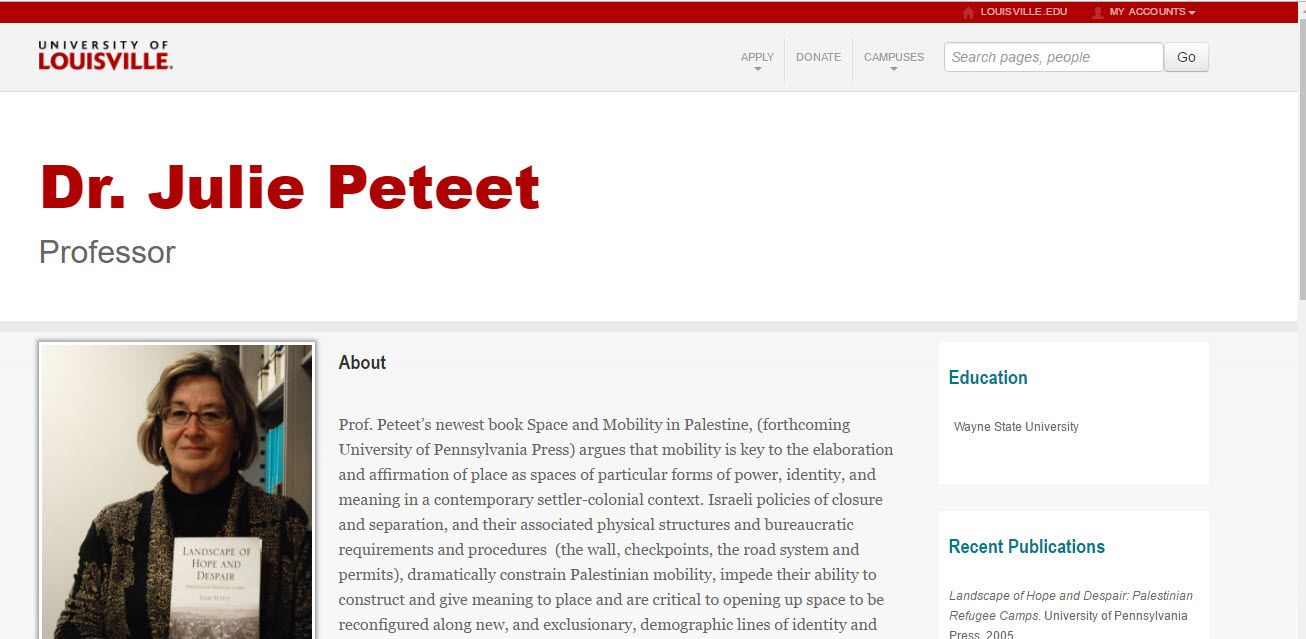
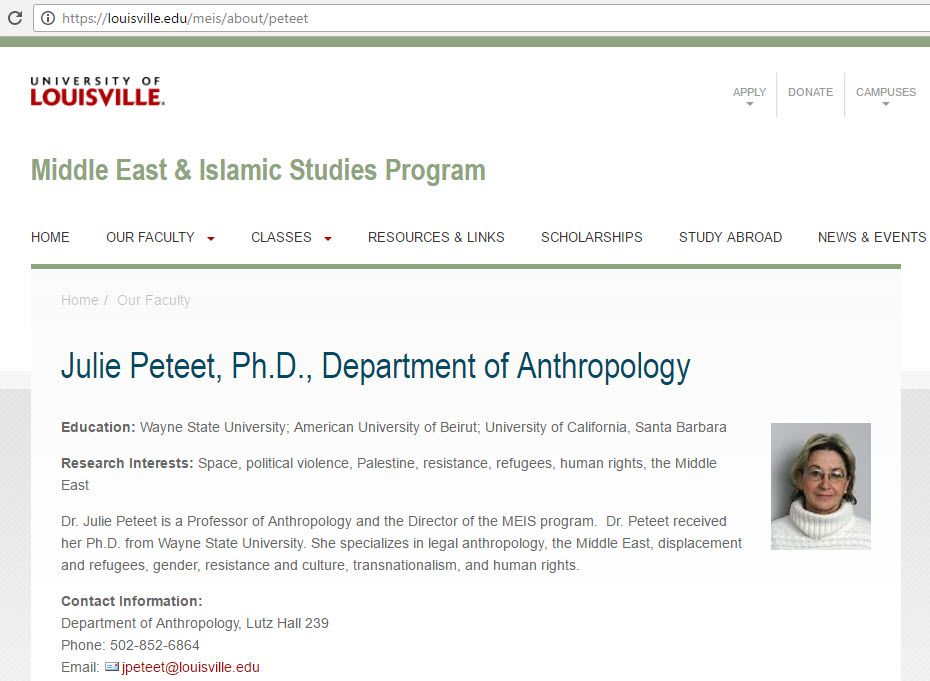
Peteet is a professor of anthropology and the director of the Middle East and Islamic Studies program at the University of Louisville (UL).
Demonizing Israel
In the winter of 2016, Peteet authored an article entitled, "The Work of Comparison: Israel/Palestine and Apartheid."
In the summer of 2016, Peteet published another article, in which she drew A comparison between Israel and Apartheid South Africa. In the article, Peteet stated that, "Zionism, as put into practice, calls for an exclusivist state, that leads to policies characteristic of apartheid, as defined by the U.N."
Later in the same article, Peteet claimed that "by the terms of international law, there is apartheid in the Palestinian lands occupied by Israel in 1967. The Israeli system of rule over the Palestinians can be credibly described, and to some extent analyzed, as something akin to apartheid as it was practiced in South Africa until 1994."
Depicting Israel as a Colonial State
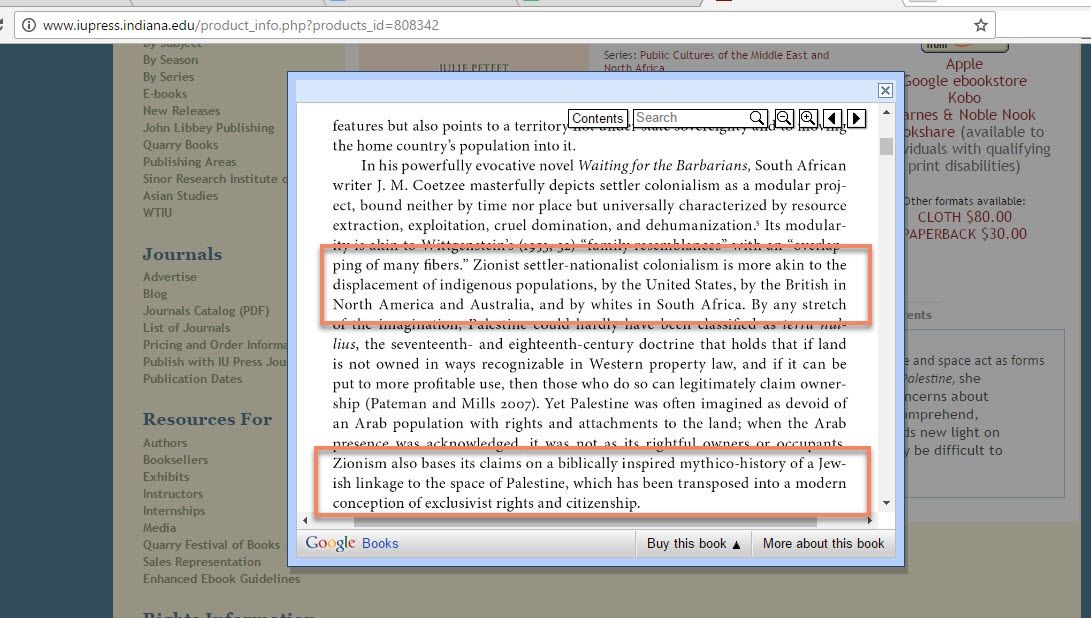
On January 19, 2017, Peteet published a book — "Space and Mobility in Palestine" — in which she claimed that “Zionist settler-nationalism colonialism is… akin to the displacement of indigenous populations, by the United States, by the British in North America and Australia, and by whites in South Africa.”
In the same book, Peteet went on to charge that "Jewish colonies may be the single most diagnostic feature of Israeli intent and policy."
Dismissing Jewish Identity as Biblical Mythology
In her 2017 book, Peteet stated that "Zionism also bases its claims on a biblically inspired mythico-history of a Jewish linkage to the space of Palestine, which has been transposed into a modern conception of exclusivist rights and citizenship."
In her 2005 book — "Landscape of Hope and Despair" — Peteet discussed the competing claims of Palestinians and Jews over the land of Israel, Peteet stating that, “the difference is between indigeneity and a settler-colonialist project of self-remaking through national construction.”
Supporting BDS
Julie Peteet is listed as one of the professors who proposed the 2014 American Anthropological Association’s (AAA) boycott of Israel. The petition accused Israel of "ethnic cleansing, colonization, discrimination, and military occupation" and calls upon the AAA to boycott Israeli academic institutions.
BDS
The Boycott, Divestment, Sanctions (BDS) movement was founded by Omar Barghouti in 2005 to challenge “international support for Israeli apartheid and settler-colonialism.” BDS is an allegedly “Palestinian-led movement,” although leading BDS activists have admitted [00:01:01] this is not true.
One of the demands of BDS includes [point 3] what is generally known as the “right of return,” a demand discredited as a way to eliminate Israel. Barghouti said the “right of return” is a means to “end Israel’s existence as a Jewish state.”
Barghouti has said that BDS “aims to turn Israel into a pariah state, as South Africa once was.”
In his activism, Barghouti has also said [00:05:55] regarding Israel: “Definitely, most definitely, we oppose a Jewish state in any part of Palestine. No…rational Palestinian, not a sellout Palestinian, will ever accept a Jewish state in Palestine.”
The movement has been linked to numerous terrorist organizations and received a public endorsement from Hamas in 2017.
BDS initiatives include calling on institutions and individuals to divest from Israeli-affiliated companies, promoting academic and cultural boycotts of Israel, and organizing anti-Israel rallies, protests and campaigns.
The movement’s most notable achievement has been the infiltration of university campuses through lobbying for “BDS resolutions.” In these cases, student governments and student groups, backed by their own anti-Israel members and affiliates, have proposed resolutions on some form of boycott of, or divestment from, Israel and Israeli-affiliated entities.
Boycott resolutions, although non-binding, have been passed by student governments on numerous North American campuses.
BDS activity is often aggressive and disruptive. It has been noted that universities that pass BDS resolutions see a marked increase in anti-Semitic incidents on campus. On one campus, when the student government debated a BDS resolution, reports emerged of violent threats against those opposing it.

- Status:
- Professor
- University:
- Louisville
- Organizations:
- BDS
- Related Profiles:
- Last Modified:
- 05/04/2026
Photos & Screenshots