Overview
Elaine Hagopian has
accused Zionists of ethnic cleansing and
claimed that Israeli forces entered into Lebanon and Gaza in order to kidnap and murder civilians.
Hagopian has
denied that Ashkenazi Jews have a connection to the land of Israel, characterizing their connection as “mythological.”
She participated as a
speaker at a controversial
conference at Harvard University, whose purpose was to discuss the dissolution of Israel.
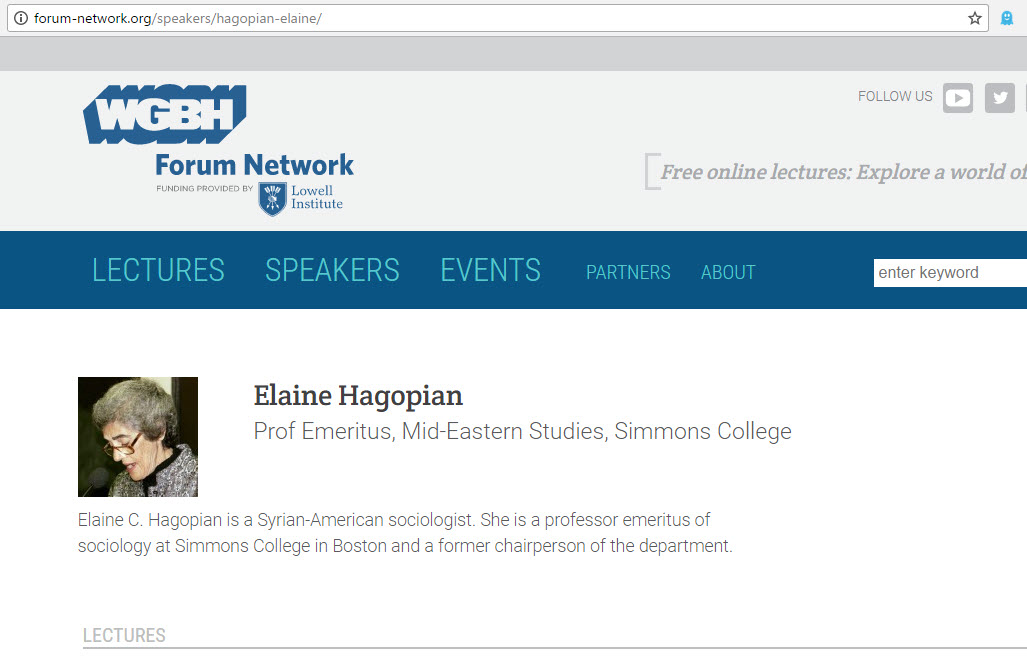
Hagopian is a
professor emeritus of Middle Eastern Studies at Simmons College.
Demonizing Israel
In the article, Hagopian claimed that Jews outnumbered Arabs in the 1948 War, and that they had, by the time of the war, “cleansed… 78% of Palestine of 83% of the original Palestinian population.”
Later in the article, Hagopian concluded that the failure of any peace process is solely “due to the fact that Israel refuses to withdraw from the occupied Palestinian territories.”
In an article published on August 11, 2006, Hagopian
wrote that “Of course, Israel is forever violating Arab air space — especially Lebanon — at any time, entering and kidnapping people, blocking some of the Lebanese fishermen from fishing in their own waters, and doing whatever they want in violation of Lebanese sovereignty.”
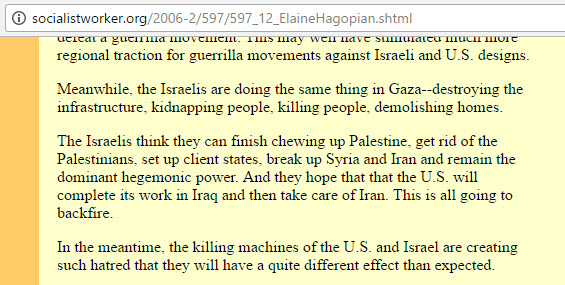
Later in the same article, Hagopian stated that “the Israelis are doing the same thing in Gaza — destroying the infrastructure, kidnapping people, killing people, demolishing homes.”
Conspiracy Theories
On November 10, 2009, Hagopian
published a book review of Northeastern University professor
M. Shahid Alam’s, “Israeli Exceptionalism: The Destabilizing Logic of Zionism.”
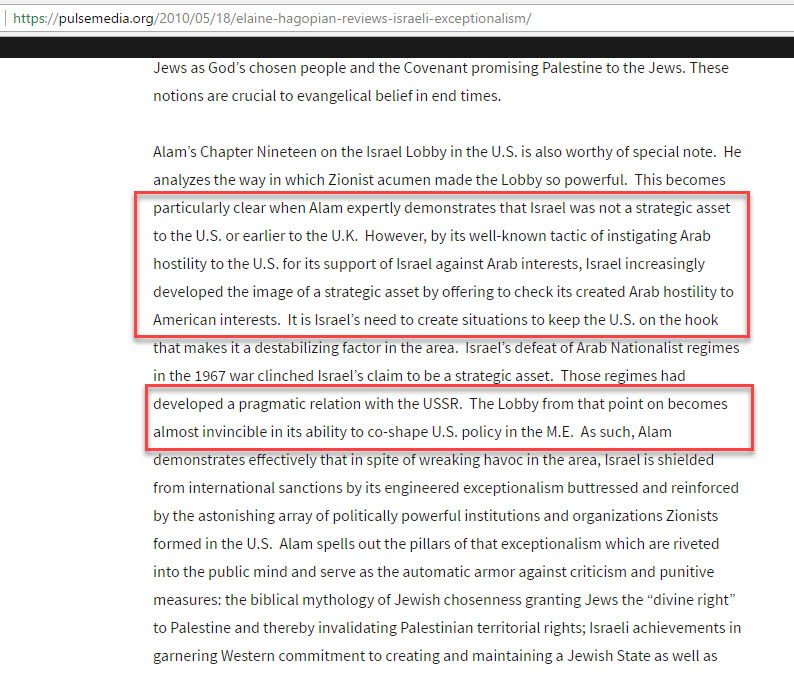
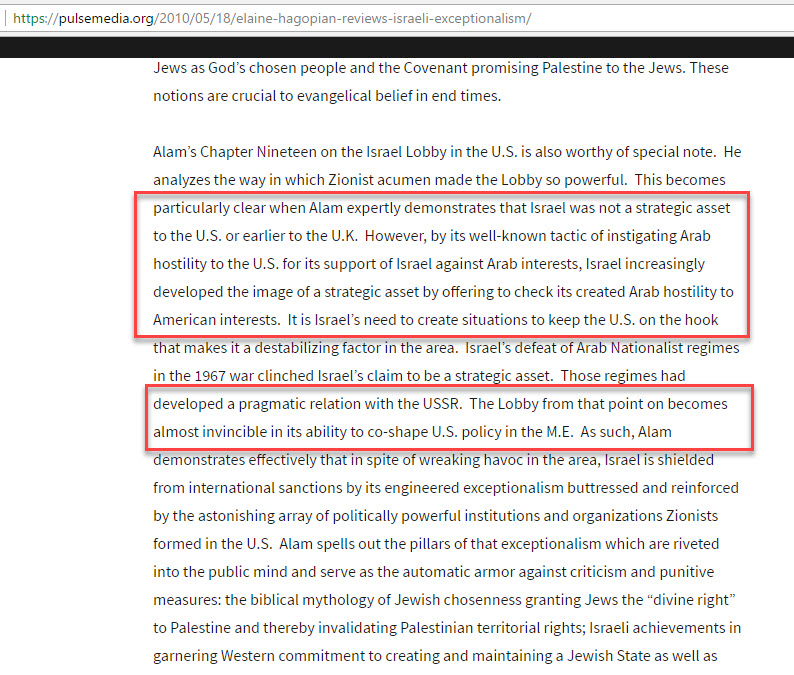
In her review, Hagopian applauded Alam for exposing what she believes to be an Israeli conspiracy to ultimately become “almost invincible in its ability to co-shape U.S. policy in the M.E.”
To achieve this, Hagopian explained that “Israel was not a strategic asset to the U.S. or earlier to the U.K. However, by its well-known tactic of instigating Arab hostility to the U.S. for its support of Israel against Arab interests, Israel increasingly developed the image of a strategic asset by offering to check its created Arab hostility to American interests.”
This theory
echoed similar claims made by Hagopian in an article published on August 11, 2006, that claimed that “Israel chose to be with imperialism. The Zionists saw that as the only way they could have a Jewish state — that by coming under the umbrella of the U.S. and pledging to protect U.S. interests, they would be able to have their way and become the hegemonic power in the region.”
Denying the Jewish Connection to Israel
In May of 2005, Hagopian
wrote a book review of Mazin B. Qumsiyeh’s “Sharing the Land of Canaan.”
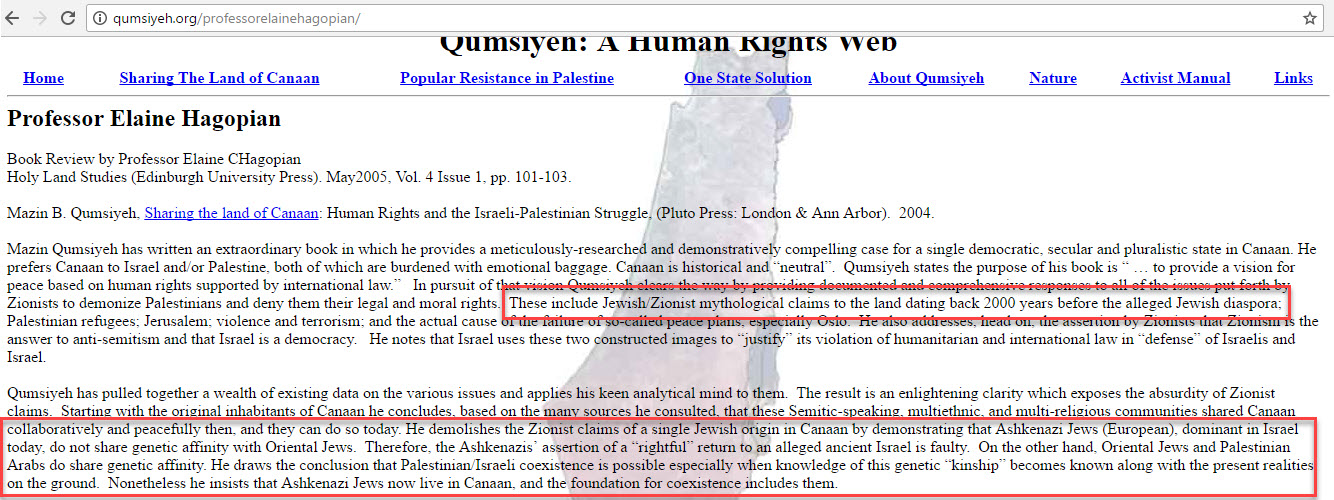
In her review. Hagopian endorsed the author’s claim that “the Ashkenazis’ assertion of a ‘rightful’ return to an alleged ancient Israel is faulty” as it is based on “Jewish/Zionist mythological claims to the land dating back 2000 years before the alleged Jewish diaspora.”
Supporting BDS On January 8, 2014, Hagopian
signed a petition, published by
Electronic Intifada, in support of the American Studies Association's (ASA) decision to boycott Israel. The petition accused Israel of “settler-colonialism, occupation, and apartheid.”
On May 21, 2007, Hagopian
signed a petition, published by BDS, entitled, “Boycott Israel – Don’t Play another ‘Sun City’!”
The petition claimed that “performing in Israel at this time is morally equivalent to performing in South Africa during the apartheid era.”
Supporting BDS
On January 8, 2014, Hagopian
signed a petition, published by
Electronic Intifada, in support of the American Studies Association's (ASA) decision to boycott Israel.
The petition accused Israel of “settler-colonialism, occupation, and apartheid.”
On May 21, 2007, Hagopian
signed a petition, published by BDS, entitled, “Boycott Israel – Don’t Play another ‘Sun City’!”
The petition claimed that “performing in Israel at this time is morally equivalent to performing in South Africa during the apartheid era.”
Anti-Israel Conference
In March of 2012, Harvard
hosted a highly controversial
conference entitled “The One-State Conference: Israel/Palestine and the One State Solution” — whose subject was the dissolution of Israel as a Jewish state.
Despite the university’s insistence that it was an entirely student-run initiative, not officially supported by the institution, several professors took leading roles in the planning and execution of the event.
Hagopian was a featured
speaker in the conference.
BDS
The Boycott, Divestment, Sanctions (BDS) movement was founded by Omar Barghouti in 2005 to challenge “international support for Israeli apartheid and settler-colonialism.” BDS is an allegedly “Palestinian-led movement,” although leading BDS activists have admitted [00:01:01] this is not true.
One of the demands of BDS includes [point 3] what is generally known as the “right of return,” a demand discredited as a way to eliminate Israel. Barghouti said the “right of return” is a means to “end Israel’s existence as a Jewish state.”
Barghouti has said that BDS “aims to turn Israel into a pariah state, as South Africa once was.”
In his activism, Barghouti has also said [00:05:55] regarding Israel: “Definitely, most definitely, we oppose a Jewish state in any part of Palestine. No…rational Palestinian, not a sellout Palestinian, will ever accept a Jewish state in Palestine.”
The movement has been linked to numerous terrorist organizations and received a public endorsement from Hamas in 2017.
BDS initiatives include calling on institutions and individuals to divest from Israeli-affiliated companies, promoting academic and cultural boycotts of Israel, and organizing anti-Israel rallies, protests and campaigns.
The movement’s most notable achievement has been the infiltration of university campuses through lobbying for “BDS resolutions.” In these cases, student governments and student groups, backed by their own anti-Israel members and affiliates, have proposed resolutions on some form of boycott of, or divestment from, Israel and Israeli-affiliated entities.
Boycott resolutions, although non-binding, have been passed by student governments on numerous North American campuses.
BDS activity is often aggressive and disruptive. It has been noted that universities that pass BDS resolutions see a marked increase in anti-Semitic incidents on campus. On one campus, when the student government debated a BDS resolution, reports emerged of violent threats against those opposing it.
Social Media and Weblinks