Benjamin Schreier
Overview
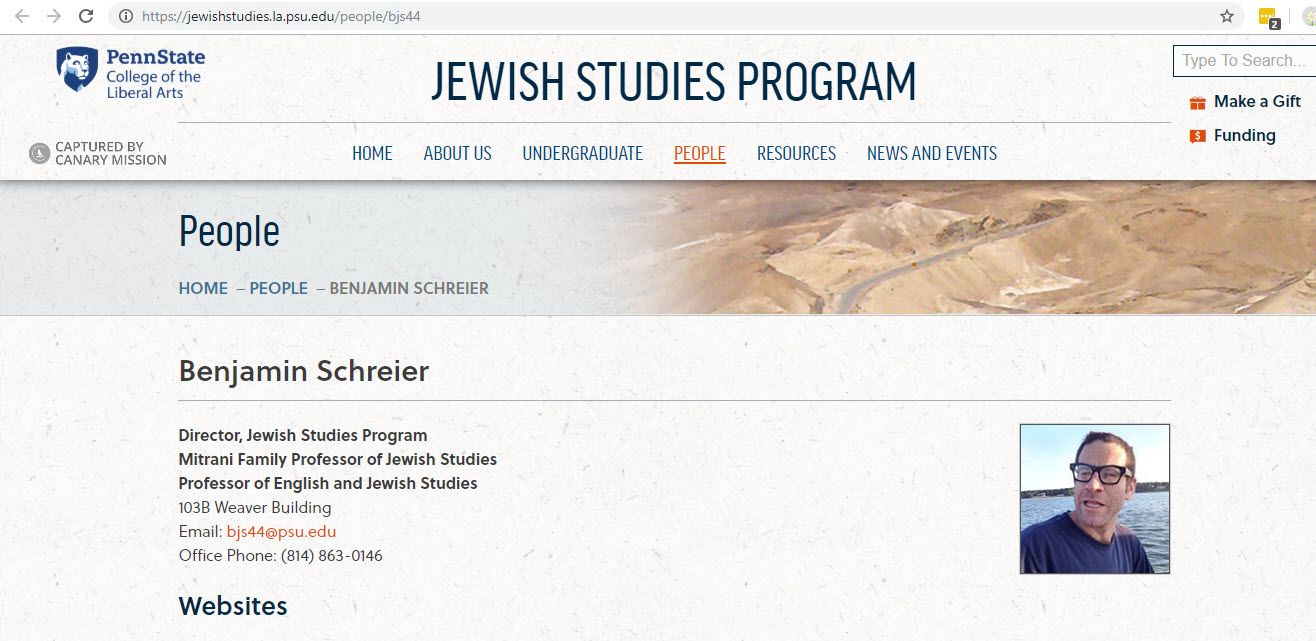
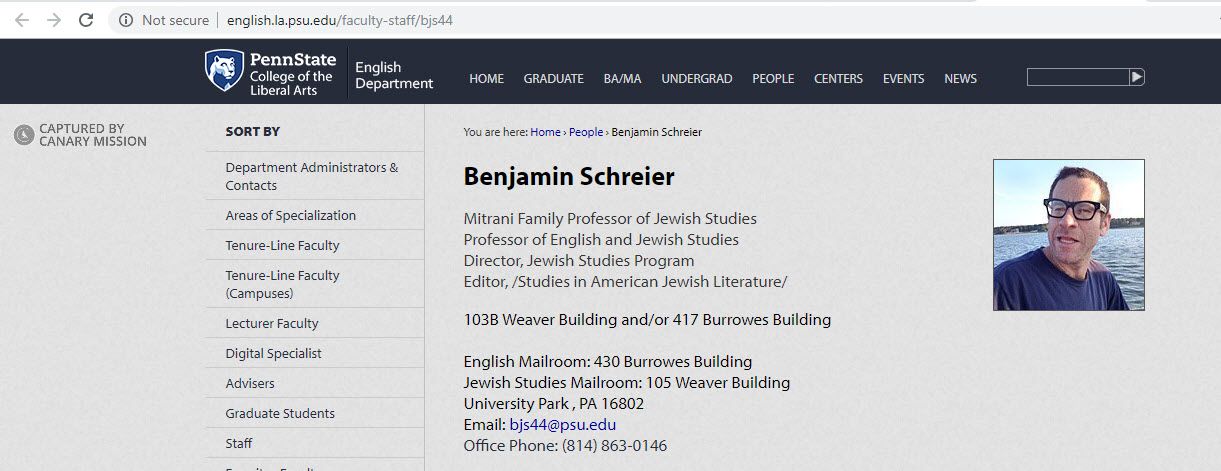
Benjamin Schreier has supported anti-Israel activists on campus, trivialized anti-Israel activism and condemned the United States government’s recognition of Jerusalem as Israel’s capital.Schreier is a professor of English and Jewish Studies and the director of the Jewish Studies Program at Penn State University (Penn State).
Supporting Anti-Israel Activists on Campus
In May 2016, Schreier published an article responding to accusations that the Jewish Studies Program at Penn State University (Penn State), of which he was the director, was anti-Israel.Schreier wrote: “It's perverse—and sad—that in the name of ‘the two-state solution’ ethnic cleansing has become the leading desideratum of mainstream liberal opinion.”
Schreier went on to say that: “The contention that BDS is a priori ‘anti-Israel’ is nonsense; what the hell does that phrase even mean?! ... To call BDS a priori antisemitic is idiotic.”
Schreier concluded his article writing that: “I find Hillel's intellectual thuggery odious...Hillel is making common cause with the McCarthies of world history.”
Schreier signed a 2017 letter, condemning a decision by Fordham’s dean to block the establishment of a Students for Justice in Palestine (SJP) chapter on campus. The letter was authored by the anti-Israel Jewish Voice for Peace (JVP) organization.
In 2016, Fordham reportedly blocked the formation of a Fordham SJP chapter “based on the reported behavior of other [SJP] chapters on other campuses,” indicating that “the establishment of a local branch could be ‘polarizing’ and pose a safety concern to students and faculty.”
Signatories demanded that Fordham “immediately rescind the rejection of SJP as a student group on campus, apologize to the students affected by this harmful decision, and reaffirm Fordham’s commitment to free speech and academic freedom.”
The petitioners also highlighted SJP’s BDS activity, characterizing SJP’s efforts to promote anti-Israel boycott as part of “a time-honored non-violent mode of political expression.” The petition accused Fordham’s administration of a “fundamental misunderstanding of what boycotts are, the purpose of a university, and the goals of SJP.”
The Center for Constitutional Rights (CCR) in cooperation with Palestine Legal (PL), and civil rights attorney Alan Levine sued Fordham on behalf of four students in April 2017. A New York court annulled Fordham’s decision in August 2019, mandating that the university recognize SJP as an official club.
Fordham appealed the ruling to the NY State Supreme Court Appellate Division in January 2020. On July 24, 2020, Fordham SJP students filed a brief asking the appellate court to deny Fordham’s appeal of the lower court’s decision.
As of October 2020, a variety of groups, not directly involved in the case, filed amicus briefs with the Appellate Division for the court's consideration including JVP.
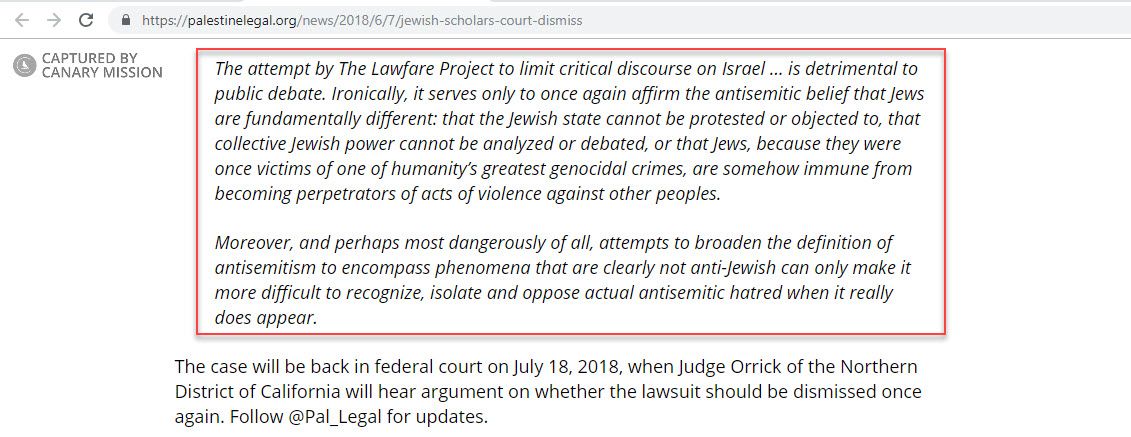
In June 2018, Schreier was one of multiple Jewish Studies professors who wrote an amicus brief in defense of anti-Israel activist, San Francisco State University (SFSU) professor, Rabab Abdulhadi.
Professor Rabab Abdulhadi has, since 2014, sought to cultivate alliances between SFSU and two Hamas-dominated Palestinian universities.
Abdulhadi faced charges in federal court for allegations of anti-Semitism. The professors sought to deny those allegations by claiming that Abdulhadi’s anti-Israel activism could not be equated with anti-Semitism.
In their brief, the professors wrote that: “The attempt... to limit critical discourse on Israel … is detrimental to public debate. Ironically, it serves only to once again affirm the antisemitic belief that Jews are fundamentally different”
Trivializing Anti-Israel Activism
According to an article published in the academic quarterly Telos on December 20, 2017, Schreier appeared on a panel discussion titled: “Navigating Jewish Campus and Community Debates on Israel/Palestine in the Age of Trump.”The article reported that in the discussion, Schreier denied the spread of anti-Israel activism, stating that “‘anti-Israel’ is a reckless, meaningless term in our current climate.”
According to another article reporting on the event, Schreier also took the opportunity to condemn Hillel International and its stance on Israel.
Condemning U.S. Recognition of Jerusalem as Israel’s Capital
In 2017, Schreier signed a petition of Jewish scholars condemning the Trump Administration’s decision to recognize Jerusalem as Israel’s capital.Signatories of the petition wrote that: “a declaration from the United States government that appears to endorse sole Jewish proprietorship over Jerusalem adds insult to ongoing injury and is practically guaranteed to fan the flames of violence.”
BDS
The Boycott, Divestment, Sanctions (BDS) movement was founded by Omar Barghouti in 2005 to challenge “international support for Israeli apartheid and settler-colonialism.” BDS is an allegedly “Palestinian-led movement,” although leading BDS activists have admitted [00:01:01] this is not true.
One of the demands of BDS includes [point 3] what is generally known as the “right of return,” a demand discredited as a way to eliminate Israel. Barghouti said the “right of return” is a means to “end Israel’s existence as a Jewish state.”
Barghouti has said that BDS “aims to turn Israel into a pariah state, as South Africa once was.”
In his activism, Barghouti has also said [00:05:55] regarding Israel: “Definitely, most definitely, we oppose a Jewish state in any part of Palestine. No…rational Palestinian, not a sellout Palestinian, will ever accept a Jewish state in Palestine.”
The movement has been linked to numerous terrorist organizations and received a public endorsement from Hamas in 2017.
BDS initiatives include calling on institutions and individuals to divest from Israeli-affiliated companies, promoting academic and cultural boycotts of Israel, and organizing anti-Israel rallies, protests and campaigns.
The movement’s most notable achievement has been the infiltration of university campuses through lobbying for “BDS resolutions.” In these cases, student governments and student groups, backed by their own anti-Israel members and affiliates, have proposed resolutions on some form of boycott of, or divestment from, Israel and Israeli-affiliated entities.
Boycott resolutions, although non-binding, have been passed by student governments on numerous North American campuses.
BDS activity is often aggressive and disruptive. It has been noted that universities that pass BDS resolutions see a marked increase in anti-Semitic incidents on campus. On one campus, when the student government debated a BDS resolution, reports emerged of violent threats against those opposing it.
Social Media and Weblinks

- Status:
- Professor
- University:
- Penn-State
- Organizations:
- BDS
- Related Profiles:
- Last Modified:
- 05/04/2026
Photos & Screenshots