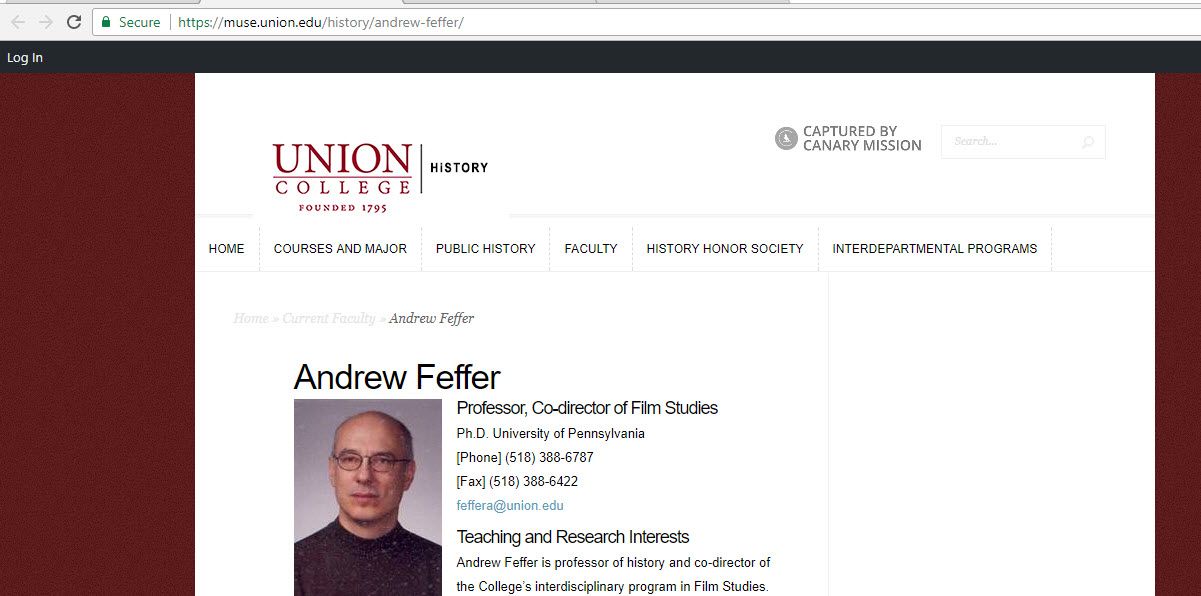
Andrew Feffer
Overview
Andrew Feffer is a supporter of the Boycott, Divestment, Sanctions (BDS) movement. He is a professor of Historyand co-director of Film Studies at Union College (Union).Supporting BDS
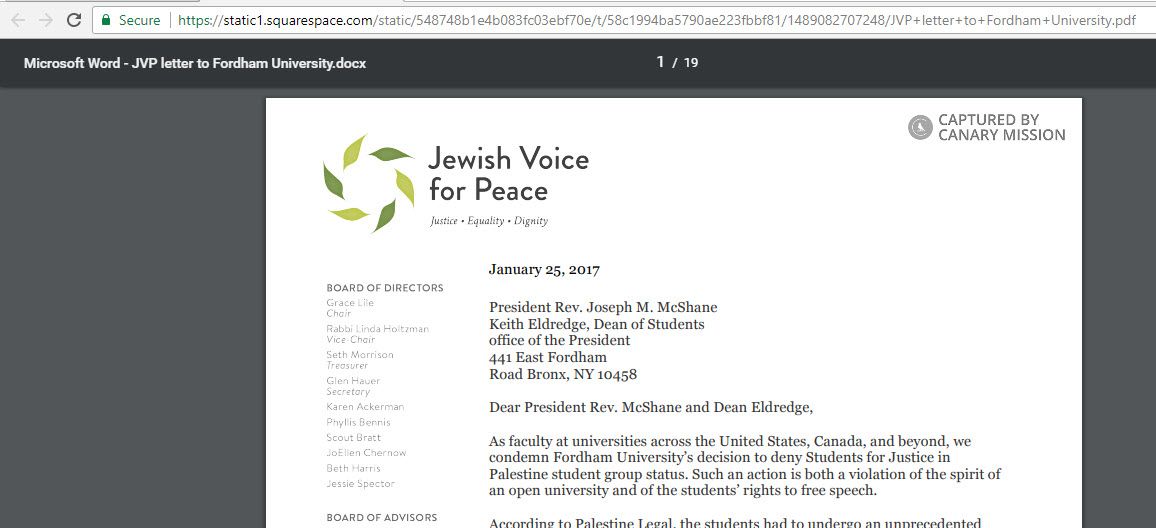
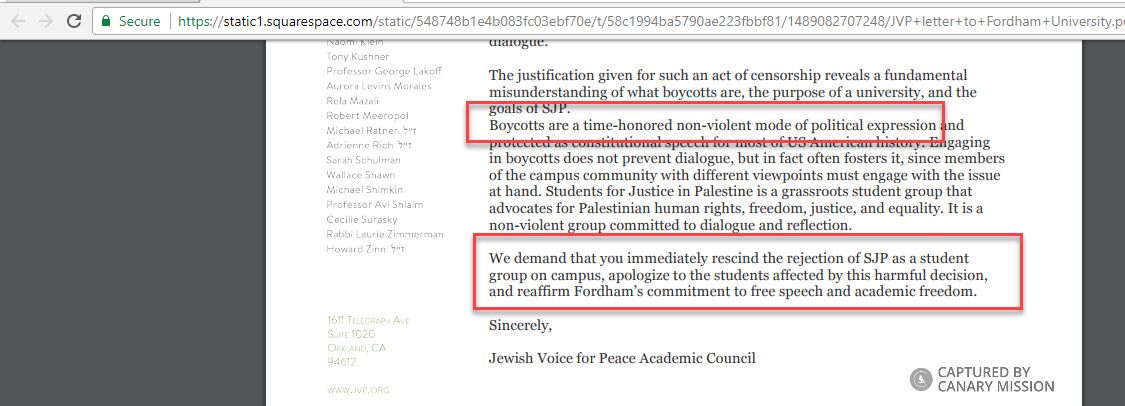
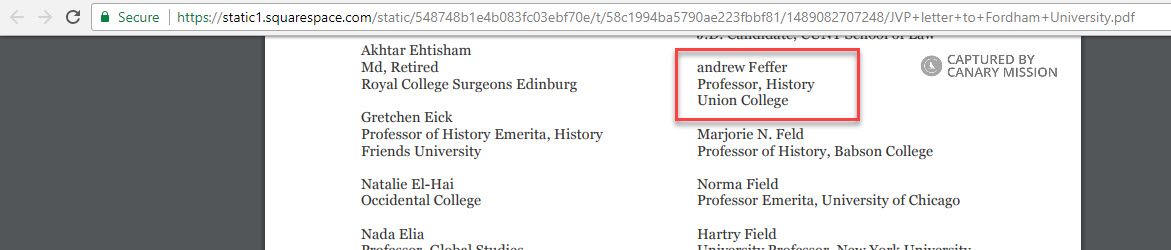
Feffer signed a letter, authored by the anti-Israel Jewish Voices for Peace (JVP) organization and published on January 25, 2017, condemning Fordham University’s decision to block the establishment of a Students for Justice in Palestine (SJP) chapter at Fordham.Signatories specifically defended SJP’s BDS activity, characterizing their efforts to boycott Israel as “a time-honored non-violent mode of political expression” and went on to demand that Fordham “immediately rescind the rejection of SJP as a student group on campus, apologize to the students affected by this harmful decision, and reaffirm Fordham’s commitment to free speech and academic freedom.”
Feffer signed an open letter to United States President Barack Obama and the American Congress, dated July 31, 2014, condemning “the disproportionate harm that the Israeli military, which the United States has armed and supported for decades, is inflicting on the population of Gaza.”
The letter exclusively blamed Israel for the Gazan civilian crisis and called upon the administration “to suspend US military aid to Israel, until there is assurance that this aid will no longer be used for the commission of war crimes.”
The letter was in response to Operation Protective Edge (OPE).
Israel commenced Operation Protective Edge (OPE) in July 2014, to stop rocket fire targeting Israeli civilians and to destroy Hamas attack tunnels.
Feffer also added his name to a petition, published by the Campaign for Peace and Democracy on January 9, 2009, titled “No More Blank Check for Israel!”
Signatories of the petition condemned Israel for “raining bombs and missiles down on one of the most densely populated sites in the world, making massive civilian casualties inevitable, and which, apart from its immorality, guarantees only another generation of hatred towards Israel.”
The petition went on to “urge the Obama administration to refuse to give Israel the U.S. blank check it has long enjoyed.”
BDS
The Boycott, Divestment, Sanctions (BDS) movement was founded by Omar Barghouti in 2005 to challenge “international support for Israeli apartheid and settler-colonialism.” BDS is an allegedly “Palestinian-led movement,” although leading BDS activists have admitted [00:01:01] this is not true.
One of the demands of BDS includes [point 3] what is generally known as the “right of return,” a demand discredited as a way to eliminate Israel. Barghouti said the “right of return” is a means to “end Israel’s existence as a Jewish state.”
Barghouti has said that BDS “aims to turn Israel into a pariah state, as South Africa once was.”
In his activism, Barghouti has also said [00:05:55] regarding Israel: “Definitely, most definitely, we oppose a Jewish state in any part of Palestine. No…rational Palestinian, not a sellout Palestinian, will ever accept a Jewish state in Palestine.”
The movement has been linked to numerous terrorist organizations and received a public endorsement from Hamas in 2017.
BDS initiatives include calling on institutions and individuals to divest from Israeli-affiliated companies, promoting academic and cultural boycotts of Israel, and organizing anti-Israel rallies, protests and campaigns.
The movement’s most notable achievement has been the infiltration of university campuses through lobbying for “BDS resolutions.” In these cases, student governments and student groups, backed by their own anti-Israel members and affiliates, have proposed resolutions on some form of boycott of, or divestment from, Israel and Israeli-affiliated entities.
Boycott resolutions, although non-binding, have been passed by student governments on numerous North American campuses.
BDS activity is often aggressive and disruptive. It has been noted that universities that pass BDS resolutions see a marked increase in anti-Semitic incidents on campus. On one campus, when the student government debated a BDS resolution, reports emerged of violent threats against those opposing it.
SJP
SJP is a student organization engaged in anti-Israel activity on North American college and university campuses.
The first chapter of SJP was founded in 2001 at the University of California at Berkeley by Professor Hatem Bazian. Bazian has spread classic anti-Semitism, reportedly promoted religious anti-Semitism and defended the Hamas terror group. In 2004, Bazian called for “intifada” in America.
SJP organizes anti-Israel campaigns, including running annual Israel Apartheid Weeks, often in collaboration with Jewish Voice for Peace (JVP) and Muslim Students Association (MSA) campus chapters.
SJP has been a major force in pushing the anti-Semitic Boycott, Divestment, Sanctions (BDS) movement on campuses. Chapters have initiated dozens of BDS resolutions in student governments, which have been proposed on or around Jewish holidays, a time when many Jewish students are off-campus.
SJP activists have reportedly physically assaulted, intimidated and harassed Jewish students, disrupted pro-Israel campus events and demonized pro-Israel campus organizations.
Chapters have often endorsed and campaigned for numerous terrorists and whitewashed terrorism.
JVP
JVP was founded in Berkeley, California in 1996, as an activist group with an emphasis on the “Jewish tradition” of peace, social justice and human rights. The organization is currently led by Rebecca Vilkomerson and its board members include Israel critics Naomi Klein, Judith Butler, Noam Chomsky and Tony Kushner.
JVP, which generally employs civil disobedience tactics to disrupt pro-Israel speakers and events, consists of American Jews and non-Jewish “allies” highly critical of Israeli policies. A staunch supporter of the BDS movement, JVP claims to aim its campaigns at companies that either support the Israeli military (Hewlett-Packard) or are active in the West Bank (SodaStream).
Although several Jewish groups critical of Israeli policies, like J Street and Partners for a Progressive Israel, make efforts to operate within the mainstream American Jewish community, JVP functions outside. The group is often criticized for serving as a tokenized Jewish voice for the pro-Palestinian camp and is widely regarded as the BDS movement’s “Jewish wing.”
JVP denies the notion of “Jewish peoplehood” and has even gone so far as to refer to its own Ashkenazi (Jews who spent the Diaspora in European countries) leadership as “white supremacy inside of JVP.”
The Anti-Defamation League (ADL) has accused JVP of being “the largest and most influential Jewish anti-Zionist group in the United States,” and said the group “exploits Jewish culture and rituals to reassure its own supporters that opposition to Israel not only does not contradict, but is actually consistent with, Jewish value.”
The ADL also claimed that “JVP consistently co-sponsors rallies to oppose Israeli military policy that are marked by signs and slogans comparing Israel to Nazi Germany, demonizing Jews and voicing support for groups like Hamas and Hezbollah.”
According to the ADL website, JVP “uses its Jewish identity to shield the anti-Israel movement from allegations of anti-Semitism and provide it with a greater degree of legitimacy and credibility.”
Social Media and Weblinks
LinkedIn:https://www.linkedin.com/in/andrew-feffer-21610115/University Website:https://muse.union.edu/history/andrew-feffer/