Niyati Shah
Overview
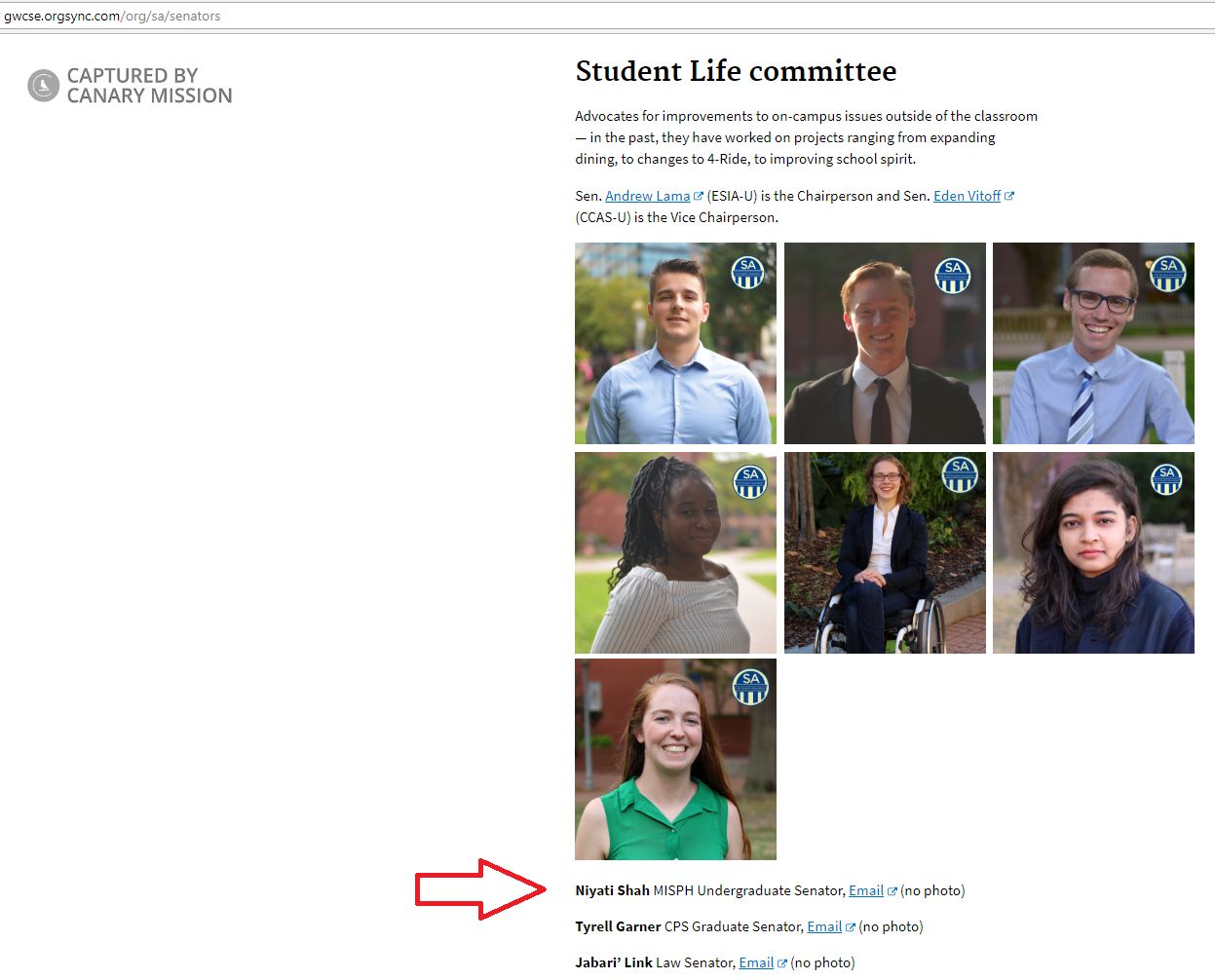
Niyati Shah voted for a secret ballot that allowed an anti-Israel Boycott, Divestment, Sanctions (BDS) resolution to pass, as a senator in the George Washington University (GWU) Student Association (SA), in 2018.As of July 2018, Shah was a member of the SA Student Life Committee which “advocates for improvements to on-campus issues outside of the classroom,” and has worked on projects dedicated to “improving school spirit.”
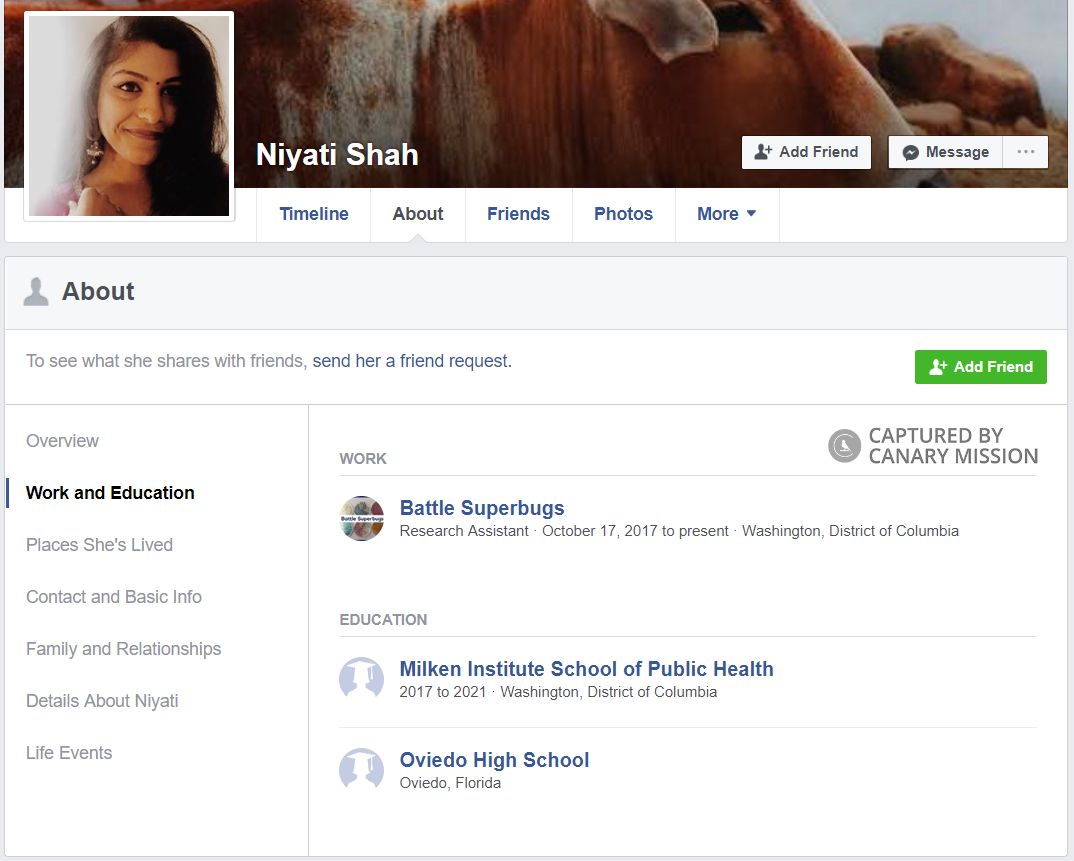
As of July 2018, Shah’s Facebook page said she plans to graduate from GWU in 2021 with a bachelor’s degree from the Milken Institute School of Public Health.
Secret Ballots Enable BDS
When a student senator votes for a secret ballot, it comes after Jewish students have expressed their pain in front of that senator and the entire student government, sometimes over several weeks. Voting for a secret ballot dismisses Jewish fears in favor of an SJP-led strategy.
Since 2015, Canary Mission has scrutinized and publicized the latent anti-Semitism of SJP activists and their role in managing BDS campaigns. Secret ballots allow student senators to vote for BDS resolutions, without any degree of democratic scrutiny.
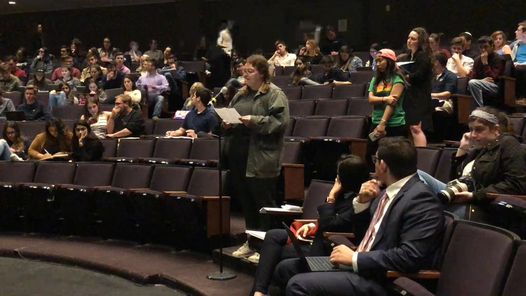
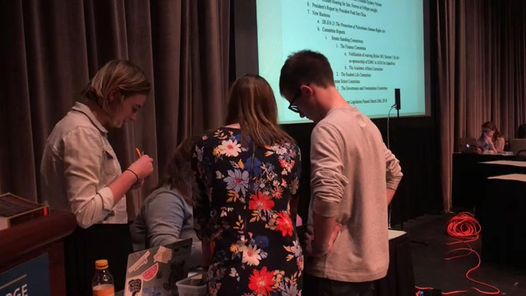
Twenty eight senators voted for the secret ballot, while one voted against and none abstained. The BDS resolution passed [00:21:53] with 18 votes for, six against and six abstentions.
The resolution implied that “Israel is the worst apartheid regime” and that Israel imposes “forced labour” on Palestinians. It also implied that Israel divides “its population along racial lines by the creation of separate reserves and ghettos for the members of a racial group or groups.”
The resolution portrayed Israeli military campaigns against Hamas and Palestinian Islamic Jihad (PIJ) as deliberate attempts to kill children and civilians. It also singled out Israel for alleged violations of the Geneva Convention and war crimes.
Israel commenced Operations Cast Lead (OCL), Pillar of Defense (OPD) and Protective Edge (OPE) in 2008-09, 2012 and 2014, respectively, in order to stop Hamas rocket fire from Gaza targeting Israeli civilians.
Three of the resolution’s four co-sponsors voted [00:09:59] against an amendment [00:07:15] acknowledging that “Israel is a state and has the right to exist” and that Israelis have the “right to safety, security and self-determination.” The fourth co-sponsor abstained.
#DivestThisTime at GWU 2018 - Instigated by SJP at GWU
On March 24, 2018, student groups at GWU launched the second BDS campaign in two years; both were titled “#DivestThisTime.” Activists with Students for Justice in Palestine (SJP) at GWU (SJP at GWU) led both campaigns.On the campaign launch day, #DivestThisTime released a Facebook promotional video, in which activists alleged [00:01:23] that Israel has committed “crimes against humanity.” They also claimed [00:03:34] that Palestinians are “bombed every day” and blamed Israel [00:02:06] for police violence against black Americans in Ferguson, Missouri.
SJP at GWU held five events leading up to the launch of #DivestThisTime, which formed part of its 2018 Israeli Apartheid Week (IAW). IAW is presented as “an international series of events that seek to raise awareness of Israel’s settler-colonial project and apartheid system over the Palestinian people” and build support for the BDS movement.
#DivestThisTime at GWU 2018 - Demonizing Israel
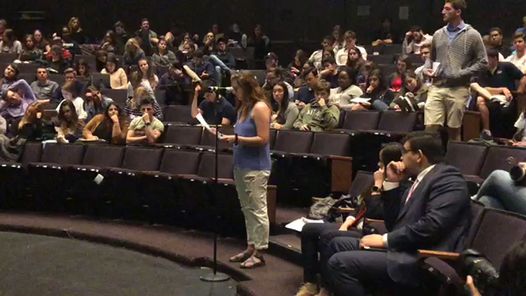
During the hearing, many Jewish students said [01:09:05] they experienced [01:24:45] anti-Semitism related to #DivestThisTime. One student spoke [00:50:40] about the Jewish community’s pain when “this hateful and divisive resolution was proposed over Passover.” One Jewish Israeli-American student said [00:48:05] it “creates an environment where I am made to feel that my identity is taboo” at GWU.
One black Jewish student said [01:39:24] that an SJP activist told him he was “weaponizing” his identity when he asked why a clause mentioning the “discriminatory conditions black people face in the Gaza Strip under Palestinian leadership” was omitted from the resolution.
SJP at GWU activists mocked [00:52:48] or dismissed [00:39:50] concerns over anti-Semitism. Other resolution supporters voiced agreement [00:45:40] with the SJP at GWU activists, including one who claimed [01:04:13] that resolution opponents were stoking “racial fears and sowing the divisions.”
A number of Jewish students walked out [00:35:19] of the hearing to protest [00:33:21] the resolution and to protest the SA’s inaction to combat anti-Semitism within its own ranks.
On April 24, 2018, three of the four resolution co-sponsors — Joshua Gomez, Eden Vitoff and Shaheera Jalil Albasit — voted [00:09:59] against an amendment [00:07:15] that said: “Palestinians and Israelis, like all people, have the right to safety, security, and self-determination” and “Israel is a state and has the right to exist.” Jessica Martinez, the other co-sponsor, abstained [00:10:06].
On May 10, 2018, Al Jazeera published a report on Youtube about #DivestThisTime. SJP at GWU activists spoke [00:01:47] to passers-by on campus and stood next to a display [00:01:43] labeled the “Israeli Apartheid Wall” that demonized Israel’s security barrier.
Israel’s security barrier, 97 percent of which is a low chain-link barrier, was built as a deterrent to Palestinian terror attacks. The concrete portions of the fence were built in response to Palestinian sniper attacks.
BDS
The Boycott, Divestment, Sanctions (BDS) movement was founded by Omar Barghouti in 2005 to challenge “international support for Israeli apartheid and settler-colonialism.” BDS is an allegedly “Palestinian-led movement,” although leading BDS activists have admitted [00:01:01] this is not true.
One of the demands of BDS includes [point 3] what is generally known as the “right of return,” a demand discredited as a way to eliminate Israel. Barghouti said the “right of return” is a means to “end Israel’s existence as a Jewish state.”
Barghouti has said that BDS “aims to turn Israel into a pariah state, as South Africa once was.”
In his activism, Barghouti has also said [00:05:55] regarding Israel: “Definitely, most definitely, we oppose a Jewish state in any part of Palestine. No…rational Palestinian, not a sellout Palestinian, will ever accept a Jewish state in Palestine.”
The movement has been linked to numerous terrorist organizations and received a public endorsement from Hamas in 2017.
BDS initiatives include calling on institutions and individuals to divest from Israeli-affiliated companies, promoting academic and cultural boycotts of Israel, and organizing anti-Israel rallies, protests and campaigns.
The movement’s most notable achievement has been the infiltration of university campuses through lobbying for “BDS resolutions.” In these cases, student governments and student groups, backed by their own anti-Israel members and affiliates, have proposed resolutions on some form of boycott of, or divestment from, Israel and Israeli-affiliated entities.
Boycott resolutions, although non-binding, have been passed by student governments on numerous North American campuses.
BDS activity is often aggressive and disruptive. It has been noted that universities that pass BDS resolutions see a marked increase in anti-Semitic incidents on campus. On one campus, when the student government debated a BDS resolution, reports emerged of violent threats against those opposing it.
Social Media and Weblinks
Facebook:https://www.facebook.com/100012211543522/Twitter:https://twitter.com/niyatishah54
VSCO:https://vsco.co/nshah54/images/1

- Status:
- Student
- University:
- George-Washington
- Organizations:
- BDS
- Related Profiles:
- Last Modified:
- 05/04/2026
Videos
Photos & Screenshots