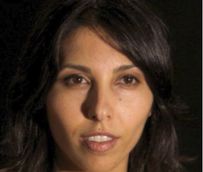
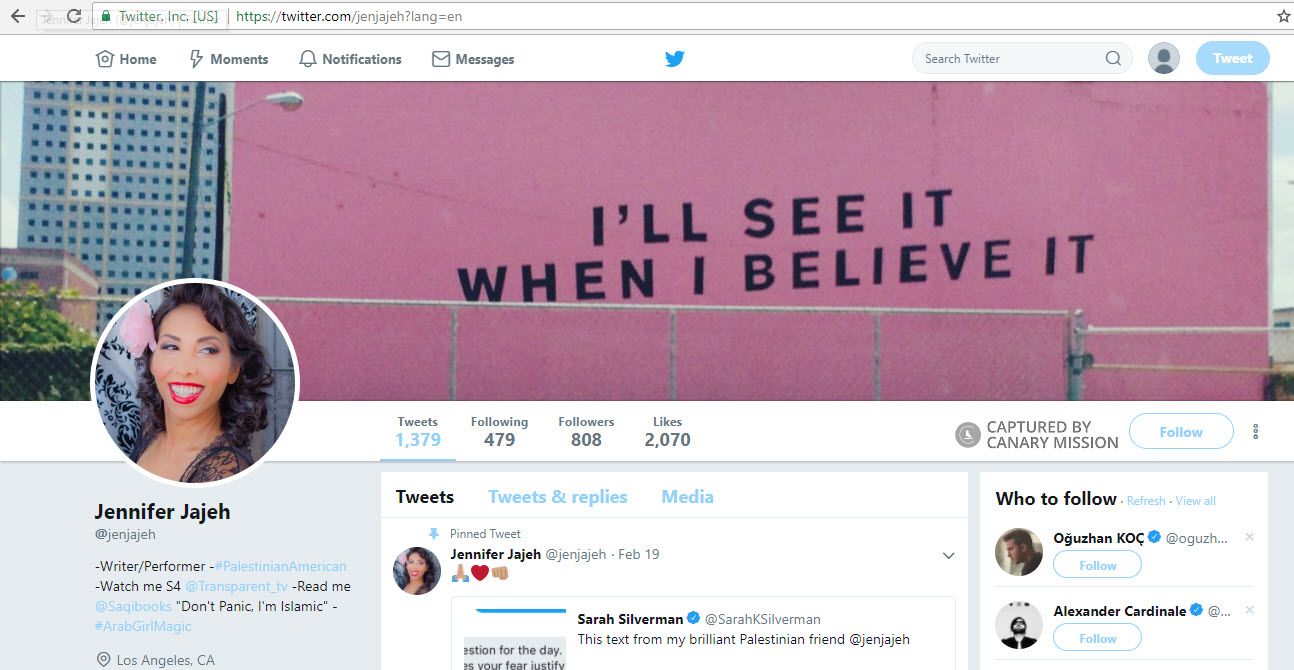
Jennifer Jajeh
Overview
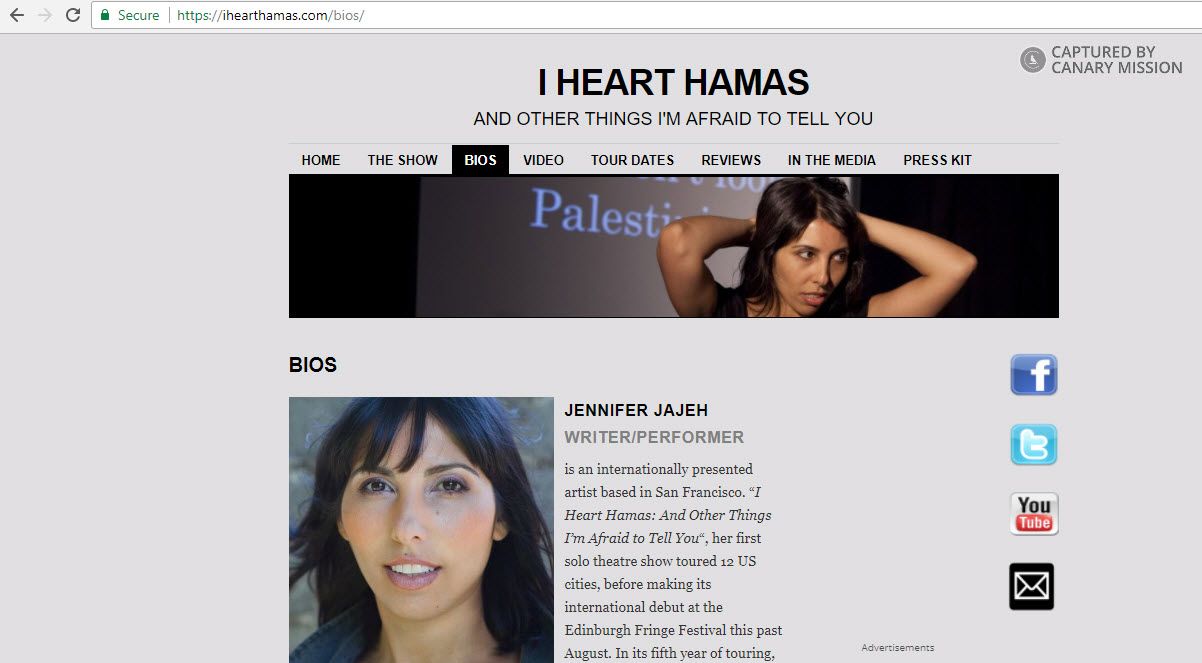
Jennifer Jajeh is the creator and star of a controversial one-woman show titled “I Heart Hamas.” She runs a website, also titled “I Heart Hamas,” which she uses to express her anti-Israel views and promote her show.Hamas is a designatedterrorist organizationby the European Union, Canada, Australia, the United States and Israel.
Jajeh has romanticized and shown support for terrorists, demonized Israel and has expressed support for the Boycott, Divestment, Sanctions (BDS) movement. She is also affiliated with Students for Justice in Palestine (SJP).
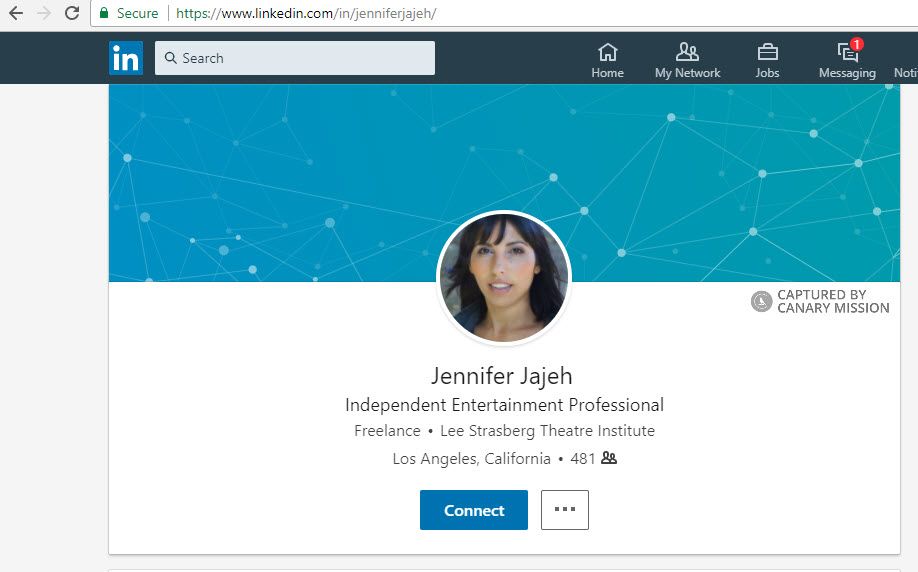
Jajeh is an actress, comedian and writer from San Francisco, California. She received a bachelor’s degree in History and Philosophy from the University of California, Los Angeles (UCLA). She received her actor's training at the Lee Strasberg Theatre Institute in New York City.
She also has a filmmaker page on the Columbia University (Columbia) Center for Palestine Studies website.
Downplaying Terrorism
Jajeh is the creator and star of a one-woman “tragicomic” show titled “I Heart Hamas: And Other Things I’m Afraid to Tell You,” which she performed across the United States from 2008-2013.Jajeh has described her play as “super controversial” and stated in an interview with the anti-Israel online publication Electronic Intifada that the title of the show was meant to be “provocative.”
In an interview with Beirut.com, she stated that her use of Hamas was intended to be “a means to question what is considered terrorism vs. resistance.”
On October 23, 2010, Jajeh performed her show at the University of Pittsburgh (Pitt), where she was hosted by the university’s SJP chapter.
Following her performance at Pitt, Pittsburgh Israel Public Affairs Committee President Samantha Vinokor, who attended the event, said she thought the play “made generalizations and glossed over information, such as the purpose of Israeli checkpoints.”
On December 29, 2008, Jajeh posted an article on her website in which she condemned an Israeli military operation against Hamas, which she characterized as “a DEMOCRATICALLY elected government” and “a Palestinian political party that has a military wing.”
Romanticizing a Terrorist
On February 16, 2013, Jajeh published an article detailing her meeting with and interview of convicted terrorist, Leila Khaled, in Amman, Jordan. The article romanticized airplane hijackings, violent “resistance,” terrorism and the BDS movement.Khaled is a leader of the Popular Front for the Liberation of Palestine (PFLP) and participated in the hijacking of TWA Flight 840 in 1969 and El Al Flight 219 in 1970. As of 2017, Khaled was a member of PFLP's Political Bureau.
Khaled has said that the second intifada failed because it was not violent enough, advocated for the use of children in terror activities and compared Zionists to Nazis.
The PFLP claimed credit for the 2014 Har Nof Massacre where six people were murdered during morning prayers in a Jerusalem synagogue. The PFLP also claimed credit for the 2001 assassination of the Israeli tourism minister.
Supporting Terrorists
On May 17, 2017, Jajeh wrote a post on Facebook expressing support for the Palestinian prisoner hunger strike and condemning the lack of media attention it received.The hunger strike was initiated by Marwan Barghouti, who was serving five consecutive life sentences for his role in suicide bombings — and shooting attacks against Israelis that killed five people during the Second Intifada.
Demonizing Israel
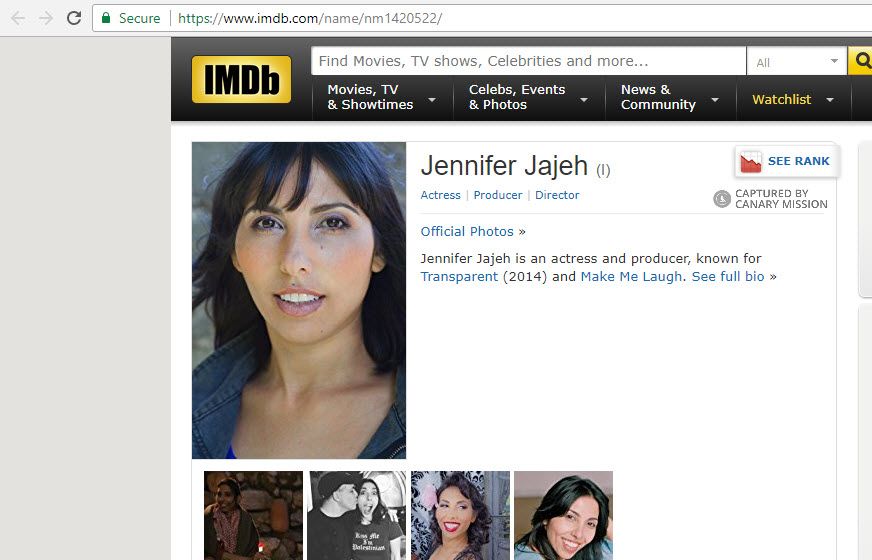
In an episode of the 2014 Amazon drama series, Transparent, Jajeh played a Palestinian woman who claims that Israeli policies prevent her from travelling and from receiving an education.On November 2, 2017, Jajeh tweeted:“100 yrs ago today some British motherf**ker gave my country away & since then all hell has broken loose. #Balfour #Palestine #historylesson.”
On May 29, 2017, Jajeh tweeted: “Isn't #Zionist #WonderWoman kind of an oxymoron?” She later tweeted: “Can you imagine how cool it would have been if she were #Israeli and #antiZionist, truly fighting for justice?”
On April 6, 2017, Jajeh tweeted: “#ChemicalWeapons used vs children in #Gaza didn't seem to warrant airstrikes, let alone a response from US. #TheMoreYouKnow.”
On January 28, 2017, Jajeh wrote on her Facebook, “Checking peoples' FB pages for political views when they cross a border, discriminating between Christians and Muslims, building a wall to keep original inhabitants out--America or Israel??? BOTH.”
In a 2008 blog post Jajeh condemned Israel’s Operation Cast Lead as “an all out assault against a governing body that was elected.” Jajeh went on to allege that Israel decided “to massacre the entire governing force and military while taking out an undetermined amount of civilians, because it didn’t “like another country’s government.”
Israel commenced Operation Cast Lead (OCL)in 2008-09 in order to stop Hamas rocket fire from Gaza targeting Israeli civilians..
Supporting BDS
On September 8, 2017, Jajeh tweeted: “I fully support #BDSM, #BDS, all the B's and the D's and the S's.”On October 3, 2017, Jajeh posted a picture to her Facebook expressing support for BDS.
SJP
SJP is a student organization engaged in anti-Israel activity on North American college and university campuses.
The first chapter of SJP was founded in 2001 at the University of California at Berkeley by Professor Hatem Bazian. Bazian has spread classic anti-Semitism, reportedly promoted religious anti-Semitism and defended the Hamas terror group. In 2004, Bazian called for “intifada” in America.
SJP organizes anti-Israel campaigns, including running annual Israel Apartheid Weeks, often in collaboration with Jewish Voice for Peace (JVP) and Muslim Students Association (MSA) campus chapters.
SJP has been a major force in pushing the anti-Semitic Boycott, Divestment, Sanctions (BDS) movement on campuses. Chapters have initiated dozens of BDS resolutions in student governments, which have been proposed on or around Jewish holidays, a time when many Jewish students are off-campus.
SJP activists have reportedly physically assaulted, intimidated and harassed Jewish students, disrupted pro-Israel campus events and demonized pro-Israel campus organizations.
Chapters have often endorsed and campaigned for numerous terrorists and whitewashed terrorism.
BDS
The Boycott, Divestment, Sanctions (BDS) movement was founded by Omar Barghouti in 2005 to challenge “international support for Israeli apartheid and settler-colonialism.” BDS is an allegedly “Palestinian-led movement,” although leading BDS activists have admitted [00:01:01] this is not true.
One of the demands of BDS includes [point 3] what is generally known as the “right of return,” a demand discredited as a way to eliminate Israel. Barghouti said the “right of return” is a means to “end Israel’s existence as a Jewish state.”
Barghouti has said that BDS “aims to turn Israel into a pariah state, as South Africa once was.”
In his activism, Barghouti has also said [00:05:55] regarding Israel: “Definitely, most definitely, we oppose a Jewish state in any part of Palestine. No…rational Palestinian, not a sellout Palestinian, will ever accept a Jewish state in Palestine.”
The movement has been linked to numerous terrorist organizations and received a public endorsement from Hamas in 2017.
BDS initiatives include calling on institutions and individuals to divest from Israeli-affiliated companies, promoting academic and cultural boycotts of Israel, and organizing anti-Israel rallies, protests and campaigns.
The movement’s most notable achievement has been the infiltration of university campuses through lobbying for “BDS resolutions.” In these cases, student governments and student groups, backed by their own anti-Israel members and affiliates, have proposed resolutions on some form of boycott of, or divestment from, Israel and Israeli-affiliated entities.
Boycott resolutions, although non-binding, have been passed by student governments on numerous North American campuses.
BDS activity is often aggressive and disruptive. It has been noted that universities that pass BDS resolutions see a marked increase in anti-Semitic incidents on campus. On one campus, when the student government debated a BDS resolution, reports emerged of violent threats against those opposing it.
Social Media and Weblinks
Twitter:https://twitter.com/jenjajehFacebook:https://www.facebook.com/jenniferjajeh
LinkedIn:https://www.linkedin.com/in/jenniferjajeh/
IMDb:https://www.imdb.com/name/nm1420522/
Personal Website:https://ihearthamas.com/tag/jennifer-jajeh/ [Private]