Della Keahna Uran
Overview
Della Keahna Uran pushed a Boycott, Divestment, Sanctions (BDS) initiative at Cornell University (Cornell) launched by Students for Justice in Palestine (SJP) in 2019.As of March 2022, Keahna Uran’s LinkedIn page said she was a “Part time Midwestern artist” located in Hayward, Wisconsin, and studying for a bachelor’s degree in Environmental Science at Cornell, slated to graduate in 2022.
Also, as of the same date, Keahna Uran’s LinkedIn said she was the External Relations Chair for the Native American and Indigenous Students at Cornell (NAISAC) since January 2019.
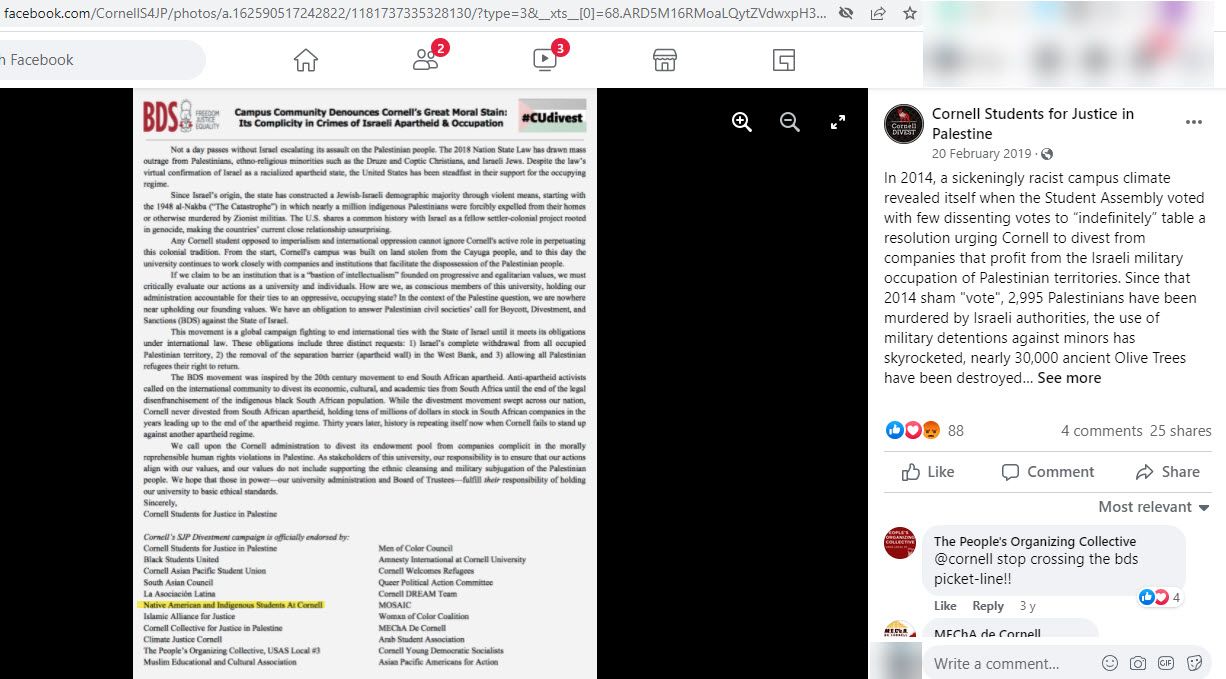
In 2019, NAISAC officially endorsed Cornell SJP’s divestment campaign.
Pushing BDS on Campus
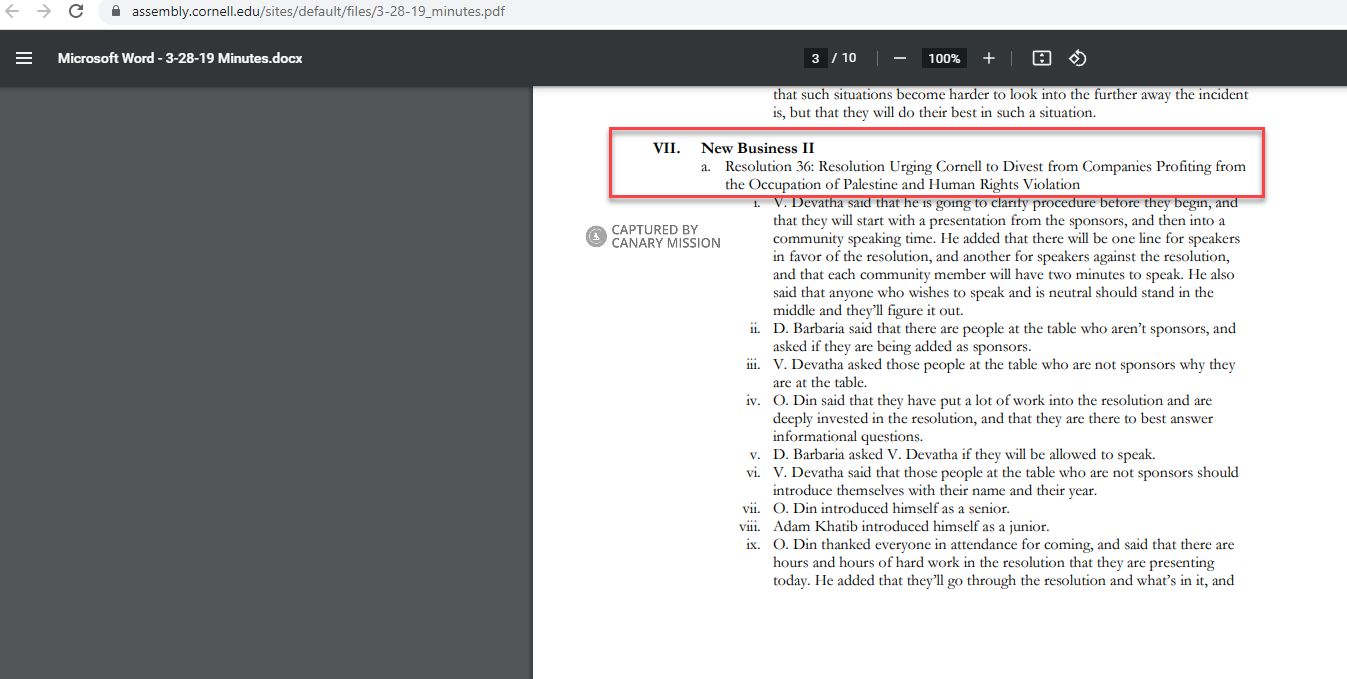
In 2019, Keahna Uran helped advance Cornell SJP’s anti-Israel divestment campaign S.A. Resolution 36, “Urging Cornell to Divest from Companies Profiting from the Occupation of Palestine and Human Rights Violation” in the Cornell Student Assembly (SA).On February 18, 2019, Cornell SJP delivered a letter to Cornell’s President Martha Pollack calling on the University to “divest from companies profiting from morally reprehensible human rights violations in Palestine.”
Cornell SJP’s resolution called on Cornell to divest from Cornell Tech’s partnership with the Technion. Cornell Tech is Cornell’s technology, business, law and design campus.
Cornell SJP also called on the university to divest from Tata Motors, Ingersoll-Rand, Raytheon, G4S,Hewlett-Packard and any other companies SJP Cornell claimed “profit directly from Israeli military occupation.”
Cornell SJP also said: “We will publicly name endowment investments…and hold university leadership responsible for complicity in crimes of apartheid.”
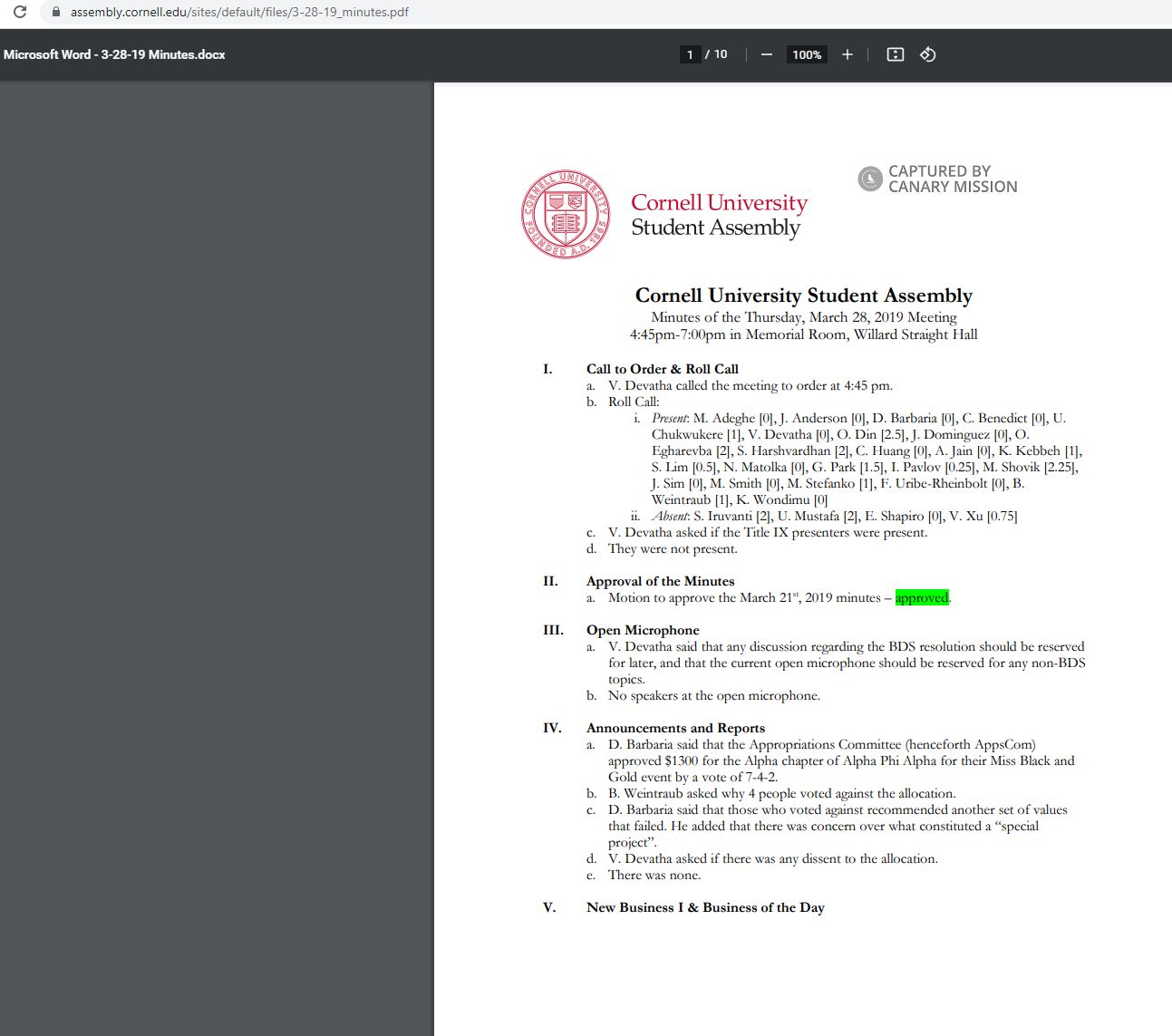
On March 28, 2019, Keahna Uran participated as a “community member” in a Cornell SA meeting, during which Cornell SJP introduced their BDS resolution.
Keahna Uran spoke [page 7] on behalf of NAISAC and explained why the group, together with five ALANA (African Latino Asian and Native American) umbrella organizations, had endorsed the resolution. She added that Cornell cannot stay neutral and accused the university of “making a killing on a killing” through supporting Israel.
On April 11, 2019, Cornell SJP presented their divestment initiative to the SA. During the discussion, Mahfuza Shovik, a resolution sponsor, denied [00:23:03] the resolution was part of the BDS movement.
SA senators used a secret ballot to vote in favor of the resolution, but the resolution failed to pass after a “community vote” (SA by-laws, section 7) was cast.
BDS activists have resorted [00:11:05] to the use of secret ballots to eliminate [02:51:15] transparency from the voting process and avoid any public scrutiny and accountability for their anti-Israel initiatives on university campuses.
BDS
The Boycott, Divestment, Sanctions (BDS) movement was founded by Omar Barghouti in 2005 to challenge “international support for Israeli apartheid and settler-colonialism.” BDS is an allegedly “Palestinian-led movement,” although leading BDS activists have admitted [00:01:01] this is not true.
One of the demands of BDS includes [point 3] what is generally known as the “right of return,” a demand discredited as a way to eliminate Israel. Barghouti said the “right of return” is a means to “end Israel’s existence as a Jewish state.”
Barghouti has said that BDS “aims to turn Israel into a pariah state, as South Africa once was.”
In his activism, Barghouti has also said [00:05:55] regarding Israel: “Definitely, most definitely, we oppose a Jewish state in any part of Palestine. No…rational Palestinian, not a sellout Palestinian, will ever accept a Jewish state in Palestine.”
The movement has been linked to numerous terrorist organizations and received a public endorsement from Hamas in 2017.
BDS initiatives include calling on institutions and individuals to divest from Israeli-affiliated companies, promoting academic and cultural boycotts of Israel, and organizing anti-Israel rallies, protests and campaigns.
The movement’s most notable achievement has been the infiltration of university campuses through lobbying for “BDS resolutions.” In these cases, student governments and student groups, backed by their own anti-Israel members and affiliates, have proposed resolutions on some form of boycott of, or divestment from, Israel and Israeli-affiliated entities.
Boycott resolutions, although non-binding, have been passed by student governments on numerous North American campuses.
BDS activity is often aggressive and disruptive. It has been noted that universities that pass BDS resolutions see a marked increase in anti-Semitic incidents on campus. On one campus, when the student government debated a BDS resolution, reports emerged of violent threats against those opposing it.