


Two Ways to Destroy the Democratic Party
Two Ways to Destroy the Democratic Party
Share:

A primary win in Providence highlights a socialist movement that agrees on destroying the U.S. political system, but divides over how long to use the Democratic Party to achieve its goal.
On the night of September 9, 2026, Providence, RI, rejected a sitting Democratic mayor in favor of a democratic socialist. State Representative David Morales, 27, beat two-term incumbent Brett Smiley in the Democratic primary after being outspent by around 5 to 1.
Morales campaigned as a democratic socialist and a member of the Democratic Socialists of America (DSA), but without the support of the local chapter, Rhode Island DSA.
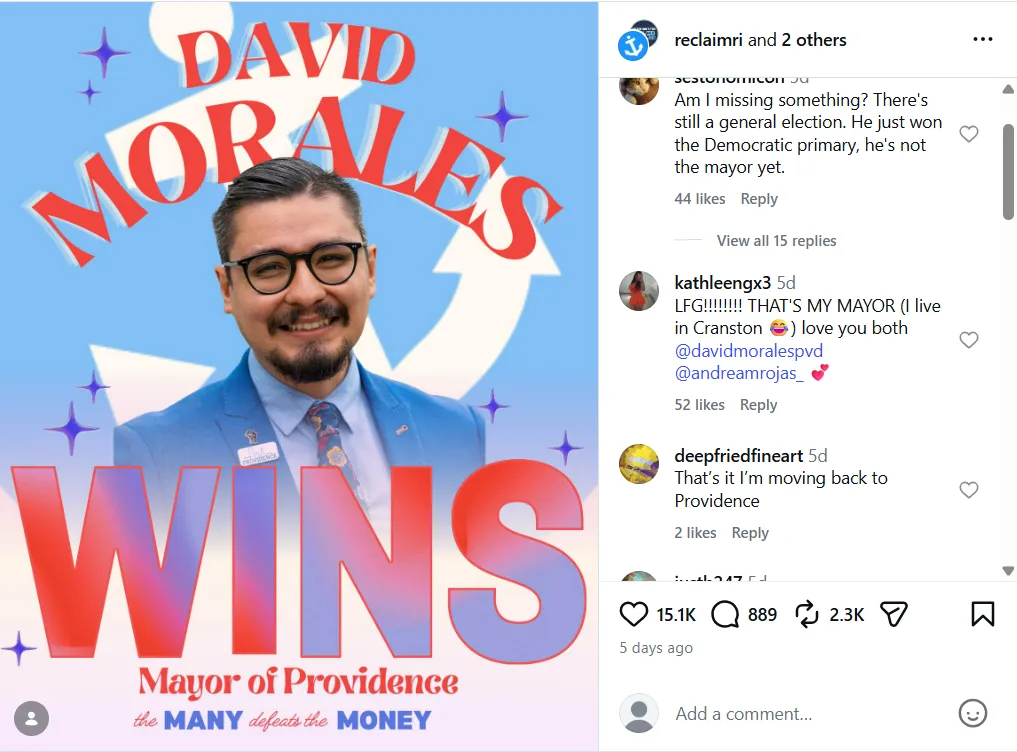
Nickan Fayyazi, an NYC DSA member, tallied the DSA wave of wins in Providence: “Every Reclaim RI endorsed candidate for Providence City Council is winning!!” she posted on X, listing eight seats and declaring a new progressive majority.
The capital of the smallest state had swung hard left in a single evening.
One organization was missing from the party. The DSA chapter in Providence, the group whose initials the national press kept stapling to Morales.
RI DSA did not knock on one door for him. It spent his entire mayoral run treating him as someone else’s candidate.
The chapter unendorsed him in 2023 for voting for a House speaker they deemed unacceptable, and has never taken him back. Its lone endorsement in the 2026 cycle was Brittany Kubicek, an independent socialist running for a state House seat.
The coverage read the night as the “Mamdani model” traveling: a socialist toppling a corporate Democrat, a win for the DSA!
The socialists who might have been happiest were the quietest, because American socialism is a movement at war with itself over a fundamental question, and Providence just held the fight in public.
The Argument that Runs Through DSA
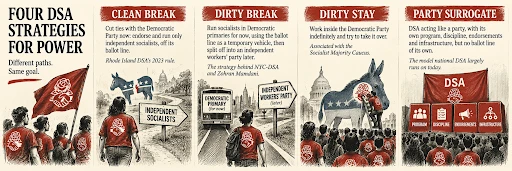
Inside DSA, factions are defined largely by how they answer one question:
Should the organization break with the Democratic Party, and if so, how soon?
One camp runs socialists on the Democratic ballot line, treats the party as a borrowed vehicle, and plans to split off into an independent workers’ party later. The movement calls this the “dirty break.”
A rival camp, called the “clean break,” refuses the disguise from the start and run candidates as independents.
A third position, mocked by the rest as the “dirty stay,” advocates staying within the Democratic coalition for good, with the goal of eventually taking over the party.
The whole spectrum lives in DSA’s caucuses, from the pragmatic Marxists of Bread & Roses, who want a gradual dirty break that stays “completely independent from the Democratic Party apparatus,” to the Marxist Unity Group and the Trotskyists of Reform & Revolution, who want an independent socialist party now. None of them defends the Democratic Party itself.
DSA’s own leaders describe the party as a tool to be used and thrown away. “The Democratic Party is not really like our friend,” Estefania Galvis, a member of NYC DSA, told a recorded chapter discussion; it “is a tool that we use under the current circumstances to be able to wield and build power.”
Michael Lange, a political analyst who has been chronicling the socialist movement’s rise, calls it the “party surrogate model”: “changing the Democratic Party by winning primary elections… rather than forming a third party.”
Not everyone wants to wait for the eventual split. Weeks after the 2025 convention voted to keep the ballot line, the caucus Reform & Revolution argued that DSA “must prepare for the break now before it is forced upon us.”
New York is where the dirty break has gone furthest. NYC-DSA ran Zohran Mamdani in a Democratic primary and won the largest mayoral prize in the country, and its national allies then wrote a resolution, “Hundreds of Zohrans,” to reproduce the model across the map.
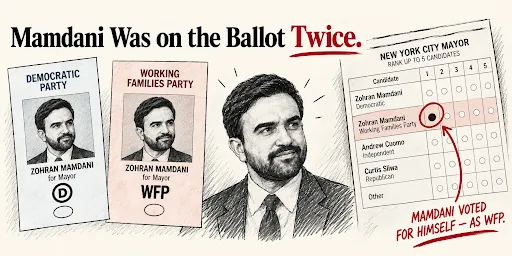
The party is a vehicle down to the ballot itself. Mamdani secured his victory in the Democratic primary, yet on Election Day, he chose to cast his own ballot under the Working Families Party banner instead. This decision underscored his lack of allegiance to the political organization whose ticket carried him to the general election.
National DSA has settled, for now, on the same road. At its 2025 convention, 1,200 delegates voted to keep running on the Democratic ballot line and rejected an amendment that would have urged independent campaigns.
Grace Mausser · co-chair, NYC-DSA, and a lead architect of Mamdani’s field campaign
On the moment: it is “arguably the most important moment for socialists, and leftists more broadly, in the U.S. in a century.”
On electoral strategy: “There are no longer live debates about whether socialists should participate in electoral contests,” only how.
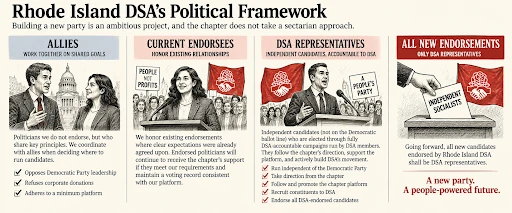
Rhode Island is one of the few chapters that took the other road and meant it. At a convention in May 2023, it rewrote its rules: every new endorsee must run as an independent “DSA representative,” off the Democratic line, in a campaign the chapter runs, and may not caucus with Democrats or vote for their leadership. Almost no large chapter will touch that rule.
The Vocabulary of the Break
Cut ties with the Democratic Party now: endorse and run only independent socialists, off its ballot line. Rhode Island DSA’s 2023 rule.
Run socialists in Democratic primaries, using the ballot line as a temporary vehicle, then split off into an independent workers’ party later. The strategy behind NYC-DSA and Zohran Mamdani.
The mocking name for never leaving: work inside the Democratic Party indefinitely and try to take it over. Associated with the Socialist Majority Caucus.
DSA acting like a party, with its own program, discipline, endorsements and infrastructure, but no ballot line of its own. The model national DSA largely runs on today.
Grandfathering
Letting Democrats, the chapter endorsed before 2023, keep those endorsements, while barring new ones. It is why Sen. Sam Bell stayed endorsed and David Morales did not.
Winning a Democratic primary with a mass volunteer canvass and small-dollar money, now being cloned nationally under the banner “Hundreds of Zohrans.”
Inside Rhode Island DSA
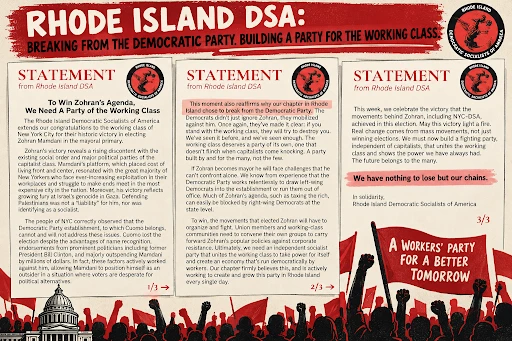
Rhode Island DSA’s co-chair, Jordan Garces, states the shared endpoint plainly: “We’re not here to make the Democrats a little bit better… It’s overthrowing the entire capitalist state.”
The website of RI DSA opens with: “The two major political parties serve the interests of the ruling class. Working people need a party of their own. That’s why Rhode Island DSA is building an alternative. Our goal is an economy that is run democratically by the working class.”
Jordan Garces · co-chair, Rhode Island DSA
On the goal of socialism: “It’s overthrowing the entire capitalist state.”
On the chapter’s candidates: “Our candidates are just an arm of the DSA… beholden to DSA and the membership of DSA.”
At a February 2026 rally against fascism: “I am also a revolutionary. I want to say that loud.”
The program published by RI DSA reads like a party platform. Its first section, “We fight for socialism,” described its goal: a socialist society “can only be reached if the working class takes political power for itself. In other words, it requires a revolution.”
The bylaws commit the chapter to “abolishing capitalist rule.”
From there, it names the enemy: the United States.
The program calls American imperialism “the single most brutal engine of international oppression,” pledges “no support for any imperialist military action by the United States or any of its proxies,” and demands an end to “America’s interventionist wars, provocations, and global dominance.”
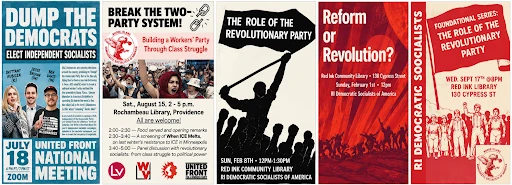
Its entire foreign policy fits in one sentence: “no money or arms to Israel, and an immediate end to the genocide in Palestine.”
At home, it wants “the abolition of ICE” and “punishment for the police officers” that the justice system “has protected.” The chapter posted “No to ICE terror at home, no to U.S. terror abroad.” In a post about marching with Jewish Voice for Peace, it also shared a call to “defeat capitalism, imperialism, and both parties.”
Rhode Island DSA labor organizer Benjamin Carman credits the Just Break Already caucus’s clean-break line with moving the chapter off the Democrats. On its podcast, the caucus told listeners that American workers should “stand with Iran and fight for the defeat of the U.S. and Israel.”
Sam Bell, the state senator who kept his Democratic line, likens ICE to “how the Nazis used the gestapo.” Enrique Sanchez, a sitting representative the chapter grandfathered, calls the agency “Nazi ICE trash thugs.” Benjamin Carman writes that Cuba, Venezuela, and Nicaragua are “in some ways more democratic than the USA.”
Sam Bell · Rhode Island state senator, DSA member, the one endorsee who refused the clean break
On ICE: agents mirror “how the Nazis used the gestapo.”
On U.S. weapons: they fund the “no-holds barred slaughtering of the people of Gaza.”
Enrique Sanchez · Rhode Island state representative, a 2022 DSA endorsee grandfathered in by the chapter
On ICE: “Nazi ICE trash thugs. They will pay for this.”
On ICE and AIPAC: ICE agents are “gestapo thugs,” and “AIPAC pours alot of shady money.”
Benjamin Carman · Rhode Island DSA labor organizer and Just Break Already caucus voice
On the United States: Cuba, Venezuela and Nicaragua are “in some ways more democratic than the USA.”
On the Democrats: “Break [Just Break Already Caucus] did the political and ideological work in the chapter to set the real policy of the chapter away from the Democratic Party.”
How a Bernie Chapter Became a Guillotine
Rhode Island DSA did not begin here. It grew out of the Sanders campaigns as an ordinary, election-winning chapter. Sam Bell, a planetary geologist, became the first DSA member elected to the General Assembly when he won a state Senate seat in 2018. Morales won a House seat in 2020 at the age of 22.
In 2021, the chapter’s then co-chair, Daniel Crowell, interviewed both of them for Jacobin, a socialist publication, as evidence that socialists could take on Rhode Island’s conservative Democrats and win. In 2022, the chapter fielded six members on the same ballot, all as Democrats; four won. For a group of a few hundred people, that was a real haul.
Then the thrill wore off, and the chapter drew a lesson that would define it. Its theorist of the period, the co-chair in 2023 and 2024, Tony Unger, wrote an account of the 2022 campaign: the canvassers vanished after election day, the winners answered to the Democratic caucus, and the chapter had spent its summer building politicians it could not control.
Out of that came a loyalty test, written into the bylaws: endorsed politicians “should not support establishment Democrats for the purpose of gaining the favor of Party leadership.”
Morales eventually failed the test.
On January 3, 2023, he voted to re-elect the Democratic House speaker, Joseph Shekarchi, a landlord-friendly power broker the chapter saw as the class enemy holding the gavel. His vote changed nothing; the speaker was reelected, 63 to 1. In the chapter’s reading, it was a signal that Morales belonged to the caucus rather than to them.
Weeks later, members unendorsed him by a 37-to-2 vote. The objection was not that Morales was a Democrat. Bell was a Democrat too, and said so when he refused the new independence rule: “I will run as a Democrat because I am a Democrat.” The chapter grandfathered him.
The sin was obedience. Garces, RI DSA co-chair, gave the doctrine its sharpest form: a DSA candidate is “just an arm of the DSA,” he said, “beholden to DSA and the membership of DSA.”
Morales had taken the chapter’s canvassers and then voted with the speaker, so they cut him loose. That spring, at the convention that renamed the chapter and bound its program, they turned one unendorsement into a permanent rule and shut the door on the Democratic ballot line.
Kinverly Dicupe, who helped build the chapter around 2020, is the link to the rival machine. She also co-founded Reclaim Rhode Island, the Bernie-era group that became Morales’s 2026 vehicle. Unger’s account calls Reclaim a magnet for the chapter’s right wing. The two organizations have been in a slow divorce ever since.
The Candidate They Actually Ran
After the Morales incident, the chapter changed what an endorsement is. Passing on the mayoral contest entirely, RI DSA threw its weight behind a single candidate for 2026: independent socialist Brittany Kubicek, a Navy submarine veteran and mechanical engineer, challenging a Democratic incumbent for a seat in the state House.
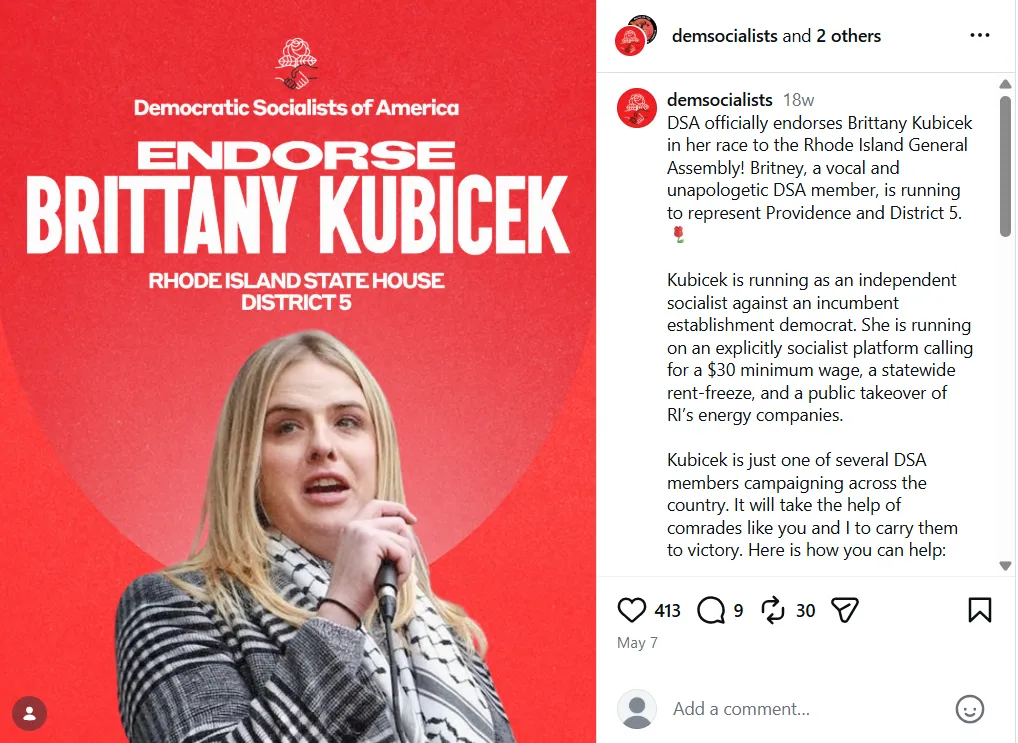
She is the only candidate in Rhode Island endorsed by the chapter or by national DSA, and her platform is the program turned into a campaign: bar ICE from state property, close the Wyatt Detention Center, and keep state money out of Israel Bonds or any firm that sustains “genocide, apartheid, ethnic cleansing, and the occupation of Palestine.” Jewish Voice for Peace co-hosted her launch.
Some of her support comes from out of state through the clean-break network: the Just Break Already caucus sent canvassers, and she held a public “coalition” call with Jordan Duran, a Philadelphia DSA organizer and extremist.
Brittany Kubicek · Navy veteran and the chapter’s only 2026 endorsee, an independent socialist for a state House seat
On ICE and police: her platform, “ICE Out & Demilitarize the Police,” bar ICE from state property, close the Wyatt Detention Center, and disarm “US militarized fascist forces at home.”
On Israel: prohibit state money from Israel Bonds or any firm sustaining “genocide, apartheid, ethnic cleansing, and the occupation of Palestine.”
On the United States: the government “always has money to oppress fellow workers around the world.”
Jordan Duran · Philadelphia DSA organizer and out-of-state ally of the Kubicek campaign
On Hamas: “No no no, I’m defending Hamas lol.”
On Hamas leader Yahya Sinwar: “a hero to the end… A legend of his time, made eternal through his struggle against the zionist project.”
A holiday greeting: “Merry Christmas to my friends in Hamas, Hezbollah, and the IRA.”
The Dirty Break, in One Candidate
Morales is what the clean-breakers fear their strategy will continue to produce. He carried most of the program and shed the parts that lose general elections. He still says he wants to “abolish ICE.” He still calls the destruction in Gaza “a genocide” and backs a municipal divestment ballot measure.
What he dropped was the police plank: after Smiley aired an ad branding him “Defunding David,” Morales disavowed defunding, promised to hire more officers, and told the Boston Globe he does not agree with the DSA platform on abolishing police.
That is the dirty break inside one man. Keep the aims, file the edges off the least popular of them, run as a Democrat, and win. It is also why his old chapter will not claim him. To the clean-break wing, a socialist who trims down their policies to win on the Democratic line is a warning, not a breakthrough.
The Feud Goes National
By the summer of 2026, the quarrel jumped state lines. A Crown Heights, NYC, fundraiser for Morales, hosted by a Reclaim Rhode Island co-chair, billed two NYC-DSA co-chairs as guests.
To New York’s dirty-breakers, bankrolling a socialist against a machine mayor was obvious. To Providence it was a bigger, richer chapter reaching across state lines to fund a man the local members had formally dropped.
Dicupe, who had built both the chapter and its rival, named the move plainly: the play “seems to be to pretend David is DSA endorsed with the approval of NYC DSA leadership as a cover.”
Kinverly Dicupe · Reclaim Rhode Island co-founder and former Providence DSA co-chair
On the NYC fundraiser: the plan is “to pretend David is DSA endorsed with the approval of NYCDSA leadership as a cover.”
On a Democratic congressman: “What about zionist David Cicilline got you thinking he meets the moment right now? Especially while the genocide is STILL on going.”
On the establishment: the Biden administration is “mired in a genocide.”
What the Win Actually Proves
Talk of inevitability, a “wave,” and a “machine” misses what Morales’ win exposed. No single socialist juggernaut is rolling over American cities. What exists instead is a movement certain of its destination that has fractured into factions over the route.
The clean-break wing looks at a socialist who won a mayoralty on a major party’s line and sees a warning. The dirty-break wing looks at a chapter that dumped its most gifted politician to endorse independents who lose, and sees a sect polishing its principles while the real left gains power.
Both describe the same project from opposite ends. They agree the American order should come down, and that the Democratic Party is a shell worth occupying only to later gut and abandon.
Providence has settled one round of it. The socialist who won owes his victory to the wing willing to wear the costume for as long as the job takes, and the wing that refuses to wear it is furious.