


DSA’s Circular Firing Squad
DSA’s Circular Firing Squad
Share:

The Democratic Socialists of America just became the largest socialist organization in American history — and it cannot stop devouring its own. It has expelled a sitting congressman, censured a councilman it helped elect, and gone to war over whether Alexandria Ocasio-Cortez is socialist enough to be endorsed for a non-existent presidential run.
On the night of August 18, 2026, the Democratic Socialists of America got the biggest win in its history and could not enjoy it for even one evening without turning on each other.
In Florida, a Jacksonville state representative named Angie Nixon won the Democratic nomination for U.S. Senate, beating former Trump-impeachment witness Alexander Vindman by double digits while being outspent roughly sixteen to one — about $975,000 against Vindman’s $16.3 million. Nixon had joined DSA during the campaign, and her victory was the first time a DSA member had ever won a major-party nomination for statewide office. It should have been a coronation.
Instead, the socialists spent the night arguing about two things: why their candidate who lost was actually a triumph, and why their candidate who won shouldn’t say the word “socialist” too loudly.
The loss came in the same primary. In Florida’s 25th congressional district, DSA’s nationally endorsed candidate, Oliver Larkin, lost to incumbent Jared Moskowitz by roughly 27 points. In addition, a state-house candidate lost by 174 votes, which meant the DSA lost all its competitive Florida House races.
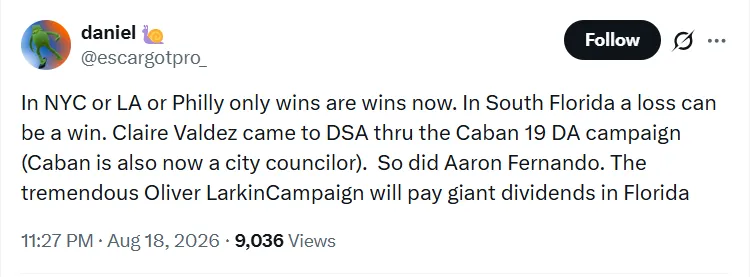
Within hours, the movement’s cadre had converted the defeat into scripture. “In NYC or LA or Philly, only wins are wins now,” one organizer posted, “[But] In South Florida, a loss can be a win.”
The hardline Marxist Unity Group published a formal “Salute To Our Florida Comrades” explaining that “losses are worth it when they bring thousands to a party that represents us, not capitalists.”
Meanwhile, the woman who actually won kept her distance. Nixon told CBS News after her victory that “it’s not about labels.” A DSA city councilman in St. Petersburg explained the lesson: Nixon won because she “on her own merits beat a bad candidate,” not because of the red flag of socialism. “It’s a lesson for DSA,” he wrote.
National DSA’s own account, meanwhile, went nearly silent on the historic win for the better part of a day.
This is the paradox of American socialism at its supposed high-water mark. On July 4, 2026, DSA boasted it had surpassed 120,000 members, making it, by its own reckoning, the largest socialist organization in United States history — bigger than the Socialist Party of America at the peak of Eugene Debs.
The story DSA tells about itself is one of unstoppable momentum — a wave, a machine, an inevitability. Spend time reading how its own people talk to one another, and a very different organization comes into focus. It is not a machine. It is a circular firing squad, and most of the shooting is done by DSA members posting under cartoon names on social media.
The AOC Civil War
If you want to understand DSA’s inner politics, start with the fight it is having over a nonexistent presidential campaign.
At its 2025 national convention, DSA voted to run a candidate for president in 2028. It did not decide who. The obvious answer — Alexandria Ocasio-Cortez, the most famous democratic socialist in America — is precisely the answer the organization cannot agree on, and the disagreement has evolved into open institutional warfare.
On one side is the Groundwork caucus, which wants DSA to endorse AOC “on day one”, the moment she announces, arguing that hesitation hands away a head start and disenfranchises the members.
On the other is a bloc of revolutionary caucuses that regards AOC as a class traitor. The Liberation Caucus laid out this puritan position in a manifesto: “No elected official can be allowed to be bigger than the organization. The movement and the Party must lead; electeds must follow.”
The caucus’s best-known voice, a Maoist YouTuber who posts as “Black Red Guard,” (AKA Christopher Winston) put it more bluntly: “There is no universe in which placing AOC, who is not a socialist, but a social democrat, one who has, on national television, denied being a member of our national organization, at the head of the most insidious empire will be anything besides a disaster.”
The two sides could not even agree on how to disagree. When the pro-AOC bloc demanded a simple all-member poll, DSA’s National Political Committee (the NPC, which essentially runs the national organization) voted 14 to 13 to kill it, routing the decision instead through a convention that will not meet until August 2027.
That one-vote margin detonated the movement online. Fox News, watching from the outside, headlined the meltdown accurately: The socialists were erupting over an endorsement of a candidate who hadn’t declared.
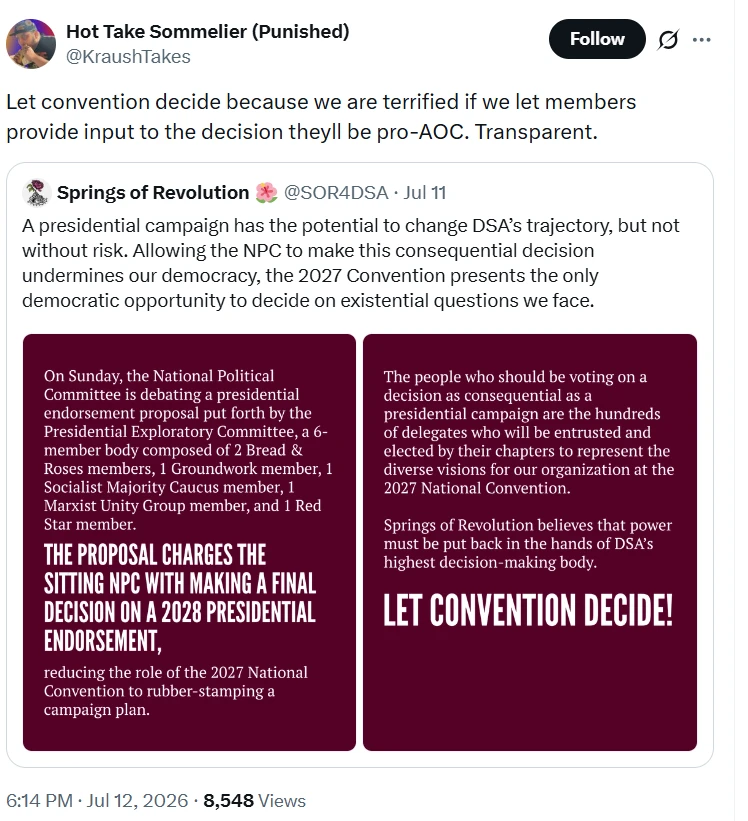
The tone is the tell. A Groundwork-aligned account mocked the NPC, accusing the leadership of stalling because “we are terrified if we let members provide input to the decision, they'll be pro-AOC. Transparent.”
Another prominent poster mocked the NPC’s logic as: “‘convention is sovereign’ ‘so we’re going to do the poll that convention mandated right’ ‘no 🙂’.” The rival caucuses were in turn dismissed as “WFP with Marxist aesthetics.” Their AOC merchandise was derided as “inverse MAGA… a cult of personality without a personality.” Their letter to leadership was characterized as a “whiny ass letter.”
The co-chair of New York City DSA, Gustavo Gordillo, who wanted the organization to support AOC from the get-go, reminded everyone that his chapter sends national “~ $2M per year in dues” — a line others read as a threat to walk.
Thus far, no candidate has announced a run for president in 2028. This is a movement conducting a scorched-earth war over a hypothetical candidacy, and treating the fight itself as evidence of seriousness rather than the reverse.
The Body Count
The AOC fight is not an aberration. DSA’s defining move is disciplining insiders, and the list of its own officials it has turned on is long and growing.
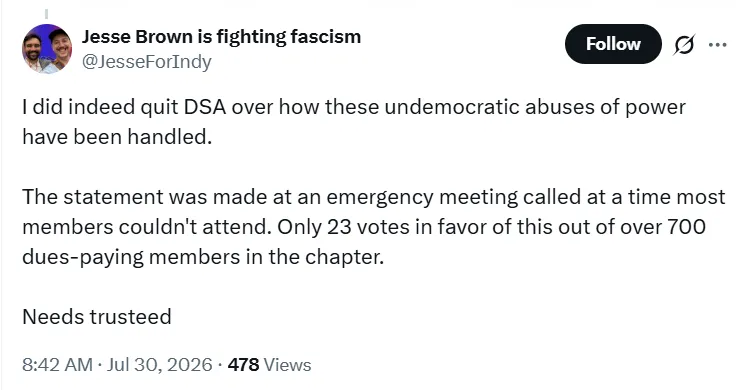
Ten days before the August 2026 Florida primary, the Central Indiana chapter of DSA voted to censure and revoke its endorsement of Jesse Brown, an Indianapolis city councilman, whom the same chapter had endorsed and helped elect two years earlier. The stated grounds were “harassment,” “grievance process” violations and “doxing” of members.
Brown, who says he had already quit the organization over dues, called the proceeding a “kangaroo court” and noted the resolution passed with only 23 votes out of more than seven hundred dues-paying members. The reporting that surfaced about the feud was almost too on-the-nose: At the center of the “harassment” charge was a Slack message in which Brown, a self-described “40-year-old pudgy pacifist,” told a fellow member to “say that s— to my face.”
The spectacle was not lost on the public. “Mom and dad need to stop fighting,” one onlooker wrote. Another simply announced, “D-I-V-O-R-C-E becomes final today.” The cruelest detail is one of timing: Six weeks earlier, DSA’s flagship magazine had held Brown up as a model socialist officeholder — a red-state insurgent proof of concept.
This is a pattern with receipts. In 2023, the Metro Detroit chapter voted 144 to 15 to expel sitting U.S. Congressman Shri Thanedar after he escorted India’s prime minister through the Capitol. When a DSA-backed challenger unseated Thanedar three years later, the chapter posted a victory lap: “Metro Detroit DSA expelled Shri in 2023, and now in 2026 we took his seat in Congress!”
In 2024, a DSA caucus publicly campaigned against re-endorsing Congressman Jamaal Bowman, and the national organization withdrew its own conditional endorsement of AOC herself after judging her insufficiently anti-Israel.
In August of this year, an anonymous mob of DSA-orbit accounts swarmed the organization’s congressional nominee in Colorado, Melat Kiros, for a single televised sentence showing sympathy towards Israel — with one account snapping, “She should start accepting aipac money!” — until she publicly recanted the line.
They fight across state lines, too. When New York City DSA’s co-chair fundraised in July for a mayoral candidate in Providence whose own Rhode Island chapter had un-endorsed him, a Philadelphia organizer announced it was “once again time to continue flaming NYC DSA.”
What a Convention Looks Like
To see the whole organism at once, watch it hold a convention.
At the 2025 gathering in Chicago, where roughly 1,200 delegates convened to hold the movement’s supreme governing body, a proposal to allow all members to vote directly for national leadership was defeated. According to the account delegates gave on the socialist podcast Cosmonaut, the action came when a speaker compared the reform’s opponents to slaveholders.
Elsewhere on the floor, an attempt to pass a hardline one-state resolution collapsed when its own left-wing backers, having failed to amend it to their liking, whipped everyone to vote against it — a maneuver one of those same sympathetic observers called plain “political immaturity.”
When the convention’s lodestar policy passed, a faction immediately wanted to expel everyone who had voted no. That policy was Resolution 22, “For a Fighting Anti-Zionist DSA,” which passed 675 to 524. That was a demand to purge 40 percent of the organization’s top activists, a demand even the convention’s own hardliners had to talk their comrades down from, on the modest grounds that “you can’t purge people for voting the wrong way at a convention.”
None of this is new. DSA is the institutional heir to a century of American socialist organizations that split, purged and shrank themselves into irrelevance over doctrinal quarrels, and its own historians know it. The irony is that the movement studies that history, only to reenact it.
The Naïveté is the Point
Here is the thing DSA’s boosters and enemies both tend to miss: the infighting is not a sign of a serious movement working out serious ideas. It is a sign of arrested development. The organization has the headcount of a mass party and the emotional register of a college group chat. In addition, it wages its most consequential fights through pseudonyms.
The people setting the tone of DSA’s internal life do not post under their names. The movement’s sharpest ideological enforcer is “Black Red Guard.” This leading voice in the AOC wars calls himself the “Hot Take Sommelier.” A prominent combatant in the anti-war faction posts as “welcome to our trash revolution.” These are not fringe trolls; they are DSA’s cadre, and their feuds set the tone for an organization with electeds in Congress and a member in a U.S. Senate general election.
The immaturity is not a slur from the right. It is the movement’s own diagnosis of itself. One of DSA’s most active national leaders, NPC member Cliff Connolly, has accused rival caucuses of running chapters by “purges” and “rule by polycule” and defended the endless warfare in a line that belongs on the organization’s banner: “The ‘no infighting’ you’re looking for is called sectarianism.”
When a political streamer quit the organization over its drama, a prolific member of the rival mass-politics wing sneered that “you don’t have the stomach for politics in general.” And these are the leaders talking. The rank and file are worse.
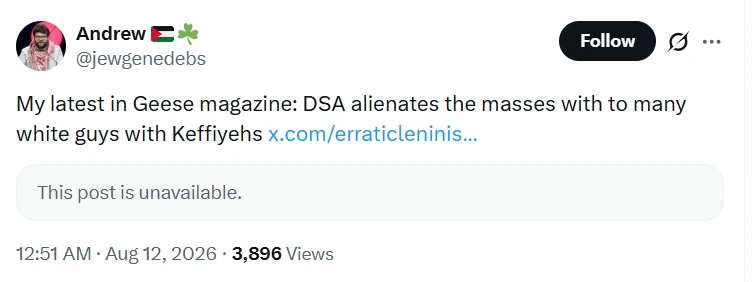
A clear illustration arrived this month, when a DSA theory magazine called Geese published an essay arguing the left alienates ordinary people with — the author’s words — too many “white guys with Keffiyehs.” The ensuing days-long brawl was a fight about the movement’s own subculture, conducted entirely within that subculture, by people accusing one another of being a “villainous group in the org dedicated to sapping our potential.”
One participant finally begged the others to stop being “conspiratorial goddamn.” It was, in essence, the whole enterprise: a mass movement so absorbed in litigating its own aesthetics that it forgets there is a country outside the group chat.
Why it Isn’t Funny
It would be easy to file all of this under harmless left-wing farce, the kind of purity spiral that has always kept American socialism small. But that would be a mistake, because the things DSA purges each other over are not small.
Resolution 22 did not merely scold pro-Israel members. It made saying that “Israel has a right to defend itself” an expellable offense — a red line so broad that, by its own terms, it could be used to expel a member with the similar ideology to Bernie Sanders.
The same convention adopted a platform committing DSA to abolishing the U.S. Senate and replacing the presidency and Supreme Court with bodies “subordinate to Congress,” and it passed a “Labor for an Arms Embargo” resolution meant to turn dockworkers and shipping unions into a tool for physically halting U.S. weapons shipments.
The hardline Marxist Unity Group, whose members sit on DSA’s national leadership committee, campaigns openly to overthrow what it calls the “slaveholder constitution.” The Liberation Caucus, which is fighting to keep AOC on a leash, holds, in writing, that “revolution will never come through the ballot box.”
When the people waging these fights lose, they are merely embarrassing. The worry is what they will do when they win.
That is the real reason the “unstoppable wave” framing deserves to be retired. The movement is not formidable because it is loud, and it is not inevitable because it is growing. DSA passed 120,000 members and spent the months that followed censuring a councilman it had just celebrated, swarming its own Colorado nominee into a public apology, killing its members’ own mandated vote by a single ballot, and staging a reply-guy war over a keffiyeh essay.
The membership number is not formidable if it consists of a crowd that agrees on very little and trusts one another even less.
Debs’s Socialist Party peaked at 113,000 members and then tore itself apart. DSA has now cleared that mark — but appears headed in the same direction. The firing squad is fully armed, it just keeps forgetting to face outward.