Jessica Carr
Overview
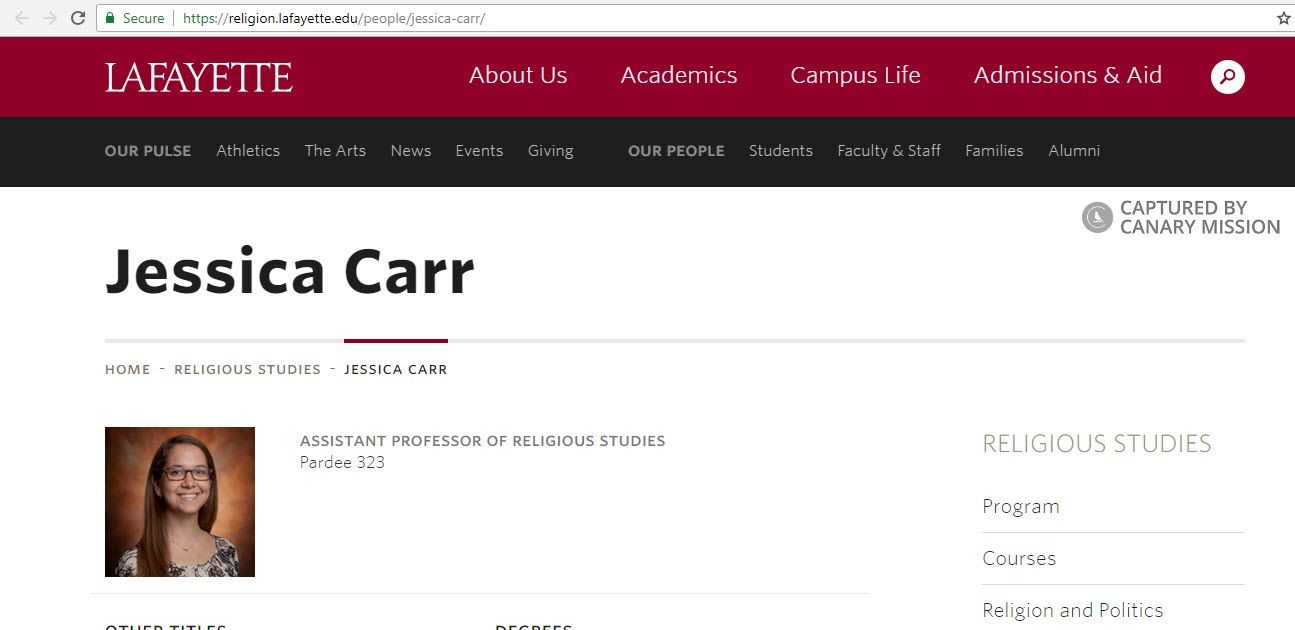
Jessica Carr has expressed support for the Boycott, Divestment, Sanctions (BDS) movement, promoted anti-Israel activism on campus and opposed the recognition of Jerusalem as the capital of Israel.Carr is an assistant professor of Religious Studies and the Berman Scholar of Jewish studies at Lafayette College (Lafayette). She formerly served as the faculty advisor for J Street U at Kenyon College.
Support for BDS
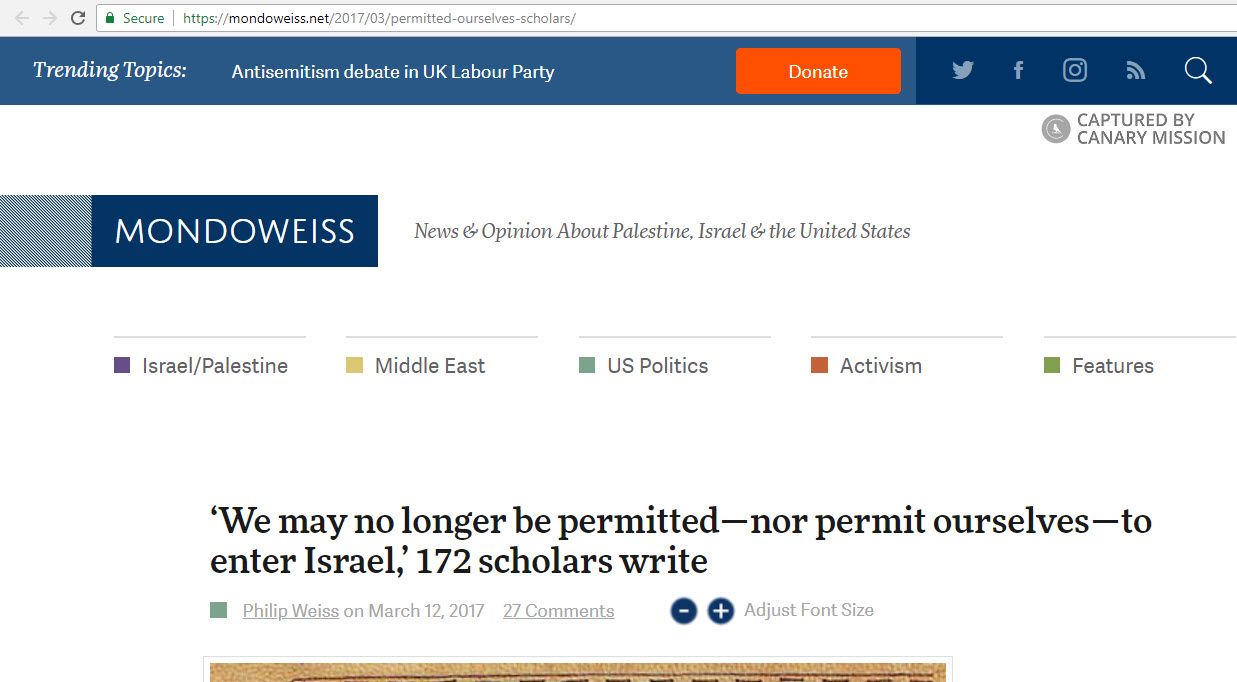
Carr signed an open letter condemning anti-BDS initiatives in Israel.The letter, signed by Jewish scholars and published by Mondoweiss on March 12, 2017, condemned the Israeli government’s anti-BDS legislation.
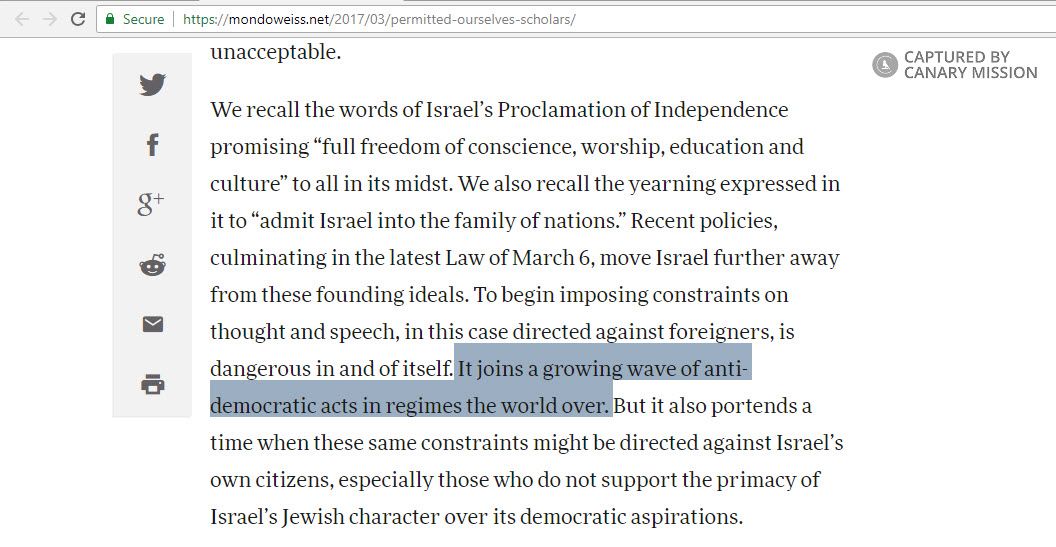
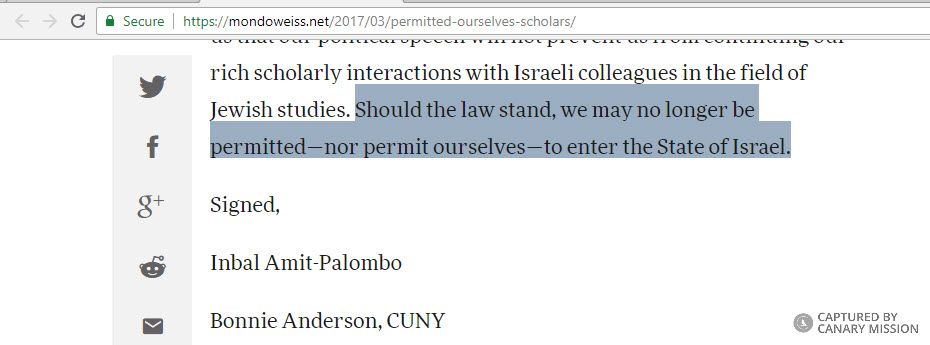
Signatories of the letter claimed that Israel joined “a growing wave of anti-democratic… regimes the world over” and threatened to abstain from traveling to Israel in protest against the new law.
Promoting Anti-Israel Activism on Campus
Carr signed a letter, authored by the anti-Israel Jewish Voice for Peace (JVP) organization and published on January 25, 2017, condemning Fordham University’s decision to block the establishment of a Students for Justice in Palestine (SJP) chapter at Fordham. In 2016, Fordham reportedly blocked the formation of a Fordham SJP chapter “based on the reported behavior of other [SJP] chapters on other campuses,” indicating that “the establishment of a local branch could be ‘polarizing’ and pose a safety concern to students and faculty.”Signatories demanded that Fordham “immediately rescind the rejection of SJP as a student group on campus, apologize to the students affected by this harmful decision, and reaffirm Fordham’s commitment to free speech and academic freedom.”
The petitioners also highlighted SJP’s BDS activity, characterizing SJP’s efforts to promote anti-Israel boycott as part of “a time-honored non-violent mode of political expression.” The petition accused Fordham’s administration of a “fundamental misunderstanding of what boycotts are, the purpose of a university, and the goals of SJP.”
Opposing U.S. Recognition of Jerusalem as the Capital of Israel
Carr signed a letter opposing the recognition of Jerusalem as Israel’s capital.Signatories of the letter warned that “a declaration from the United States government that appears to endorse sole Jewish proprietorship over Jerusalem adds insult to ongoing injury and is practically guaranteed to fan the flames of violence.”
The letter went on to state: “We therefore call on the U.S. government to take immediate steps to deescalate the tensions resulting from the President’s declaration and to clarify Palestinians’ legitimate stake in the future of Jerusalem.”
BDS
The Boycott, Divestment, Sanctions (BDS) movement was founded by Omar Barghouti in 2005 to challenge “international support for Israeli apartheid and settler-colonialism.” BDS is an allegedly “Palestinian-led movement,” although leading BDS activists have admitted [00:01:01] this is not true.
One of the demands of BDS includes [point 3] what is generally known as the “right of return,” a demand discredited as a way to eliminate Israel. Barghouti said the “right of return” is a means to “end Israel’s existence as a Jewish state.”
Barghouti has said that BDS “aims to turn Israel into a pariah state, as South Africa once was.”
In his activism, Barghouti has also said [00:05:55] regarding Israel: “Definitely, most definitely, we oppose a Jewish state in any part of Palestine. No…rational Palestinian, not a sellout Palestinian, will ever accept a Jewish state in Palestine.”
The movement has been linked to numerous terrorist organizations and received a public endorsement from Hamas in 2017.
BDS initiatives include calling on institutions and individuals to divest from Israeli-affiliated companies, promoting academic and cultural boycotts of Israel, and organizing anti-Israel rallies, protests and campaigns.
The movement’s most notable achievement has been the infiltration of university campuses through lobbying for “BDS resolutions.” In these cases, student governments and student groups, backed by their own anti-Israel members and affiliates, have proposed resolutions on some form of boycott of, or divestment from, Israel and Israeli-affiliated entities.
Boycott resolutions, although non-binding, have been passed by student governments on numerous North American campuses.
BDS activity is often aggressive and disruptive. It has been noted that universities that pass BDS resolutions see a marked increase in anti-Semitic incidents on campus. On one campus, when the student government debated a BDS resolution, reports emerged of violent threats against those opposing it.