Ben and Jerry – Obsessed With Divestment
Ben and Jerry are obsessed. Not with ice cream, as one would expect. But with divestment from Israel.
The famous ice cream company founded by Ben Cohen and Jerry Greenfield, known for their “social justice” crusades, threw its parent company Unilever into a tailspin last year when it announced that it would no longer sell its products “in occupied Palestinian territory.”
Unilever, a British conglomerate, bought out Ben and Jerry’s for $325 million in 2000. The ice cream giant was an extremely profitable company for Unilever until June 2021, when the divestment announcement was made.
The move ultimately cost Unilever’s stock value to plunge by the equivalent of $26 billion. In addition, American states with anti-BDS (Boycott, Divestment and Sanctions) laws pulled out another estimated $1 billion in pension funds they had invested in Unilever.
The British conglomerate did not take the divestment well, as would be expected, and fought back.
A year later, in June 2022, Unilever announced it had sold its interest in the ice cream company to its Israeli license holder, Avi Zinger.
Under the terms of the agreement, Zinger is allowed to operate independently of both Unilever and the ice cream company.
He can also use the Ben and Jerry logo and branding but only in Hebrew or Arabic. Zinger is also free to sell the ice cream in any locale, including the areas Ben and Jerry deem “occupied.”
Ben and Jerry: Relentless Focus on Divestment
But the compromise wasn’t good enough for the divestment aspirations of Ben and Jerry, who asserted:
“In our view, ending the sales of ice cream in the occupied territories is one of the most important decisions the company has made in its 43-year history.”
The company, which originally intended to boycott the entire country of Israel, sought an injunction against Unilever to cancel the sale to Zinger. Ben and Jerry’s argued that the sale would confuse its customers. Namely, having the Israeli company selling the ice cream would conflict with Ben and Jerry’s political stance.
In August, federal district court judge Andrew Carter shot down the injunction, saying the sale would not harm the ice cream company’s brand. In dismissing Ben and Jerry's lawsuit against Unilever, Carter said the reasoning was “too speculative.”
“Ben & Jerry’s has offered no evidence of such confusion or the impact of the alleged confusion,” Carter wrote in his opinion.
Now Ben and Jerry’s say they will amend their lawsuit against Unilever, claiming that the conglomerate broke their initial merger agreement signed 22 years ago. That agreement stipulated that Ben and Jerry would be able to maintain authority over the social mission of the company.
However, that same agreement gives Unilever control over all operation decisions made by the ice cream company. Further, Unilever contends that the sale cannot be canceled since it has already gone through.
The Hypocrisy of Ben And Jerry's Divestment Campaign
Meanwhile, Ben and Jerry’s are getting trolled online for the company’s hypocrisy in their choice of social justice issues.
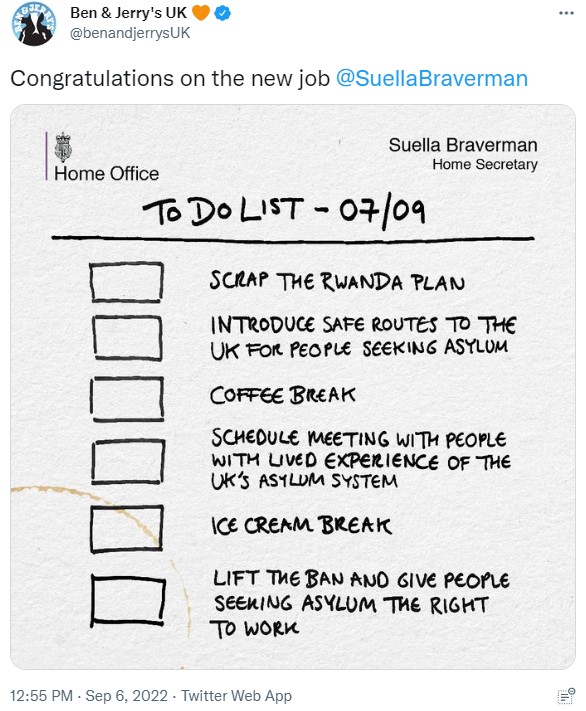
Ben and Jerry’s UK recently tweeted a “to do” list to the UK’s newly appointed home secretary, Suella Braverman. The list centered on lifting what the company called the UK’s “ban” on open immigration.
One account, the Campaign for Common Sense, made a “to-do list” for Ben and Jerry’s in response. The list consists of two items:
“Stick to selling ice cream. Stop trying to distract from the fact that you’re owned by a massive multinational called Unilever that exploits poor countries.”
One could make a similar critique about Ben and Jerry’s divestment obsession. Ben and Jerry should stick to selling ice cream.
Far from harming Israel, divestment from companies operating in what Ben and Jerry call “occupied territory” takes good-paying jobs and economic security away from the very same Palestinians the ice cream company purports to support.
Further, there are 100 land disputes worldwide. Amidst all the “socially responsible causes” for which the ice cream company advocates, Ben and Jerry’s singularly focuses on the land dispute involving the only Jewish state in the world.
That, in short, is the definition of anti-Semitism.