Rei Terada
Overview
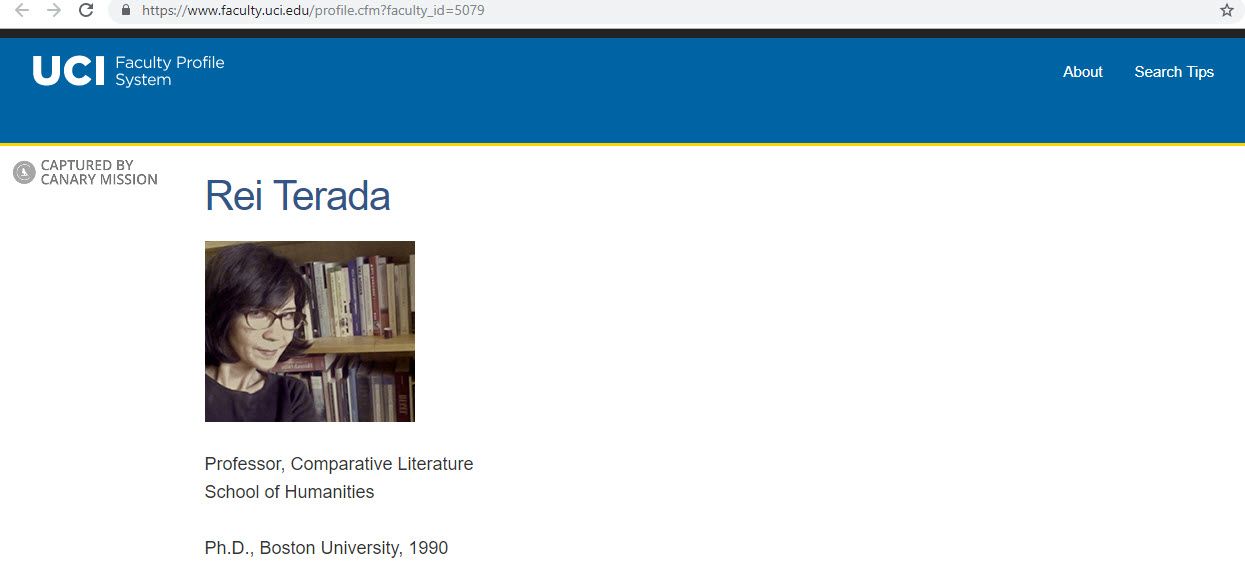
Rei Terada testified in defense of anti-Israel activists dubbed the “Irvine 11.” She has defended anti-Zionism on campus and is a supporter of the Boycott, Divestment, Sanctions (BDS) movement.As of September 2019, Terada was a Professor and the Director of Graduate Studies in the Department of Comparative Literature in the School of Humanities at the University of California, Irvine (UCI).
Defending the “Irvine 11”
On September 15, 2011, it was reported that Terada testified in defense of the “Irvine” 11.The September 2011 article also reported: “Terada said that in her 20-year career she had never seen someone attempt to impose such rules during a politically charged event on a university campus, especially one that had been expected to attract protests.”
In an article published on February 1, 2011, it was reported that Terada “joined the street corner rally” in support of the Irvine 11.
The February 2011 article also reported that Terada told: “the group that last year’s protest was not only legal, it was necessary, considering Oren — who has been criticized for his positions on the treatment of Palestinians — speaks nationwide.”
Terada also reportedly said at the rally: “‘Only that kind of speech can lead the powerless,’” and “‘The time and place is a part of the speech. It unlocks the full potential of political speech …they took the opportunity they had to put their speech in the same place that Oren put his.’”
Defending Anti-Zionism on Campus
In December 2016, Terada signed her name as a “contact person” for an open letter to the University of California (UC) Vice Provost Haynes, condemning a report on anti-Semitism on campus.Signatories of the letter wrote: “If these are constitutionally protected views and opinions, then how and why should Jewish students be protected from them? What is the line between criticism of Israel, however upsetting, and anti-Jewish sentiments?”
The letter went on to defend comparisons made between Israel and Nazi Germany, claiming that “such comparisons are not just made by anti-Jewish speakers against Israel, but have also been made by Israeli and Diaspora Jewish critics, including Holocaust survivors, who also have supported BDS activities that are also considered potential evidence of anti-Jewish prejudice.”
Signatories of the letter argued that “The definition of ‘anti-Zionism’ as intolerance and/or bigotry is vague and overbroad” and stated that “We believe that this formulation is now being revived by seeking to include ‘anti-Zionism’ as a form of bigotry and intolerance, and we urge you to reject that view.”
Supporting BDS
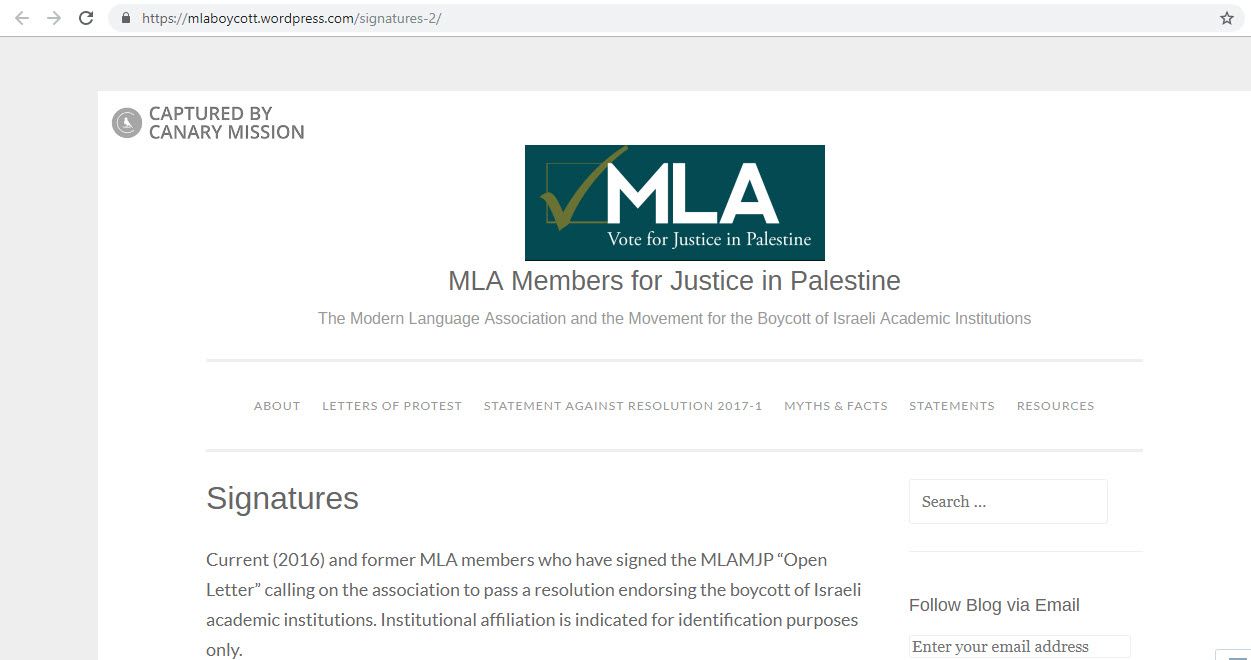
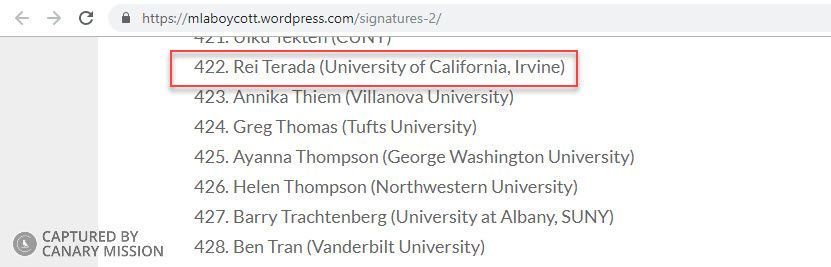
Terada signed a statement from the University of California (UC) faculty, published on March 9, 2015, calling on the university “to refrain from investing in certain companies that openly assist the Israeli government and army in the occupation of Palestine.”Also in March 2015, Terada signed an open letter calling for the adoption of BDS by the MLA.
The open letter was addressed to the Modern Language Association (MLA), “calling on the association to pass a resolution endorsing the boycott of Israeli academic institutions.”
In January 2017, the MLA Delegate Assembly approved a resolution (2017-1) acknowledging “the Palestinian Campaign for the Academic and Cultural Boycott of Israel contradicts the MLA’s purpose” and conflicted with another resolution (2002-1), that condemned boycotts against scholars. Therefore, the Assembly “resolved that the MLA refrain from endorsing the boycott.”
BDS
The Boycott, Divestment, Sanctions (BDS) movement was founded by Omar Barghouti in 2005 to challenge “international support for Israeli apartheid and settler-colonialism.” BDS is an allegedly “Palestinian-led movement,” although leading BDS activists have admitted [00:01:01] this is not true.
One of the demands of BDS includes [point 3] what is generally known as the “right of return,” a demand discredited as a way to eliminate Israel. Barghouti said the “right of return” is a means to “end Israel’s existence as a Jewish state.”
Barghouti has said that BDS “aims to turn Israel into a pariah state, as South Africa once was.”
In his activism, Barghouti has also said [00:05:55] regarding Israel: “Definitely, most definitely, we oppose a Jewish state in any part of Palestine. No…rational Palestinian, not a sellout Palestinian, will ever accept a Jewish state in Palestine.”
The movement has been linked to numerous terrorist organizations and received a public endorsement from Hamas in 2017.
BDS initiatives include calling on institutions and individuals to divest from Israeli-affiliated companies, promoting academic and cultural boycotts of Israel, and organizing anti-Israel rallies, protests and campaigns.
The movement’s most notable achievement has been the infiltration of university campuses through lobbying for “BDS resolutions.” In these cases, student governments and student groups, backed by their own anti-Israel members and affiliates, have proposed resolutions on some form of boycott of, or divestment from, Israel and Israeli-affiliated entities.
Boycott resolutions, although non-binding, have been passed by student governments on numerous North American campuses.
BDS activity is often aggressive and disruptive. It has been noted that universities that pass BDS resolutions see a marked increase in anti-Semitic incidents on campus. On one campus, when the student government debated a BDS resolution, reports emerged of violent threats against those opposing it.
Social Media and Weblinks
University Website:https://www.faculty.uci.edu/profile.cfm?faculty_id=5079
- Status:
- Professor
- University:
- California-Irvine
- Organizations:
- BDS
- Related Profiles:
- Last Modified:
- 05/04/2026
Photos & Screenshots