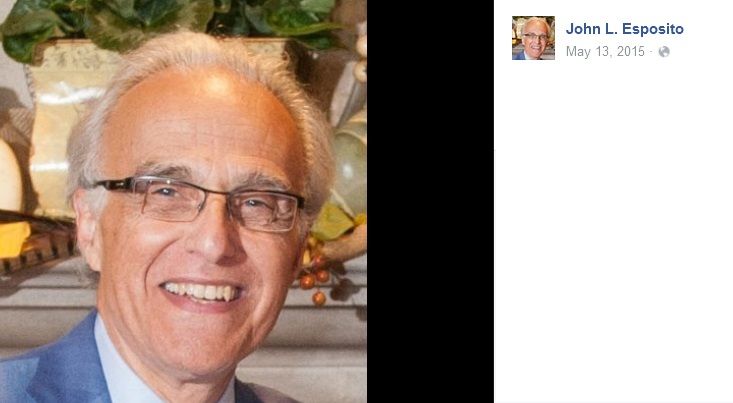
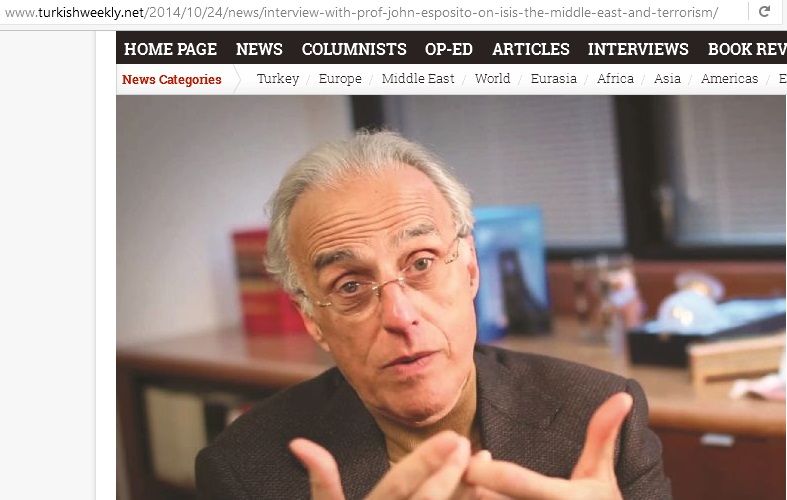
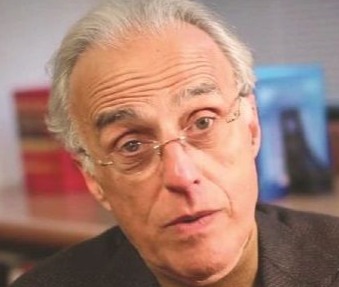
John Esposito
Overview
John Esposito [John Louis Esposito] backs the Boycott, Divestment, Sanctions (BDS) movement.
In 2014, Esposito signed a letter calling on "scholars and librarians within Middle East studies to boycott Israeli academic institutions." The letter further pledged "not to collaborate on projects and events involving Israeli academic institutions, not to teach at or to attend conferences and other events at such institutions, and not to publish in academic journals based in Israel.”
On Twitter, Esposito has conjured anti-Semitic references to the “Jewish Lobby,” echoing the age-old canard about Jews controlling foreign governments — recently revitalized by John Mearsheimer and Stephen Walt in their book titled “The Israel Lobby.”
Esposito is a professor of International Affairs and Islamic Studies at Georgetown University (Georgetown), as well as the Director of the Prince Alwaleed Center for Muslim-Christian Understanding (CMCU) at Georgetown.
Ties to Terrorist Organizations
Esposito has been involved with three entities that comprised the "Palestine Committee" — revealed to be a front group for the Muslim Brotherhood, which spawned the terror organization Hamas and which continues to assist it. The entities include the Holy Land Foundation (HLF), the Council on American Islamic Relations (CAIR), and the United Association for Studies and Research (UASR). Esposito’s involvement is detailed below.
Defending Financers of the Terrorist Organization Hamas in Federal Court
In November 2008, Esposito served as an expert defense witness testifying on behalf of five former HLF officers, who were accused funneling $12 million to the Islamist terror group Hamas. Despite Esposito’s representations that the defendants did not provide material support to Hamas, the defendants were found guilty on 108 counts, and received sentences ranging between 15 and 65 years in U.S. federal prison.
Whitewashing Hamas Fronts in the United States
Esposito has spoken at several CAIR banquets and fundraisers, and has referred to CAIR as a "phenomenal organization," despite its ties to Hamas and the Muslim Brotherhood (p. 16-17).
In 2000, Esposito joined the advisory board of the United Association for Studies and Research (UASR), a Virginia Think tank founded by Hamas Deputy Political Director Mousa Abu Marzook and run by senior Hamas member Ahmed Yousef. That year, Esposito’s CMCU held a joint conference with UASR at Georgetown (p. 18).
In 1993, the New York Times reported that Muhammad Salah, a convicted Hamas terrorist, revealed that the political command of Hamas in the U.S. was the UASR.
Sanitizing The Hamas and Hezbollah Terrorist Organizations
In 2000, several years after both Hamas and Hezbollah were designated Foreign Terrorist Organizations by the U.S. State Department, Esposito repeatedly “made statements to paint Hamas and Hizballah as legitimate political parties with whom the United States should reason and negotiate” (p. 4).
When asked in an interview with the Middle East Affairs Journal if Hamas and Hezbollah were terrorist organizations, Esposito answered "[o]ne can't make a clear statement about Hamas," and argued that Hezbollah operates "within the Lebanese political system functioning as a major player in parliament” (p. 4-5).
Whitewashing Anti-Semites and Terrorists
In 1994, Esposito testified at a House Foreign Affairs Committee hearing that Rashid Ghannoushi, leader of An-Nahdah — an outlawed Tunisian Islamist party — was a “moderate” and that the United States should grant him a visa (p. 7).
At a 1992 Chicago conference, Ghannoushi reportedly said: “Every evil in the world, the Zionists are behind it. This is no exaggeration. There are so many evils in this world, and behind which are the Children of Israel.” Ghannoushi has also praised the mothers of Palestinian suicide bombers, celebrated Hamas and called for “hundreds of years" of struggle against Israel.
Since 1999, Esposito has collaborated in a number of partnerships with Azzam Tamimi, a member of Hamas (p. 10-11). The Hamas charter is filled with classical and modern anti-Semitic ideas and conspiracy theories traditionally designed to instill fear and hatred of the Jewish people.
In a November 2004 television interview with BBC News, Tamimi said “…If I can go to Palestine and sacrifice myself [become a suicide bomber] I would do it.”
Esposito has also defended Yusuf al-Qaradawi, a spiritual leader of the Muslim Brotherhood, despite al-Qaradawi long-standing support for Palestinian suicide bombings (p. 12).
In 2004, Esposito slammed the U.S. Department of Homeland Security for revoking, under the Patriot Act, a work visa granted to Tariq Ramadan to teach at Notre Dame. The Act denies entry to persons who have used a "position of prominence within any country to endorse or espouse terrorist activity." Ramadan has also made financial contributions to French charities linked to Hamas (p. 13).
Esposito wrote that “Ramadan is a scholar recognized throughout the world for his labors on behalf of interfaith understanding and the building of peace.”
Glorifying Terror-Financier Sami al-Arian
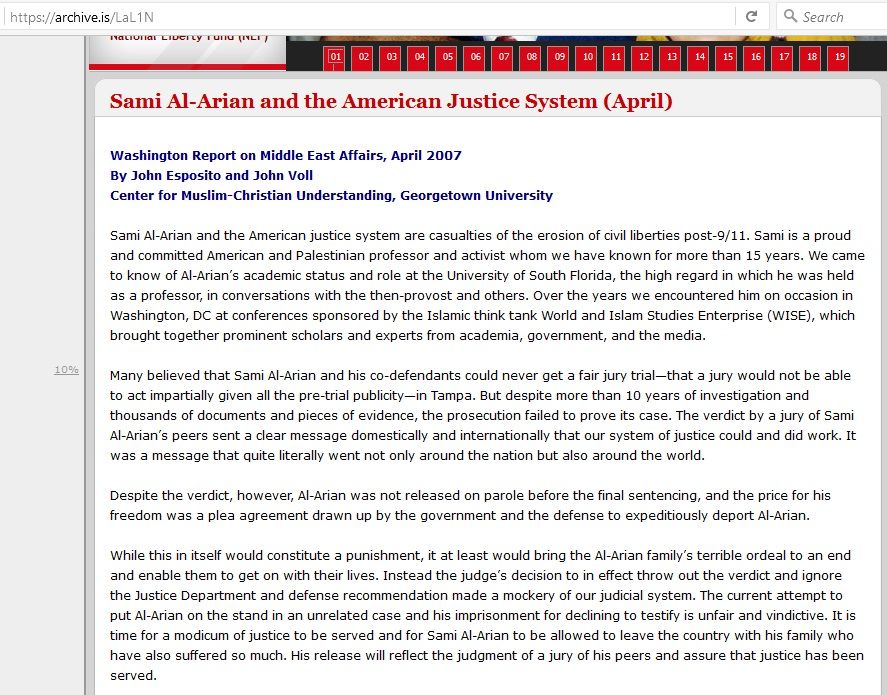
Esposito is a "good friend" (p. 9) and long-time apologist for Sami al-Arian, a former University of South Florida professor — who pled guilty to conspiring to aid the Islamist terror group Palestinian Islamic Jihad (PIJ) and admitted knowing that it used violence to achieve its ends.
Palestinian Islamic Jihad (PIJ) is a terror group “whose objective is the destruction of the State of Israel and the establishment of a sovereign, Islamic Palestinian state.” PIJ is backed by Iran and has killed dozens of Israelis in suicide bombings and other attacks.
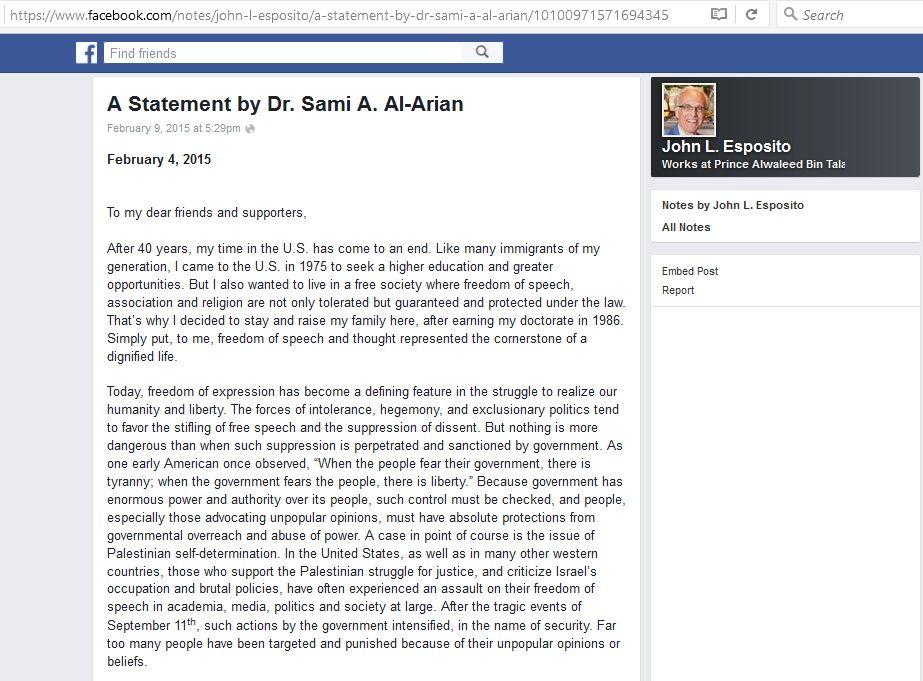
In a 2007 article, Esposito called for al-Arian’s release and has elsewhere referred to him as “an extraordinarily bright, articulate scholar and intellectual-activist, a man of conscience with a strong commitment to peace and social justice” (p. 10). On February 9, 2015, Esposito posted on Facebook a letter written by Al-Arian characterizing his terror financing trial and eventual deportation as an attack on “freedom of expression.”
Endorsing Terror-Inciting Institutions
As of July 20, 2016, Esposito signed a statement posted on the website of the Israel-hating group Jewish Voice for Peace (JVP), titled "Religious Studies Scholars Statement of Solidarity with the Palestinian Boycott, Divestment, and Sanctions Movement."
The statement slammed Israel for alleged “violations of human rights” and went on to say: “[w]e pledge to defend freedom of expression, intellectual curiosity, engaged pedagogy, political commitment, and open scholarship for all, including Palestinian children and university students whose rights to an education are systematically violated...”
Under the anchor text “university students” JVP linked to an article that recounted “military incidents” at various Palestinian universities, such as Al Quds, Birzeit, and Al Najah.
However, the article omitted all mention of the student activities that led to the military incidents.
The article alleged that at Al Quds university “sixty students were arrested and detained for their political affiliations and on-campus activities” — but omitted that the students arrested were directly involved in murderous terror activity. The article also absented mention of Hamas’ activities on campus and the Islamic Jihad parade at the university, featuring traditional Nazi salutes.
When Brandeis University — which had a relationship with Al Quds— requested Al Quds to condemn the Islamic Jihad rally, the university instead released a statement condemning “Jewish extremists” and discussing “freedom.” Brandeis subsequently severed its connection with Al Quds.
JVP and Esposito's unqualified support of all [Palestinian] “university students” contains no exception for Birzeit university’s Shabiba student group.
In December 2015, the Shabiba student group posted Facebook pictures of themselves beside a Christmas tree decorated with the portraits of terrorist murderers — including one who had recently stabbed four Israeli civilians. The terrorists whose images decorated the Christmas tree were collectively responsible for thousands of murderous attacks against Israelis. Behind the Birzeit students was a sign that proclaimed: “The way to freedom is a bullet and a martyr... a crescent and a cross; Merry Christmas, [Fatah] Shabiba student movement, Birzeit University.”
Esposito’s unqualified support also extends to students at Al-Najah University.
Al-Najah (alternatively, An Najah) University, the largest Palestinian university in the West Bank, launched and celebrated a triumphal exhibit lauding the August 9, 2001 Sbarro cafe suicide bombing. That bombing specifically targeted religious Jewish patrons and killed 18 people, including 8 children. The blast wounded another 87 people. Al-Najah’s exhibit featured a mock-up of Sbarro’s, including gnawed pizza crusts and bloody plastic body parts suspended from the ceiling, as if they were blasting through the air.
Per an Associated Press report, another part of the exhibit glorified the "martyrs" who carried out suicide operations, portraying their images with a Koran and Kalashnikov rifle in hand. The exhibit also included a large rock in front of a mannequin wearing the black hat, black jacket and black trousers typically worn by ultra-Orthodox Jews. A recording from inside the rock called out: "O believer, there is a Jewish man behind me. Come and kill him."
Slamming A Program for American Muslim-Jewish Understanding
On July 1 2015, Esposito promoted on Facebook a petition calling for an immediate halt to the Muslim Leadership Initiative (MLI), sponsored by the Shalom Hartman Institute, as “a betrayal of the Palestinian People.”
MLI "invites North American Muslim leaders to explore how Jews understand Judaism, Israel and North American Jewish identity through a Zionist lens," and to expand their understanding of Jewish “ethics, faith, and practice.” According to MLI founder Imam Abdullah Antepli, “MLI aims to put mainstream North American Jewry in conversation with their Muslim counterparts.”
The petition rejected the program, claiming: “MLI is now a part of the Hasbara Israeli propaganda operation,” and slammed the program as “a deliberate attempt to make Muslims more sympathetic to Zionism, and to present an anti-BDS perspective…”
The petition shunned the engagement of Muslim Americans with Israel or other institutions unless they “promote Palestinian liberation and comply with Palestinian demands.”
The petition further pledged “to not give a platform to any MLI participant to speak about their experiences at our community centers, places of worship, and campuses and call on a complete boycott of MLI.”
Advancing CAIR
Esposito has spoken at several Council on American Islamic Relations (CAIR) banquets and fundraisers (p. 16).
BDS
The Boycott, Divestment, Sanctions (BDS) movement was founded by Omar Barghouti in 2005 to challenge “international support for Israeli apartheid and settler-colonialism.” BDS is an allegedly “Palestinian-led movement,” although leading BDS activists have admitted [00:01:01] this is not true.
One of the demands of BDS includes [point 3] what is generally known as the “right of return,” a demand discredited as a way to eliminate Israel. Barghouti said the “right of return” is a means to “end Israel’s existence as a Jewish state.”
Barghouti has said that BDS “aims to turn Israel into a pariah state, as South Africa once was.”
In his activism, Barghouti has also said [00:05:55] regarding Israel: “Definitely, most definitely, we oppose a Jewish state in any part of Palestine. No…rational Palestinian, not a sellout Palestinian, will ever accept a Jewish state in Palestine.”
The movement has been linked to numerous terrorist organizations and received a public endorsement from Hamas in 2017.
BDS initiatives include calling on institutions and individuals to divest from Israeli-affiliated companies, promoting academic and cultural boycotts of Israel, and organizing anti-Israel rallies, protests and campaigns.
The movement’s most notable achievement has been the infiltration of university campuses through lobbying for “BDS resolutions.” In these cases, student governments and student groups, backed by their own anti-Israel members and affiliates, have proposed resolutions on some form of boycott of, or divestment from, Israel and Israeli-affiliated entities.
Boycott resolutions, although non-binding, have been passed by student governments on numerous North American campuses.
BDS activity is often aggressive and disruptive. It has been noted that universities that pass BDS resolutions see a marked increase in anti-Semitic incidents on campus. On one campus, when the student government debated a BDS resolution, reports emerged of violent threats against those opposing it.
CAIR
CAIR describes itself as a “grassroots civil rights and advocacy group” and “America's largest Muslim civil liberties organization, with regional offices nationwide.” Its official mission is “enhance understanding of Islam, protect civil rights, promote justice, and empower American Muslims.”
CAIR reportedly has “significant ties” to the Muslim Brotherhood, as well as Hamas. A number of former CAIR employees have been convicted on fraud and terrorism-related charges that resulted monetary fines, jail terms and, sometimes, deportation.
CAIR was founded in 1994 and opened its first office in Washington, DC, with the help of a $5,000 donation from the Holy Land Foundation for Relief and Development (HLF), a charity founded by Mousa Abu Marzook.
Marzook, who was listed as a "Specially Designated Terrorist" by the U.S. Treasury Department in 1995, is reportedly a senior member of Hamas.
In May 2007, CAIR was listed as an “unindicted co-conspirator” in a U.S.-filed action against the HLF for providing funds to Hamas.
CAIR was also listed as a terrorist entity by the United Arab Emirates, in 2014.
Social Media and Weblinks
Facebook:https://www.facebook.com/john.l.esposito.1
Twitter:https://twitter.com/JohnLEsposito
- Status:
- Professor
- University:
- Georgetown
- Organizations:
- BDS,
- CAIR,
- more...
- Related Profiles:
- Rachel Kuykendall,
- Last Modified:
- 05/04/2026
Photos & Screenshots