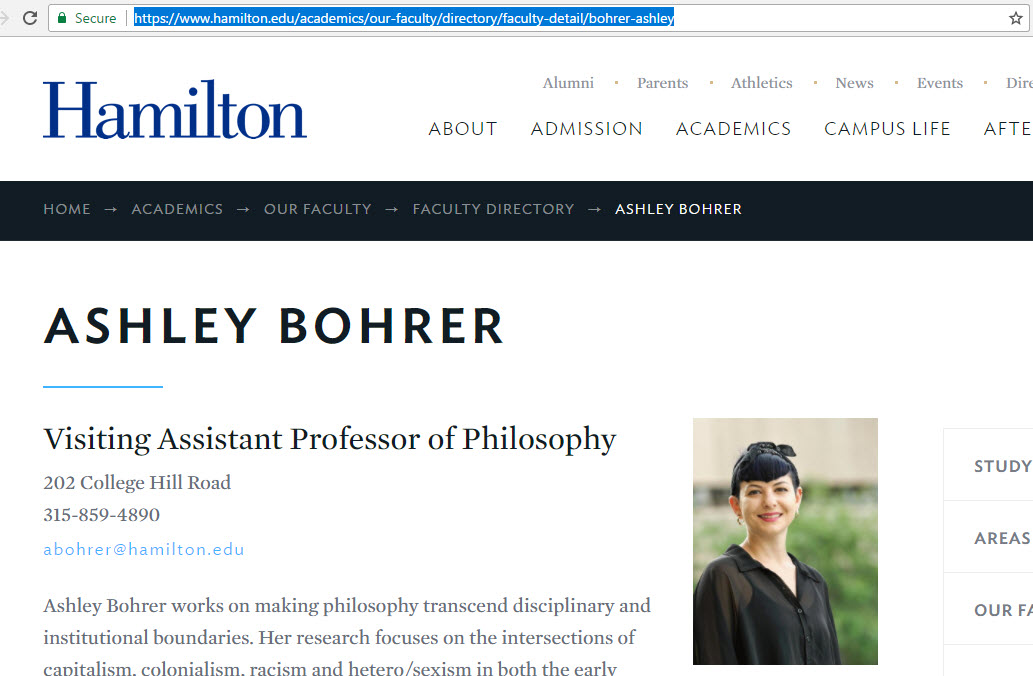
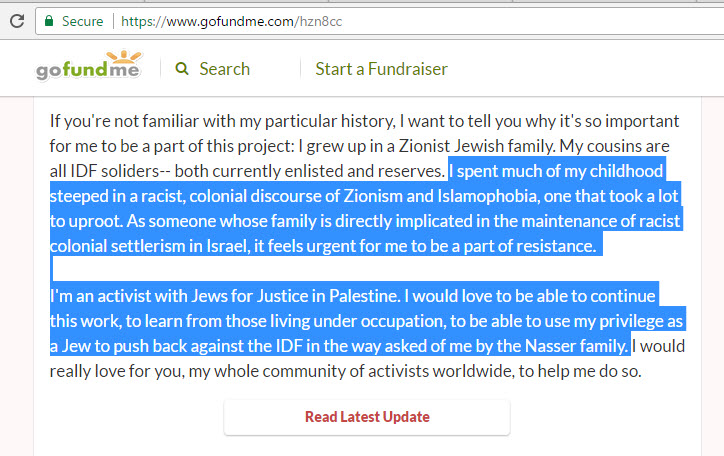
Ashley Bohrer
Overview
Anti-Israel Activism
Demonizing Israel
Supporting Steven Salaita
In 2014, The University of Illinois withdrew an offer of employment to Salaita after becoming aware of his anti-Semitic tweets. One tweet, posted shortly after Hamas kidnapped three teenage Israeli high school students, read: "You may be too refined to say it, but I’m not: I wish all the f**king West Bank settlers would go missing.” In 2017, Salaita posted to Facebook: “People ask if I would go back in time and change anything. I would not…I will die unapologetic.” In February 2019, Salaita stated that he had become a school bus driver in the Washington, D.C., area.
JVP
JVP was founded in Berkeley, California in 1996, as an activist group with an emphasis on the “Jewish tradition” of peace, social justice and human rights. The organization is currently led by Rebecca Vilkomerson and its board members include Israel critics Naomi Klein, Judith Butler, Noam Chomsky and Tony Kushner.
JVP, which generally employs civil disobedience tactics to disrupt pro-Israel speakers and events, consists of American Jews and non-Jewish “allies” highly critical of Israeli policies. A staunch supporter of the BDS movement, JVP claims to aim its campaigns at companies that either support the Israeli military (Hewlett-Packard) or are active in the West Bank (SodaStream).
Although several Jewish groups critical of Israeli policies, like J Street and Partners for a Progressive Israel, make efforts to operate within the mainstream American Jewish community, JVP functions outside. The group is often criticized for serving as a tokenized Jewish voice for the pro-Palestinian camp and is widely regarded as the BDS movement’s “Jewish wing.”
JVP denies the notion of “Jewish peoplehood” and has even gone so far as to refer to its own Ashkenazi (Jews who spent the Diaspora in European countries) leadership as “white supremacy inside of JVP.”
The Anti-Defamation League (ADL) has accused JVP of being “the largest and most influential Jewish anti-Zionist group in the United States,” and said the group “exploits Jewish culture and rituals to reassure its own supporters that opposition to Israel not only does not contradict, but is actually consistent with, Jewish values.”
The ADL also claimed that “JVP consistently co-sponsors rallies to oppose Israeli military policy that are marked by signs and slogans comparing Israel to Nazi Germany, demonizing Jews and voicing support for groups like Hamas and Hezbollah.”
According to the ADL website, JVP “uses its Jewish identity to shield the anti-Israel movement from allegations of anti-Semitism and provide it with a greater degree of legitimacy and credibility.”
BDS
The Boycott, Divestment, Sanctions (BDS) movement was founded by Omar Barghouti in 2005 to challenge “international support for Israeli apartheid and settler-colonialism.” BDS is an allegedly “Palestinian-led movement,” although leading BDS activists have admitted [00:01:01] this is not true.
One of the demands of BDS includes [point 3] what is generally known as the “right of return,” a demand discredited as a way to eliminate Israel. Barghouti said the “right of return” is a means to “end Israel’s existence as a Jewish state.”
Barghouti has said that BDS “aims to turn Israel into a pariah state, as South Africa once was.”
In his activism, Barghouti has also said [00:05:55] regarding Israel: “Definitely, most definitely, we oppose a Jewish state in any part of Palestine. No…rational Palestinian, not a sellout Palestinian, will ever accept a Jewish state in Palestine.”
The movement has been linked to numerous terrorist organizations and received a public endorsement from Hamas in 2017.
BDS initiatives include calling on institutions and individuals to divest from Israeli-affiliated companies, promoting academic and cultural boycotts of Israel, and organizing anti-Israel rallies, protests and campaigns.
The movement’s most notable achievement has been the infiltration of university campuses through lobbying for “BDS resolutions.” In these cases, student governments and student groups, backed by their own anti-Israel members and affiliates, have proposed resolutions on some form of boycott of, or divestment from, Israel and Israeli-affiliated entities.
Boycott resolutions, although non-binding, have been passed by student governments on numerous North American campuses.
BDS activity is often aggressive and disruptive. It has been noted that universities that pass BDS resolutions see a marked increase in anti-Semitic incidents on campus. On one campus, when the student government debated a BDS resolution, reports emerged of violent threats against those opposing it.
Social Media and Weblinks

Photos & Screenshots