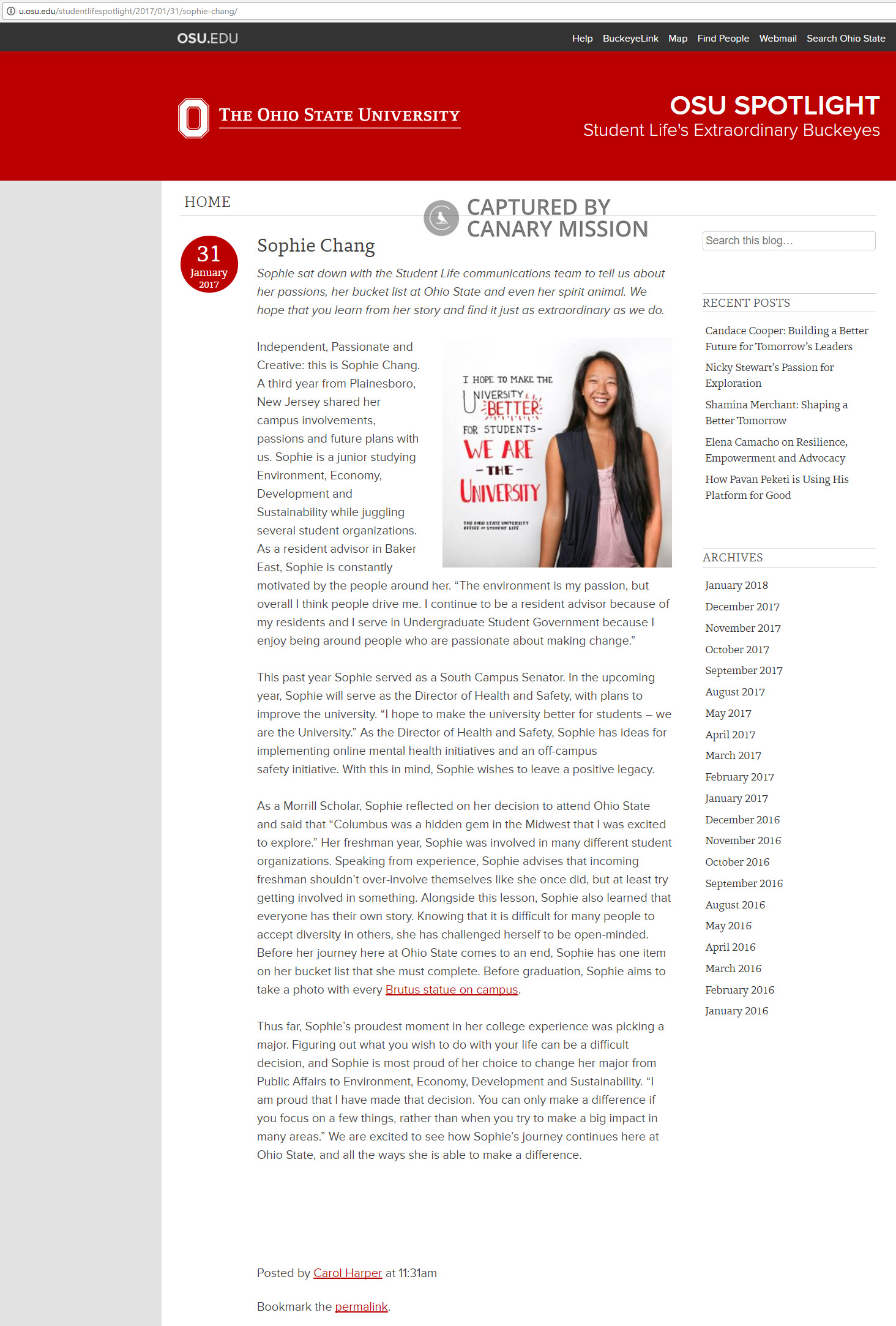
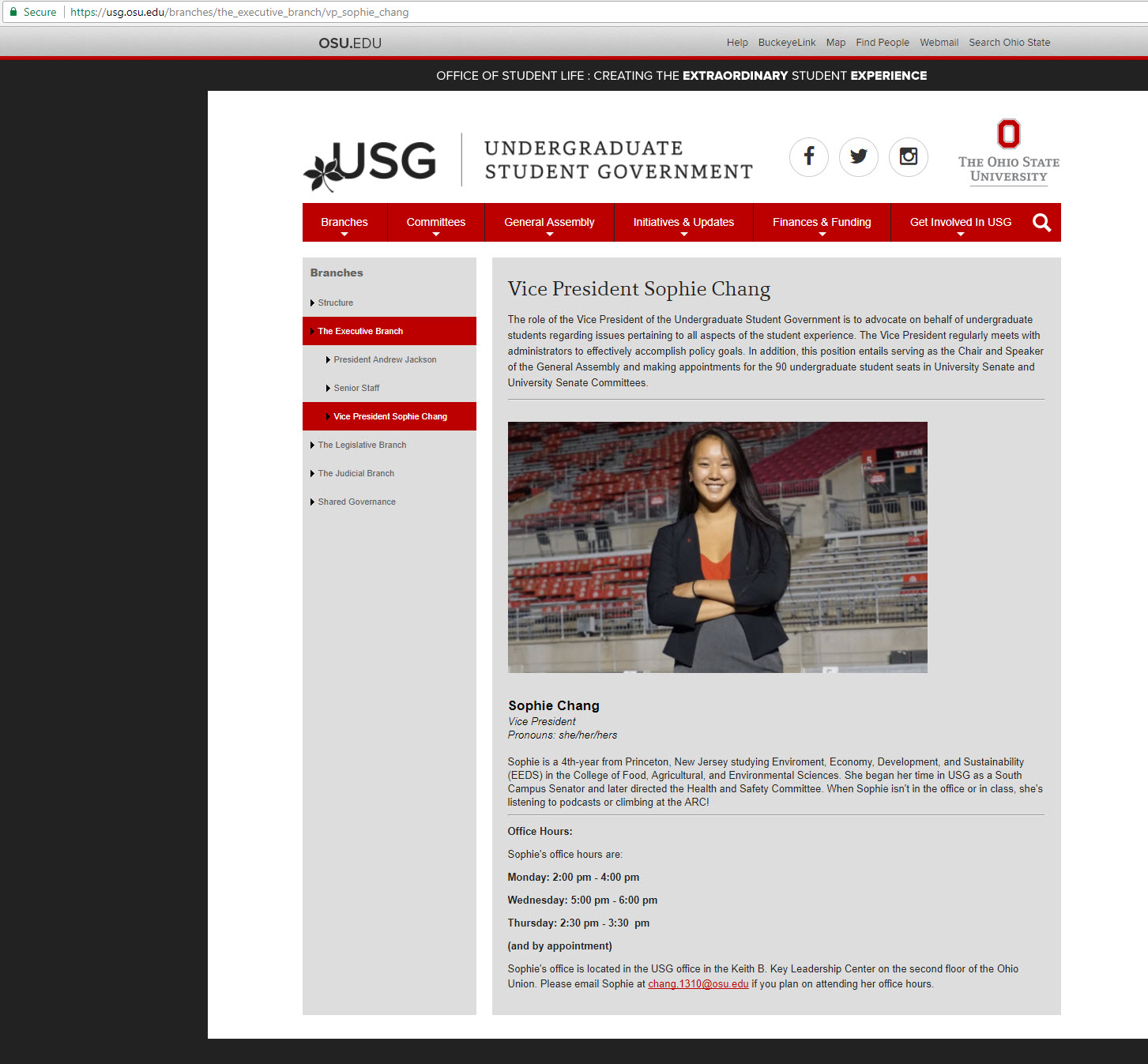
Sophie Chang
Overview
The bill capped an ongoing campaign to push the agenda of the Boycott, Divestment, Sanctions (BDS) movement at OSU, called“OSU Divest.” The initiative was supported by Students for Justice in Palestine (SJP) at OSU.
As of January 2018, Chang’s LinkedIn said she was the “Student Body Vice President” at OSU since April 2017, as well as a University Senator and Chair of the University Panel on Food and Sustainability.
Read the full Report on Ohio State University, June 2018, here.
OSU Divest 2018
On January 25, 2018, USG approved a watered-down anti-Israel resolution via a “secret vote.” The resolution allowed the “student government to create a committee of senators to investigate Ohio State’s investment in companies that might be linked to domestic human rights violations.”The resolution was “on track to fail” until it was amended to be “less explicitly linked to the Israeli-Palestine conflict.” Another proposed amendment to add a statement denouncing the BDS movement was rejected.
However, the resolution retained its references to anti-Israel boycott resolutions passed by student governments at over a dozen other universities. Links to multiple websites accusing Israel of “apartheid” and promoting BDS were also retained.
The university newspaper reported that the first round of secret ballot voting resulted in a revote, because more votes were recorded than senators present. USG offered no explanation for the discrepancy.
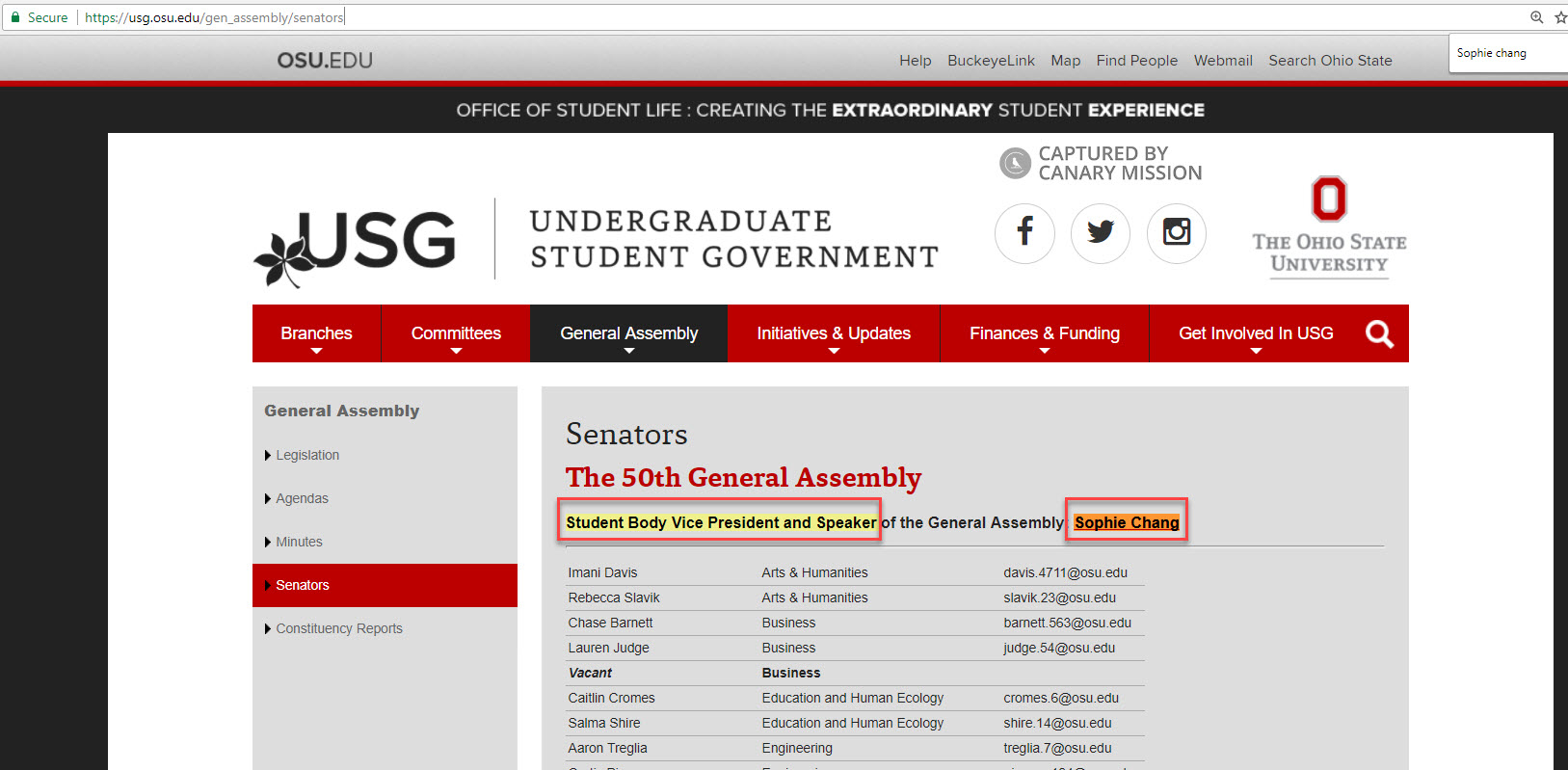
Sophie Chang, USG speaker and vice president, was reportedly responsiblefor approving the voting mechanism of a secret ballot and “refused to state how many senators voted in favor of the motion.”
During the discussion on the resolution, 38 OSU students reportedly spoke against the resolution, and 8 spoke in favor. One student described the resolution as “intentionally dishonest,” while other students cited “its anti-Semitic undertones.”
OSU Divest 2017
OSU’s Students for Justice in Palestine (SJP) worked together with OSU Divest to launch a divestment campaign in late January of 2015. In March of 2015, OSU Divest unsuccessfully attempted to put a last-minute divestment referendum on the University Student Government (USG) election ballot.During the pre-vote discussion of the bill, OSU divest members accused Israel of “apartheid.” One claimed that United States presidential election candidates “all paraded to AIPAC to pledge allegiance to a foreign government.”
The divestment bill claimed that the call for (active) divestment is a "neutral position" but targeted companies involved in Israel's security as "complicit in human rights abuses.”
OSU Divest petitioned students to place the Divestment resolution open to popular vote, and received enough signatures for their Divestment initiative to be placed on the USG ballot as a referendum.
Daniella Israelstam, a sophomore at OSU who worked against the divestment resolution, reported that OSU Divest used “misleading” tactics, “disguising what was petition [sic.] by saying, ‘please sign this if you support human rights’.”
The vote, which took place from March 6-8, 2017, defeated the divestment bill with 3,843 votes in favor and 4,084 opposed.
As of November 27, 2017, Alyssa Ruebensaal-Novak was listed as SJP OSU’s 2017-2018 Divest Committee Head, with her role being to “recruit and head SJPs efforts to get divest passed.”
BDS
The Boycott, Divestment, Sanctions (BDS) movement was founded by Omar Barghouti in 2005 to challenge “international support for Israeli apartheid and settler-colonialism.” BDS is an allegedly “Palestinian-led movement,” although leading BDS activists have admitted [00:01:01] this is not true.
One of the demands of BDS includes [point 3] what is generally known as the “right of return,” a demand discredited as a way to eliminate Israel. Barghouti said the “right of return” is a means to “end Israel’s existence as a Jewish state.”
Barghouti has said that BDS “aims to turn Israel into a pariah state, as South Africa once was.”
In his activism, Barghouti has also said [00:05:55] regarding Israel: “Definitely, most definitely, we oppose a Jewish state in any part of Palestine. No…rational Palestinian, not a sellout Palestinian, will ever accept a Jewish state in Palestine.”
The movement has been linked to numerous terrorist organizations and received a public endorsement from Hamas in 2017.
BDS initiatives include calling on institutions and individuals to divest from Israeli-affiliated companies, promoting academic and cultural boycotts of Israel, and organizing anti-Israel rallies, protests and campaigns.
The movement’s most notable achievement has been the infiltration of university campuses through lobbying for “BDS resolutions.” In these cases, student governments and student groups, backed by their own anti-Israel members and affiliates, have proposed resolutions on some form of boycott of, or divestment from, Israel and Israeli-affiliated entities.
Boycott resolutions, although non-binding, have been passed by student governments on numerous North American campuses.
BDS activity is often aggressive and disruptive. It has been noted that universities that pass BDS resolutions see a marked increase in anti-Semitic incidents on campus. On one campus, when the student government debated a BDS resolution, reports emerged of violent threats against those opposing it.
Social Media and Weblinks
Facebook:https://www.facebook.com/1648563511
- Status:
- Professional
- University:
- Ohio-State
- Organizations:
- BDS
- Related Profiles:
- Leila Elaqad,
- Last Modified:
- 05/04/2026
Videos

Photos & Screenshots