Sarah Schmitt
Overview
Sarah Schmitt was a 2016-2017 board member and programming director of Students for Justice in Palestine (SJP) at the University of California, Los Angeles (UCLA).In April 2016, Schmitt was reportedly a history major at UCLA, slated to graduate in 2017.
As of October 2018, Schmitt’s Facebook page said she was a lifeguard at the California State Parks - Orange Coast District, in San Clemente, California.
SJP Activism
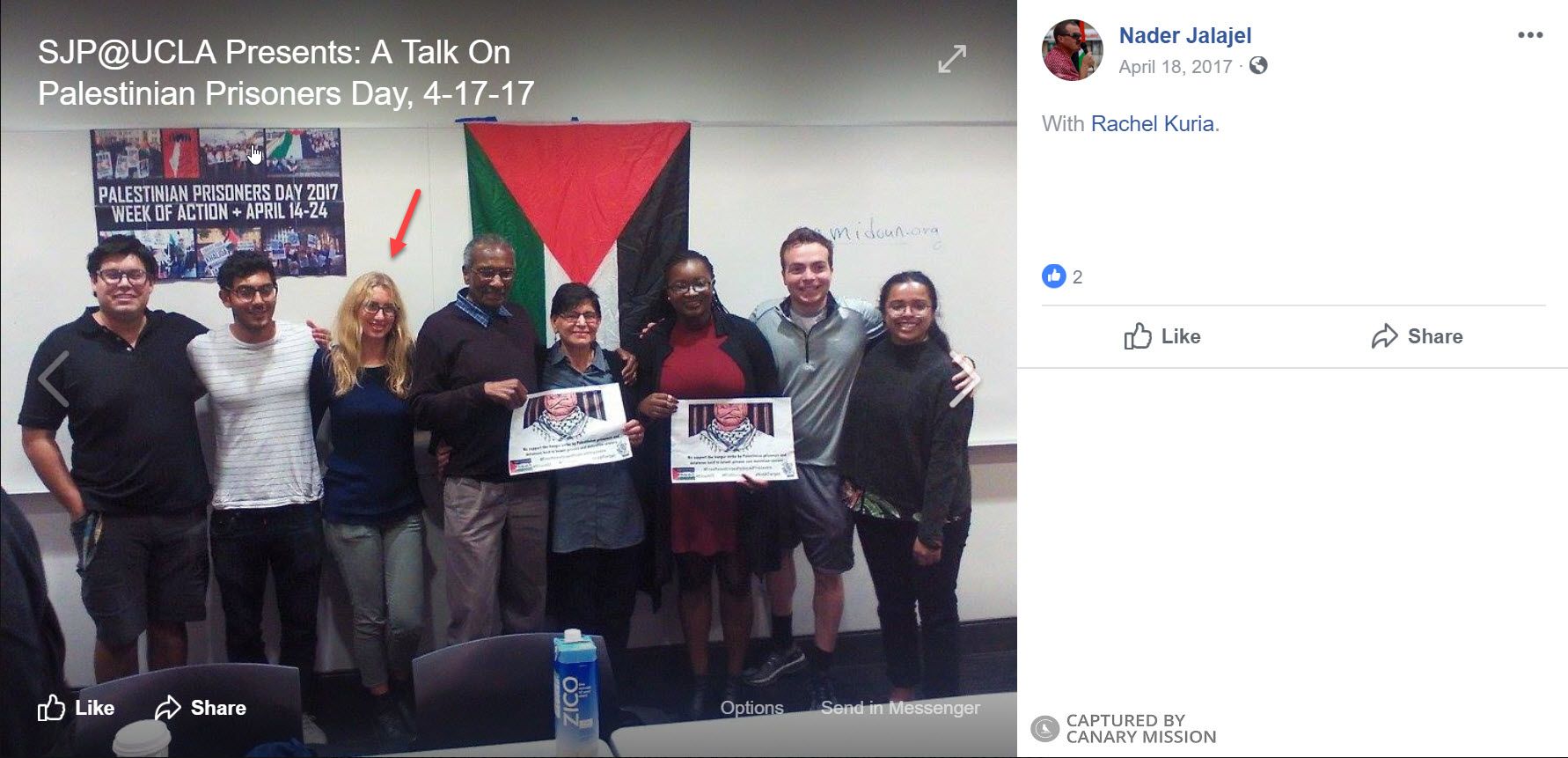
On April 17, 2017, Schmitt posed in a photo along with professor Rabab Abdulhadi following a “Palestinian Prisoners Day” talk hosted by SJP at UCLA. The event page said that Abdulhadi would be discussing: “Israel as a colonial carceral state, colonial violence and indigenous resistance.”Abdulhadi has — since at least January 2014 — sought to cultivate alliances between SFSU and two Hamas-dominated Palestinian universities.
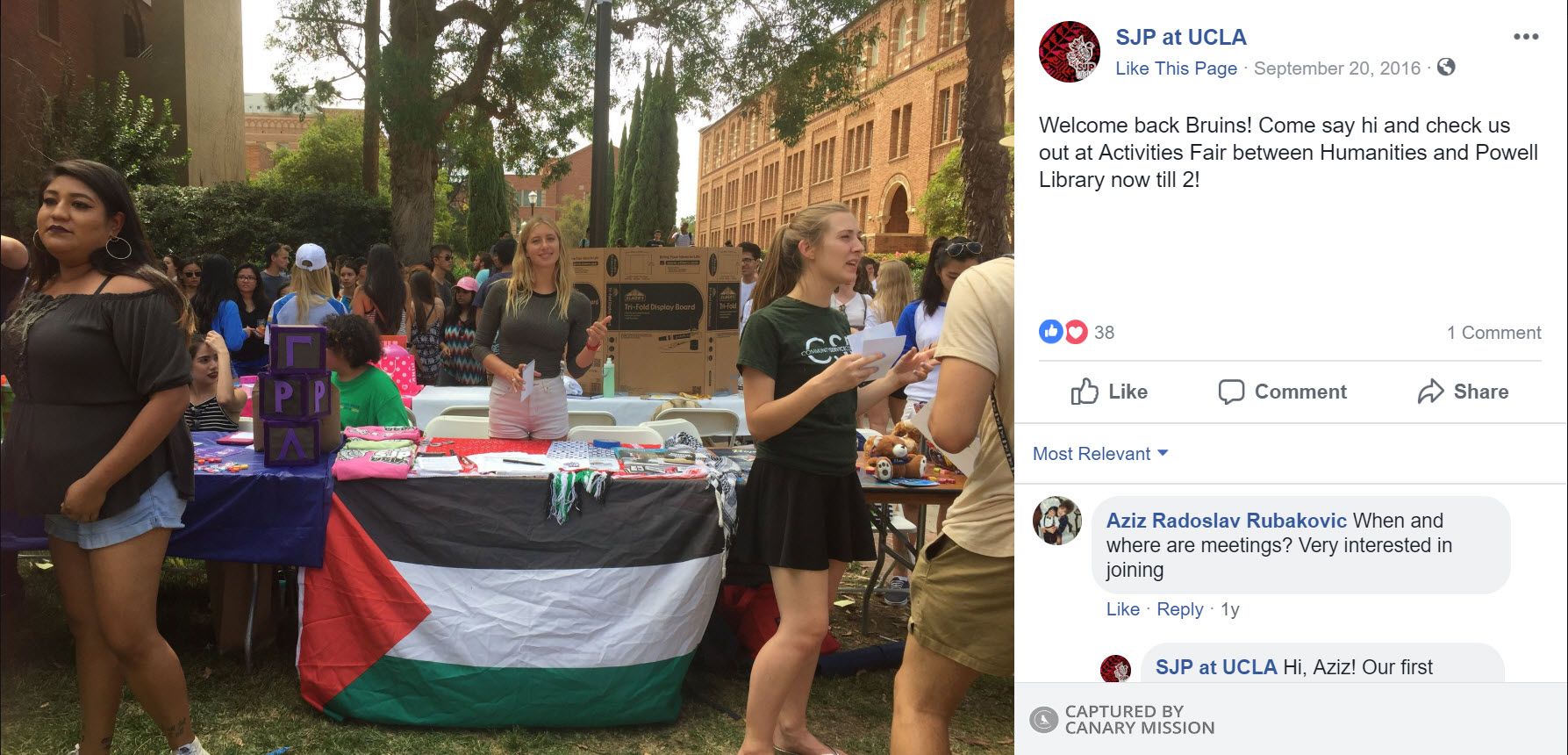
On September 20, 2016, Schmitt appeared in a Facebook photo tabling for SJP at UCLA on campus.
On November 30, 2016, SJP at UCLA screened the anti-Israel film “The Occupation of the American Mind.” The event also featured the film’s anti-Israel executive producer, Professor Sut Jhally, and anti-Israel musician and BDS-supporter Roger Waters.
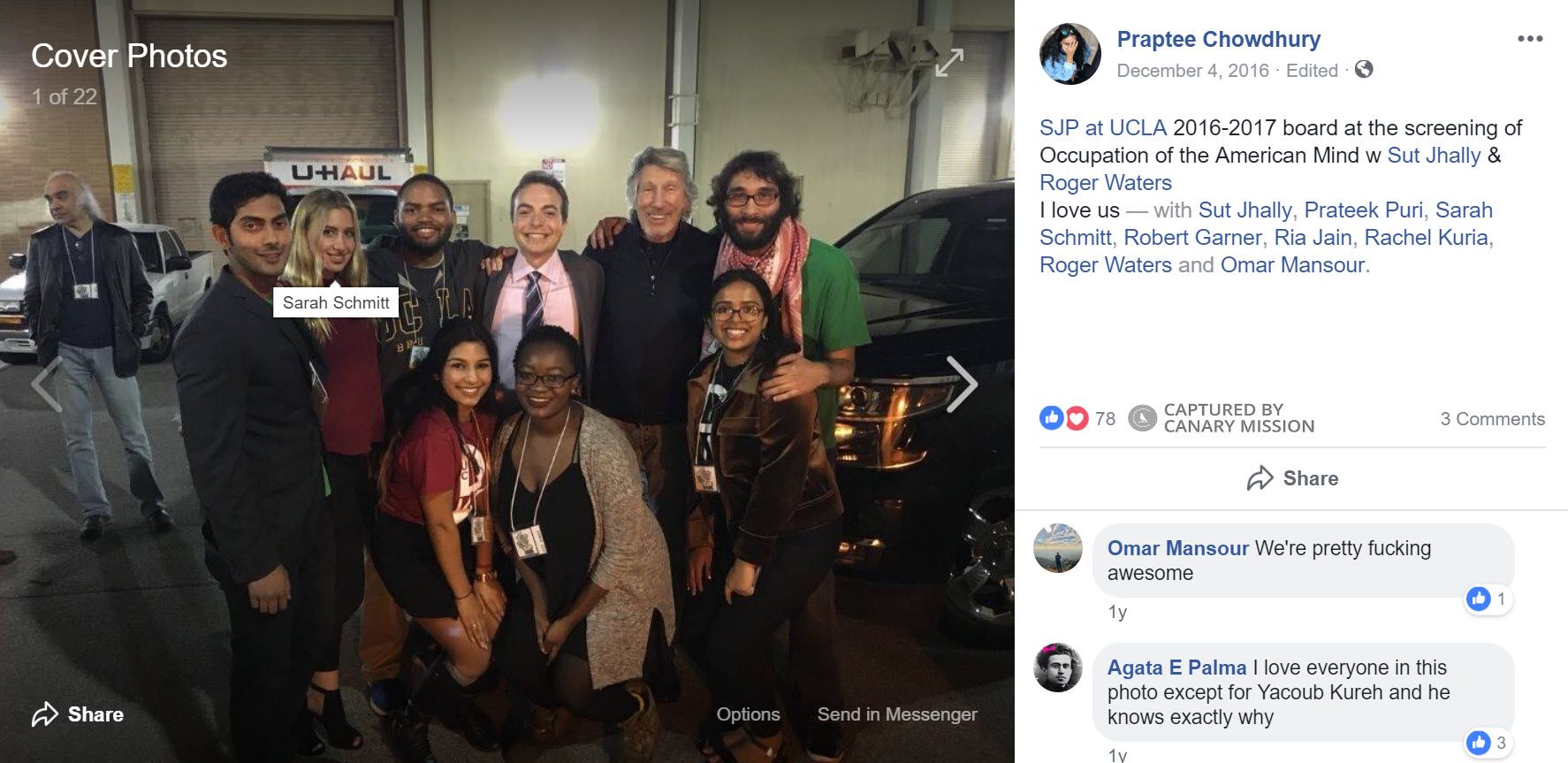
On December 1, 2016, Schmitt posed in a photo along with other SJP at UCLA 2016-2017 board members on Facebook, along with Jhally and Waters.
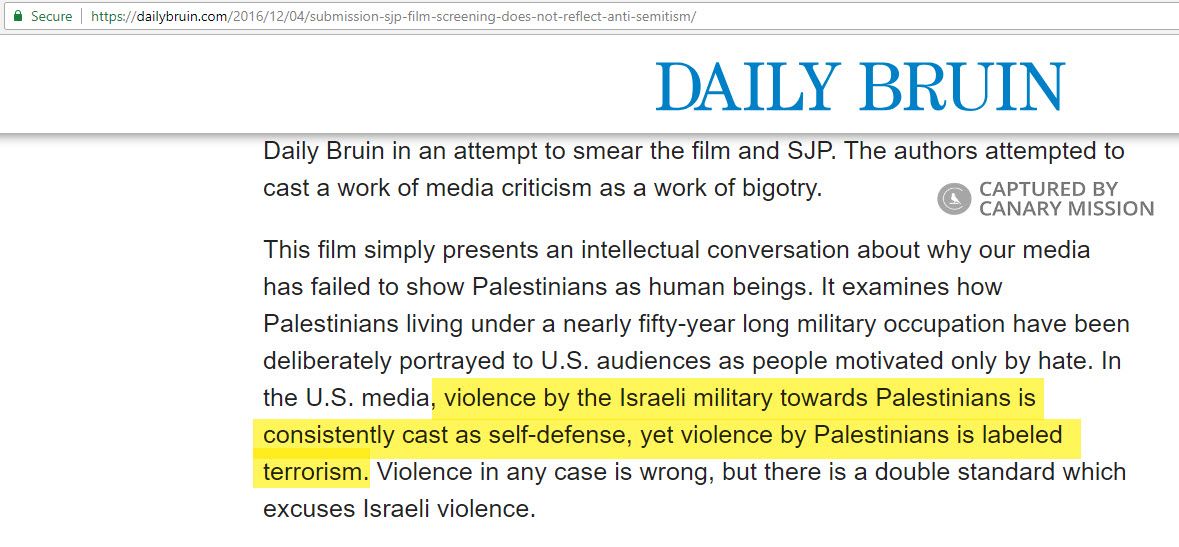
On December 4, 2016, Schmitt co-authored an op-ed together with SJP activist Robert Gardner that appeared in the Daily Bruin titled, “SJP film screening does not reflect anti-Semitism.” The article denied that Jhally’s film “represented an ‘intellectualization’ of anti-Semitism and stated that those “who truly care about peace should focus their energy on how to end the occupation.”
SJP at UCLA - Support for Terrorists
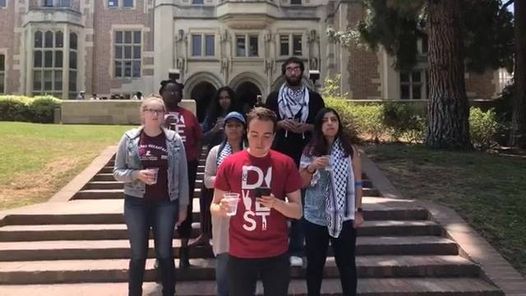
On May 15, 2017, SJP at UCLA participated in a “Saltwater Challenge.”In October 2015, there was an upsurge in violence across Israel incited by Palestinian political and religious leaders. The wave of stabbings, known as the “Knife Intifada,” was characterized by young Palestinians throughout the country stabbing and attempting to stab Israeli civilians.
The submission then listed a number of “Palestinians killed by Israelis... since Oct. 1, the beginning of the third intifada,” such as: Mohannad Halabi, Fadi Alloun, Amjad Hatem al-Jundi, Bassem Bassam Sidr, Hassan Khalid Manasra, Fadel al-Qawasmi and Mohamed Nathmie Shamassnah.
In October 2015, Halabi murdered two Israelis and injured two others, including a 2-year-old, during a stabbing spree. One day earlier, Halabi posted on his Facebook page that "the [t]he third Intifada is here" and wrote "[w]ake up from your slumber and save al-Aqsa. Let the revolution erupt."
Fadi Aloon was shot by Israeli security forces after he stabbed a 15-year-old Israeli boy. Several hours before the attack, Aloon posted “Either martyrdom or victory” on his Facebook page.
During an interview with the Lebanese Al-Quds TV channel following the attack,
SJP at UCLA - Anti-Semitism
In February 2015, four SJP at UCLA activists and council senators with the Undergraduate Students Association (USA) were involved in a widely publicized anti-Semitic incident.Beyda’s position on the Judicial Board was later confirmed at a re-vote and the four objecting counselors submitted a formal apology to Beyda and the Jewish community.
SJP at UCLA - Intimidation
In 2016, SJP at UCLA reportedly harassed and intimidated Milan Chaterjee, the former president of UCLA’s Graduate Student Association (GSA), to such an extent that he stepped down from his student government position and left UCLA.In November 2015, Chaterjee attempted to block an effort by SJP at UCLA to use school funds to promote the BDS movement during a diversity caucus Town hall event, in accordance with a policy requiring viewpoint neutrality.
Chaterjee said that, as a result, he was "relentlessly attacked, bullied, and harassed by BDS-affiliated organizations and students" for months.
SJP at UCLA alleged that the council members committed “conflict of interest violations” by participating in the sponsored trips and should have abstained from voting on a February 2014 BDS resolution. SJP at UCLA also argued the council members’ votes on the divestment resolution should have been disqualified.
Although the ballot on the divestment resolution was secret, it was assumed that the two voted against the resolution because they both spoke against the resolution during discussions prior to the vote.
The student judicial board later ruled that the trips taken by the council members did not constitute a conflict of interest.
SJP at UCLA - BDS Activism
In December 2013, SJP at UCLA launched its first divestment campaign, drafting a resolution calling on the UC Regents to pull funding from five companies doing business with Israel, including Caterpillar, Cemex, Cement Roadstone Holdings (CRH), General Electric (GE), and Hewlett-Packard (HP). The February 2014 debate lasted over ten hours and went until six in the morning the following day. The resolution was ultimately voted down.
In November 2014, SJP at UCLA again pushed a divestment resolution “calling on the Regents to divest from companies that enable and profit from violations of Palestinian rights.”
The resolution claimed that the same five companies “provided weapons used” by Israel “in attacks on civilians and civilian infrastructure in the Gaza Strip,” and that investment in these companies “shows implicit support” for “the killings of civilians.”
On November 18, 2014, the undergraduate student government adopted the divestment resolution with a vote of 8-2-2.
In February 2015, SJP at UCLA pushed BDS beyond the UCLA campus by promoting a divestment resolution to the UC Student Association (UCSA). The resolution also called on the UC Regents to divest from American-based corporations that “violate Palestinian human rights.”.
The UCSA Board of Directors passed the resolution by a 9-1-5 vote.
SJP at UCLA also used their 2014 Palestine Awareness Week (PAW) to promote divestment, erecting a “mock apartheid wall” and hosting a screening and discussion of the film “Roadmap to Apartheid,” a film that compared Israel to apartheid in South Africa.
SJP at UCLA - Glorifying Rasmea Odeh
On February 14, 2017, SJP at UCLA glorified Rasmea Odeh on their Facebook page in honor of Palestine Awareness Week (PAW), calling her an “icon of the Palestine liberation movement,” and “an example for the millions of Palestinians who have not given up organizing for their rights.”The post concluded: “#Justice4Rasmea #FreePalestine #PAW2017.”
Odeh confessed, in a highly detailed account, the day following her arrest. In a 2004 documentary, one of Odeh’s co-conspirators directly implicated her as the mastermind.
SJP at UCLA - Hosting Israel Haters
On November 15, 2017, SJP at UCLA hosted anti-Israel journalist David Sheen. The event description said Sheen would “speak about racism and ethnic cleansing within the Israeli community.” Sheen is an anti-Israel propagandist.On November 30, 2016, SJP at UCLA screened the anti-Israel film “The Occupation of the American Mind.” The event also featured the film’s anti-Israel executive producer, Professor Sut Jhally, and anti-Israel activist and musician Roger Waters.
In his films, Jhally claims that the “Israel lobby” has waged “the most successful PR campaign ever,” the result of which is a strong pro-Israel bias in American public media.
On January 27, 2016, SJP at UCLA hosted anti-Israel activists Max Blumenthal and Miko Peled.
In January 2017 Peled said [00:00:06] that the Israeli army was one of the “best trained, best equipped, best fed, terrorist organizations in the world,” and claimed [00:00:16] that “their entire purpose is terrorism.”
Blumenthal’s book “Goliath: Life and Loathing in Greater Israel” has been dubbed “The Israel Hater’s Handbook” by Eric Alterman of progressive magazine The Nation.
Muhtaseb regularly uses her Facebook and Twitter to demonize Israel, whitewash Palestinian terrorism and collaborate with fellow anti-Israel activists. Atshan has praised inciters of violence as well as Sheikh Omar Suleiman who, in 2014, called on Twitter for a “Third Intifada” to destroy Israel.
SJP
SJP is a student organization engaged in anti-Israel activity on North American college and university campuses.
The first chapter of SJP was founded in 2001 at the University of California at Berkeley by Professor Hatem Bazian. Bazian has spread classic anti-Semitism, reportedly promoted religious anti-Semitism and defended the Hamas terror group. In 2004, Bazian called for “intifada” in America.
SJP organizes anti-Israel campaigns, including running annual Israel Apartheid Weeks, often in collaboration with Jewish Voice for Peace (JVP) and Muslim Students Association (MSA) campus chapters.
SJP has been a major force in pushing the anti-Semitic Boycott, Divestment, Sanctions (BDS) movement on campuses. Chapters have initiated dozens of BDS resolutions in student governments, which have been proposed on or around Jewish holidays, a time when many Jewish students are off-campus.
SJP activists have reportedly physically assaulted, intimidated and harassed Jewish students, disrupted pro-Israel campus events and demonized pro-Israel campus organizations.
Chapters have often endorsed and campaigned for numerous terrorists and whitewashed terrorism.
JVP
JVP was founded in Berkeley, California in 1996, as an activist group with an emphasis on the “Jewish tradition” of peace, social justice and human rights. The organization is currently led by Rebecca Vilkomerson and its board members include Israel critics Naomi Klein, Judith Butler, Noam Chomsky and Tony Kushner.
JVP, which generally employs civil disobedience tactics to disrupt pro-Israel speakers and events, consists of American Jews and non-Jewish “allies” highly critical of Israeli policies. A staunch supporter of the BDS movement, JVP claims to aim its campaigns at companies that either support the Israeli military (Hewlett-Packard) or are active in the West Bank (SodaStream).
Although several Jewish groups critical of Israeli policies, like J Street and Partners for a Progressive Israel, make efforts to operate within the mainstream American Jewish community, JVP functions outside. The group is often criticized for serving as a tokenized Jewish voice for the pro-Palestinian camp and is widely regarded as the BDS movement’s “Jewish wing.”
JVP denies the notion of “Jewish peoplehood” and has even gone so far as to refer to its own Ashkenazi (Jews who spent the Diaspora in European countries) leadership as “white supremacy inside of JVP.”
The Anti-Defamation League (ADL) has accused JVP of being “the largest and most influential Jewish anti-Zionist group in the United States,” and said the group “exploits Jewish culture and rituals to reassure its own supporters that opposition to Israel not only does not contradict, but is actually consistent with, Jewish value.”
The ADL also claimed that “JVP consistently co-sponsors rallies to oppose Israeli military policy that are marked by signs and slogans comparing Israel to Nazi Germany, demonizing Jews and voicing support for groups like Hamas and Hezbollah.”
According to the ADL website, JVP “uses its Jewish identity to shield the anti-Israel movement from allegations of anti-Semitism and provide it with a greater degree of legitimacy and credibility.”